
Say these three things out loud, in order, when it matters: “I am invoking my right to remain silent,” “I do not consent to any searches,” and if you’re arrested or held for questioning, “I want a lawyer.” Stay calm, keep your hands visible, and let those three lines do the legal work. Everything else is detail.
TL;DR:
- Refusing consent does not prevent searches based on probable cause or recognized exceptions like plain view or vehicle searches.
- Police can perform limited searches during an arrest or if they have reasonable suspicion of weapons during a stop, but beyond that, searches require clear justification.
- Miranda warnings are only necessary when a suspect is in custody and actively questioned, not during routine traffic stops or detention.
- Part of protecting your rights includes documenting the stop, seizure, or search details immediately, and avoiding resistance or unnecessary arguments with officers.
- Smartphone searches require explicit consent or a warrant, and refusal to unlock or search your device cannot be used as evidence of guilt.
Table of Contents
- Your Rights During a Police Stop: The Fourth and Fifth Amendment Basics
- What to Do During a Traffic Stop
- How to Refuse or Limit a Search During a Stop
- When Miranda Warnings Actually Apply
- If You Are Arrested: What to Do Next
- How to Document and Report a Problematic Stop
- Your Rights Over Phone and Electronic Device Searches
- Stop and Frisk: When It Applies and What Its Limits Are
- Handling a Police Stop Involving a Minor
- Firm Perspective: What Early Details Actually Change in a Case
- When to Contact Grace Legal Group
- Sources
Your Rights During a Police Stop: The Fourth and Fifth Amendment Basics
The Fourth Amendment protects you against unreasonable searches and seizures. The Fifth Amendment protects you against being forced to incriminate yourself. Those two guarantees are the entire foundation of your rights during a police stop, and almost every practical script you’ll use traces back to one or the other.
Neither right is absolute. Courts have carved out several well-established exceptions that let officers search or seize without a warrant:
- Probable cause: officers who reasonably believe a vehicle contains evidence of a crime can search it without your consent.
- Automobile exception: this lets officers search a car without a warrant, though Cornell Law’s overview of vehicle search doctrine notes the exception doesn’t extend to entering a home or its curtilage to reach that vehicle.
- Search incident to arrest: once you’re lawfully arrested, officers can search your person and the immediate area around you.
- Plain view: contraband visible in plain sight, sitting on a car seat, for instance, can be seized without a separate warrant.
Here’s what surprises most people: silence by itself doesn’t legally invoke your Fifth Amendment right. You have to say it. Courts have held that an ambiguous silence can be read as not invoking the right at all, so the words matter as much as the intent behind them.
Refusing consent doesn’t stop a search backed by probable cause, but it does something almost as valuable. It preserves your ability to challenge that search later in court. Consent given, even reluctantly, is much harder to walk back than consent explicitly denied.
What to Do During a Traffic Stop
A traffic stop is where most people’s rights actually get tested, and it’s also where most mistakes happen. Follow these steps in order:
- Keep both hands on the wheel until the officer approaches, then narrate before you move: “I’m reaching for my registration now.”
- Provide your license, registration, and insurance when asked. This is a legal requirement in every state, and refusing it will escalate the stop for no benefit.
- Answer identifying questions only. You don’t have to answer questions about where you’re going, where you’ve been, or what’s in the car.
- Ask “Am I free to go?” This single question tests whether you’re being detained or just chatted with. A “yes” means walk away calmly. A “no” means you’re now in a detention, and different rules apply.
Pro Tip: Passengers have the same right to remain silent as drivers, and courts have held that passengers can be temporarily detained during a stop too, so don’t assume you’re exempt just because you weren’t driving.
How to Refuse or Limit a Search During a Stop
Say it plainly that you do not consent to any searches of your car, person, or belongings. State it clearly once, then stop talking. Don’t argue, don’t repeat it five times, and never put your hands on an officer or a vehicle door to physically block a search.
A few things to keep in mind about what happens next:
- Refusing consent doesn’t guarantee a search won’t happen. If an officer has probable cause or another recognized exception applies, the automobile exception can still justify a warrantless search despite your objection.
- Plain-view evidence, anything visible without opening a container or compartment, can be seized regardless of your refusal.
- If officers search anyway after you’ve refused, do not physically resist. Comply, then document everything the moment it’s safe: what was searched, what was said, and who else witnessed it.
That documentation becomes the raw material for a suppression motion later. Refusal without a record of the refusal is much weaker in court than refusal you can prove happened.
When Miranda Warnings Actually Apply
A huge number of people believe police have to read them their rights the moment they’re pulled over. They don’t. Miranda warnings are only required when two conditions exist together: you’re in custody, and officers are interrogating you. Roadside questioning during a routine traffic stop is generally treated as noncustodial, so Miranda usually doesn’t apply until you’re formally arrested.
- Once you’re in custody and being questioned, invoke your rights clearly and explicitly, using unambiguous statements such as “I want a lawyer” or “I want to remain silent.”
- Vague statements like “maybe I should talk to someone” have been found insufficient in California case law addressing how clearly a suspect must invoke counsel.
- If officers fail to read you Miranda warnings, it doesn’t automatically void your arrest. It can make certain statements inadmissible, but the legal remedy usually requires an attorney to pursue through a suppression motion.
If You Are Arrested: What to Do Next
The moments right after an arrest set the tone for everything that follows. Handle them deliberately:
- Say “I want a lawyer” immediately, then stop answering questions entirely, including “small talk” that officers sometimes use to keep you talking.
- Do not sign anything and do not consent to any additional search of your phone, car, or home without your attorney present.
- Write down or memorize the details the moment you’re able: exact time, location, patrol car number, officer names and badge numbers, and contact information for any witnesses.
- Hand all of it to your attorney as soon as you can. Small details fade fast, and they’re often what makes or breaks a later challenge.
If evidence was already seized before you invoked your rights, there are specific next steps for challenging an unlawful search that an attorney can walk through with you.
How to Document and Report a Problematic Stop
Build the record while it’s fresh. Note the time, location, patrol car number, and the officer’s name or badge number the moment the stop ends. If you recorded video, back it up to a second device right away and don’t rely on a phone that could be lost, damaged, or, in a worst case, seized.
- Save timestamps and any audio alongside the video, since metadata can matter later.
- Write down witness names and phone numbers before people scatter.
- File a complaint through internal affairs or a civilian oversight board. Many counties, including Los Angeles County, maintain a formal complaint process for exactly this kind of situation.
- Talk to an attorney before you file anything formal if you believe the stop involved an unlawful search or excessive force. What you say in a complaint can affect a later civil or criminal case.
Your Rights Over Phone and Electronic Device Searches
Your phone gets more Fourth Amendment protection than almost anything else officers might want to look at during a stop. Courts have recognized that a smartphone holds an amount of personal information a wallet or glove compartment never could, and that distinction matters legally.
Officers generally need either your consent or a warrant to search the contents of your phone. A traffic stop, by itself, doesn’t give them the authority to scroll through your texts, photos, or apps. If an officer asks to look at your phone, the same script applies: “I do not consent to a search of my phone.” You are not required to unlock it, provide a passcode, or use biometric authentication like a fingerprint or face scan to open it for them.
There’s a wrinkle worth knowing. If officers seize your phone as evidence, that seizure alone doesn’t authorize a search of its contents. They typically still need a warrant to actually access what’s inside, even after they’ve taken the device into custody. If you’re asked to hand over your phone, you can comply with a lawful seizure while still verbally declining consent to search it. Those are two separate things, and keeping them separate protects you.

Refusing to unlock a device is not, on its own, evidence of guilt, and it shouldn’t be treated as an invitation for officers to escalate the stop. If a device is searched despite your refusal, treat it the same way you’d treat a search of your car: don’t resist, document exactly what happened, and raise the issue with an attorney as soon as possible.
Stop and Frisk: When It Applies and What Its Limits Are
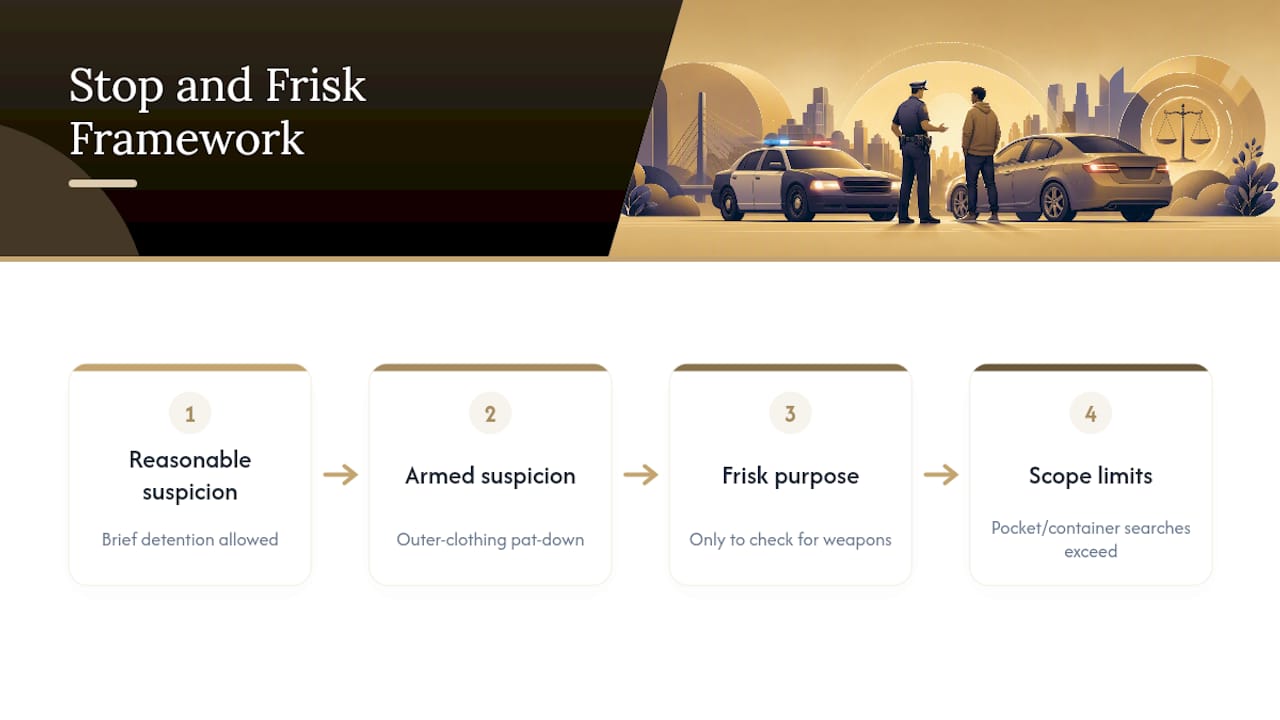
Stop and frisk comes from a specific legal standard, and it’s narrower than most people assume. Under the framework established by Terry v. Ohio, an officer can briefly detain you if they have reasonable suspicion, a lower bar than probable cause, that you’re involved in criminal activity. That detention allows a limited pat down of your outer clothing, but only if the officer also reasonably suspects you’re armed and dangerous.
This is not a general search. A frisk under this standard is meant to check for weapons, not to go hunting through your pockets for drugs, cash, or anything else. If an officer feels something during a lawful pat down that’s obviously a weapon or contraband based on touch alone, that can justify pulling it out. But if the officer goes beyond a surface pat down, manipulating pockets, reaching into a bag, opening a container, that typically exceeds what a Terry stop allows and can become a separate Fourth Amendment issue.
Reasonable suspicion has to be specific and articulable. An officer can’t detain and frisk you based on a hunch, your location in a “high crime area” alone, or nervous behavior by itself. Courts have pushed back on stops built on vague or generalized justifications, which is part of why understanding how attorneys evaluate reasonable suspicion matters if you think a stop crossed the line.
If you believe you were frisked without adequate justification, don’t physically resist in the moment. Comply, then document everything: what the officer said justified the stop, exactly what was searched, and how long it lasted.
Handling a Police Stop Involving a Minor
Minors carry the same core constitutional rights as adults during a police stop: the right to remain silent and the right to refuse consent to a search. What changes is how those rights typically get exercised and the added layer of parental involvement.
A minor can invoke the right to remain silent using the same language an adult would: “I want to remain silent” or “I don’t want to answer questions without a lawyer.” Age doesn’t strip that right away, though officers sometimes treat younger people as easier to pressure into talking. That’s exactly why the scripted phrases matter more, not less, for a minor caught in an intimidating situation.
Parents or guardians should be contacted as soon as reasonably possible if a minor is detained, and in many juvenile justice systems, questioning a minor in custody without notifying a parent or attempting to secure one raises separate legal issues beyond the stop itself. If you’re a parent and you learn your child has been stopped or detained, your first move should mirror the adult playbook: get a lawyer involved before any formal questioning proceeds, and instruct your child not to answer substantive questions until that happens.
Schools add another layer. Resource officers on campus operate under different standards than street patrol in some jurisdictions, and searches of school lockers or bags can follow a lower legal bar than a search on a public street. If your child was searched or questioned at school, that context needs to be part of the conversation with an attorney, not treated as identical to a stop that happened on a sidewalk.
Firm Perspective: What Early Details Actually Change in a Case
Attorneys who evaluate stops for a living look past what happened and focus on how it happened, second by second. Did the officer articulate specific facts before frisking, or default to a vague “furtive movement”? Did consent get asked before or after a search began? Those distinctions decide whether a suppression motion succeeds.
Cases get reviewed by more than one attorney, often including someone with prior law enforcement experience who knows what a legitimate probable-cause narrative actually looks like versus one built after the fact. Precise phrasing at the moment of the stop, and documenting it immediately afterward, gives that later review something real to work with.
— Jake
When to Contact Grace Legal Group
If you’ve been arrested, injured during a stop, or a search turned up something officers plan to use against you, the time to get a lawyer involved is now, not after your court date arrives. Waiting doesn’t preserve options. It closes them.

Every case is reviewed with multiple attorneys, one of them typically drawing on prior law enforcement background, to spot probable-cause and consent problems before prosecutors see the file. This combination of perspectives helps catch details a single-attorney review might miss. An initial case review can identify whether evidence was obtained unlawfully, outline possible defense strategies tailored to your circumstances, and map out your options before deadlines pass. If a stop, search, or arrest has already happened, look at the defense strategies available in most criminal cases and reach out to start a case review today.
This article is general information, not a substitute for advice from a qualified lawyer. Consult a qualified legal professional about your own circumstances before acting on anything here.
Sources
- Cornell Law — Vehicle searches overview under the Fourth Amendment
- LegalClarity — California Miranda rights (explanation referencing Berkemer)