
What is Brady material and why does it matter?
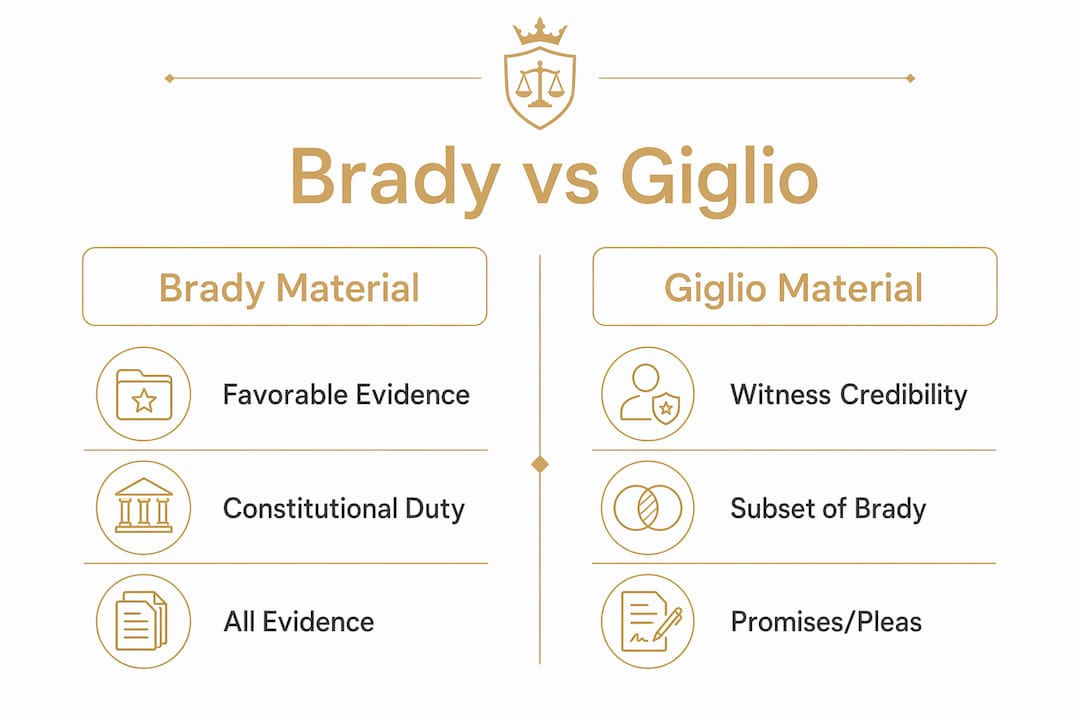
Brady material is any evidence favorable to a criminal defendant that the prosecution is constitutionally required to disclose. The rule comes directly from the Supreme Court’s 1963 decision in Brady v. Maryland, which held that suppressing favorable evidence violates the Due Process Clause of the Fourteenth Amendment, regardless of whether the prosecution acted in good faith or bad faith.
Three elements define a Brady violation, as confirmed in Strickler v. Greene (1999):
- The evidence must be favorable to the accused, either because it tends to prove innocence (exculpatory) or undermines a witness’s credibility (impeachment).
- The evidence must have been suppressed by the State, whether intentionally or by accident.
- The suppression must have caused prejudice to the defendant, meaning the outcome of the trial was affected.
Disclosure is not optional, and it does not depend on whether the defense asks for it. In United States v. Bagley, the Supreme Court eliminated the pretrial request requirement, confirming that prosecutors carry an affirmative constitutional duty to turn over all material, favorable evidence. That duty extends to evidence held by law enforcement, not just the prosecutor’s own files.
Table of Contents
- The two main types of exculpatory evidence Brady covers
- How courts decide whether withheld evidence is “material”
- Common Brady violation examples that surface in real cases
- What prosecutors are actually required to do
- How Brady material differs from Giglio material
- What happens when Brady material is withheld
- Why Brady violations are so hard to catch
- The cases that built the Brady doctrine
- How Brady disclosure shapes trial strategy on both sides
- How to raise a Brady issue after conviction
- Federal vs. state Brady disclosure standards
- Gracelegalgroup: experienced criminal defense when Brady issues are at stake
- Key Takeaways
The two main types of exculpatory evidence Brady covers
Brady material falls into two broad categories, and understanding the difference shapes how defense attorneys build their cases.
Exculpatory evidence directly tends to prove a defendant’s innocence or reduce their culpability. Common examples include:
- DNA test results that exclude the defendant
- Surveillance footage placing the defendant elsewhere at the time of the crime
- Witness statements that contradict the prosecution’s theory of events
- Physical evidence inconsistent with the charged offense
Impeachment evidence does not necessarily prove innocence but attacks the credibility of witnesses the prosecution relies on. This category includes:
- Deals, promises, or leniency agreements made with cooperating witnesses
- Prior inconsistent statements a witness gave to investigators
- Evidence that a witness has a personal motive to lie
- A witness’s prior criminal history that bears on truthfulness
Both categories carry equal weight under the Brady disclosure obligation. As the Supreme Court made clear in United States v. Bagley, impeachment evidence falls squarely within Brady because a jury’s assessment of witness credibility can be the deciding factor between conviction and acquittal.
How courts decide whether withheld evidence is “material”
Not every piece of favorable evidence automatically triggers a Brady violation. Courts apply a materiality standard: the withheld evidence is material only if there is a reasonable probability that the outcome of the trial would have been different had it been disclosed.
“A ‘reasonable probability’ is a probability sufficient to undermine confidence in the outcome.” — United States v. Bagley, 473 U.S. 667 (1985), later affirmed in Kyles v. Whitley (1995). The test does not ask whether the defendant would certainly have been acquitted; it asks whether the suppressed evidence puts the whole case in a different light.
Kyles v. Whitley clarified four critical points about this standard. First, “reasonable probability” is a question of confidence in the verdict, not a sufficiency-of-evidence test. Second, the defendant does not need to show that the remaining evidence was inadequate to support a conviction. Third, a failure to disclose material evidence is inherently harmful, so no separate harmless-error review is needed. Fourth, courts must assess all undisclosed evidence collectively, not item by item. That last point is significant: individually minor pieces of suppressed evidence can combine to meet the materiality threshold when viewed together.
Common Brady violation examples that surface in real cases
Brady violations take many forms. These are the scenarios that appear most often in reported cases and post-conviction proceedings:
-
Withheld witness statements. A detective interviews a bystander who says the defendant was not the shooter. That statement never reaches defense counsel. The witness testifies at trial, and the prior statement that would have destroyed the testimony stays buried in a police file.
-
Undisclosed plea agreements. A key government witness receives a reduced sentence in exchange for testimony. The prosecution fails to tell the defense. The jury hears the witness as a neutral party with no stake in the outcome.
-
Falsified or altered police reports. An officer edits a report to remove details that contradict the prosecution’s timeline. The original version, which would have supported the defense, is never produced.
-
Hidden exculpatory forensic evidence. Lab results show the substance seized was not a controlled drug, or DNA from the crime scene does not match the defendant. The prosecution proceeds without disclosing the results.
-
Suppressed evidence of police misconduct. An officer involved in the arrest has a documented history of fabricating evidence. That history, which would have been devastating on cross-examination, is never disclosed.
-
Withheld expert witness communications. A prosecution expert privately told investigators that the physical evidence was inconclusive. The defense never learns this and cannot challenge the expert’s confident courtroom testimony.
These Brady violation examples share a common thread: the defense is left to argue against a version of the facts that the prosecution knew was incomplete.
What prosecutors are actually required to do
The Brady obligation is not passive. Prosecutors carry an affirmative duty to search all relevant files, including police and investigative files, not just their own office records. Ignorance of evidence held by law enforcement is not a defense to a Brady violation.
Key procedural duties include:
- Reviewing all files connected to the investigation, including those held by police departments and other agencies involved in the case
- Disclosing favorable evidence to the defense in time for it to be used effectively at trial
- Continuing to disclose newly discovered Brady material even after the trial has begun
- Erring on the side of disclosure when uncertain whether evidence qualifies
Courts and internal prosecution policies reinforce these duties, but the prosecutor’s role in evidence disclosure ultimately depends on individual judgment calls. Defense attorneys can file pretrial motions requesting Brady material, and courts can order disclosure, but the prosecution controls what evidence exists and what gets produced.
How Brady material differs from Giglio material
Giglio material is a subset of Brady material, not a separate doctrine. The distinction matters in practice.
| Feature | Brady material | Giglio material |
|---|---|---|
| Source case | Brady v. Maryland (1963) | Giglio v. United States |
| Scope | All favorable evidence: exculpatory and impeachment | Impeachment evidence specifically tied to witness credibility |
| Focus | Guilt, innocence, or punishment | Deals, promises, or incentives given to government witnesses |
| Application | Broad: any favorable evidence material to the case | Narrow: credibility of specific witnesses the prosecution calls |
Giglio v. United States confirmed that when the government makes a promise to a witness, whether a formal plea deal or an informal assurance of leniency, that promise must be disclosed. A witness who testifies without the jury knowing about a deal is presenting a distorted picture of their motivation. Giglio material is impeachment evidence under Brady, but prosecutors and defense attorneys track it separately because it specifically targets the reliability of cooperating witnesses, a recurring issue in drug and organized crime prosecutions.
What happens when Brady material is withheld
The consequences of a Brady violation depend on when it is discovered and how material the suppressed evidence was.
Possible outcomes include:
- Mistrial if the violation surfaces during trial and the court determines the defense cannot receive a fair proceeding
- Prohibition on evidence where the court bars the prosecution from using evidence that the withheld information would have undermined
- Overturned conviction on appeal when the defendant demonstrates the suppressed evidence was material
- New trial ordered by an appellate court or post-conviction court
- Sanctions against the prosecutor, including professional discipline, if the withholding was intentional or knowing
- Civil liability in some circumstances
The defendant carries the burden of proving both that the withheld evidence was favorable and that it was material. Meeting that burden requires showing a reasonable probability that disclosure would have changed the result, not a certainty. Because violations typically surface after conviction, the most common remedy is overturning the conviction through direct appeal or a habeas corpus petition.
Why Brady violations are so hard to catch
The structural problem with Brady enforcement is straightforward: the prosecution controls the evidence, and the defense cannot demand what it does not know exists. A defendant sitting in a cell after conviction has no way to audit the police files that were never turned over.
Experts have described the result as an epidemic of Brady violations, with many cases coming to light only years after the fact, often through investigative journalism, innocence projects, or unrelated litigation that accidentally surfaces suppressed files. The system relies heavily on prosecutors self-policing, which creates obvious gaps. Even well-intentioned prosecutors may not recognize that a piece of evidence in a detective’s notes qualifies as Brady material, particularly when the materiality standard requires predicting how a jury might have reacted to information it never saw.
Defense attorneys play a critical role in pushing back. Filing specific, detailed Brady requests before trial puts prosecutors on notice and creates a record. Courts can also appoint special masters or order in-camera review of prosecution files in cases where Brady compliance is genuinely disputed.
The cases that built the Brady doctrine
Brady v. Maryland (1963) is the foundation, but the doctrine took its current shape through a series of subsequent decisions. John Brady was convicted of murder in Maryland after the prosecution withheld a co-defendant’s confession admitting to the actual killing. The Supreme Court held that suppressing that confession violated due process, establishing the core rule.
United States v. Bagley (1985) unified the materiality standard across all Brady situations, whether the defense made a specific request, a general request, or no request at all. The Court adopted the “reasonable probability” test that courts still apply today.
Kyles v. Whitley (1995) expanded the prosecution’s obligations by making clear that the duty to disclose extends to evidence held by police, not just the prosecutor’s office, and that materiality is assessed collectively across all suppressed evidence.
Strickler v. Greene (1999) gave courts the three-element framework: favorable evidence, suppression by the State, and resulting prejudice. That framework is now the standard checklist for evaluating any claimed Brady violation.
How Brady disclosure shapes trial strategy on both sides
For the defense, Brady material can reshape an entire case. A withheld witness deal, once disclosed, gives defense counsel the ammunition to cross-examine a cooperating witness as someone with a powerful motive to lie. Suppressed forensic results can shift the burden of proof back to where it belongs. Knowing what the prosecution’s evidence actually shows, rather than what the prosecution chose to present, is the difference between a reactive defense and a proactive one. Understanding available defense strategies becomes far more effective when Brady material is fully in hand.
For the prosecution, Brady obligations require building a case with the assumption that all favorable evidence will eventually reach the defense. Prosecutors who disclose early and completely avoid the risk of a conviction being overturned years later on Brady grounds. The obligation also disciplines the investigation itself: when officers know their notes and reports will be reviewed for Brady material, the incentive to shade facts diminishes.
A skilled criminal defense attorney knows how to identify what Brady material should exist based on the nature of the charges, the witnesses involved, and the investigation’s history, and then press for it aggressively.
How to raise a Brady issue after conviction
Post-conviction Brady claims follow a specific procedural path. The most common vehicle is a habeas corpus petition, filed in federal court under 28 U.S.C. § 2254 for state prisoners, or under 28 U.S.C. § 2255 for federal prisoners. The petition must allege that the prosecution suppressed favorable, material evidence and that the suppression prejudiced the defendant.
On direct appeal, a Brady claim must typically have been preserved at trial through a timely objection or motion. If the violation was not discovered until after trial, courts may still consider it under the plain error standard, though the bar is higher. Post-conviction motions for a new trial based on newly discovered evidence offer another route, though timeliness requirements vary by jurisdiction.
The practical challenge is that Brady claims on appeal require the defendant to identify specific suppressed evidence, which is difficult when the defense does not know what was withheld. Innocence organizations, public records requests, and civil litigation have all been used to surface Brady material that was buried in prosecution or police files for years.
Federal vs. state Brady disclosure standards
The constitutional floor is the same everywhere: the Fourteenth Amendment applies to all states, and the Brady v. Maryland rule is federal constitutional law. But the ceiling varies considerably.
At the federal level, the Federal Rules of Criminal Procedure and Department of Justice internal policies impose disclosure obligations that go beyond the constitutional minimum in some respects, including earlier disclosure timelines in certain cases.
At the state level, many states have enacted statutes or court rules that expand Brady obligations. California, for example, requires disclosure of all material evidence under Penal Code § 1054.1, with specific timelines. New York’s Criminal Procedure Law was significantly amended in 2019 to require much earlier and broader disclosure than the constitutional minimum. Texas, following a series of high-profile wrongful convictions, passed the Michael Morton Act in 2013, mandating open-file discovery in criminal cases.
The result is a patchwork: a defendant in a state with open-file discovery rules has far greater access to prosecution evidence than the constitutional minimum requires, while a defendant in a state that tracks only the Brady floor may receive far less. The constitutional guarantee is the backstop, not the ceiling.
Gracelegalgroup: experienced criminal defense when Brady issues are at stake
If you are facing criminal charges in Los Angeles and believe the prosecution may be withholding evidence, the difference between a conviction and a dismissal can come down to how aggressively your attorney pursues Brady material.

Gracelegalgroup is a Los Angeles criminal defense firm built around exactly this kind of detailed, investigative representation. The firm assigns two dedicated attorneys to every case, and its team includes former law enforcement professionals who know how police files are organized and where favorable evidence tends to get buried. That background is a direct advantage when pressing for Brady disclosure: the attorneys know what to ask for because they know how investigations actually work. Gracelegalgroup also prepares detailed mitigation packets designed to reframe how prosecutors see a client’s case, a strategy that complements Brady disclosure by giving the prosecution a fuller picture before charges are locked in. If you are ready to have your case reviewed by attorneys who will look at every angle, contact Gracelegalgroup for a consultation.
Key Takeaways
Brady material is constitutionally mandated evidence favorable to a defendant that prosecutors must disclose, and suppressing it violates due process under the Fourteenth Amendment.
| Point | Details |
|---|---|
| Brady’s constitutional basis | The duty to disclose comes from Brady v. Maryland (1963) and the Fourteenth Amendment’s due process guarantee. |
| Two types of covered evidence | Both exculpatory evidence and impeachment evidence fall within the Brady disclosure obligation. |
| Materiality standard | Withheld evidence is material when there is a reasonable probability the outcome would have differed if it had been disclosed. |
| Post-conviction remedies | Habeas corpus petitions and direct appeals are the primary vehicles for raising Brady violations discovered after conviction. |
| Gracelegalgroup’s approach | The firm’s two-attorney model and former law enforcement background make it well-positioned to identify and pursue Brady material in Los Angeles criminal cases. |