
In common conversation, people use “assault” as a catch-all term for any fight. However, California law splits these into two distinct categories under the Penal Code.
Assault (PC 240) vs. Battery (PC 242)
- Assault (PC 240): This is essentially an “attempted” battery. If a minor swings a fist at someone but misses, or raises a heavy object as if to strike, they can be charged with assault. No physical contact is required.
- Battery (PC 242): This involves the actual “willful and unlawful” use of force or violence. Even a slight touch can be considered battery if it is done in a rude, angry, or offensive manner.
Simple vs. Aggravated Assault
Most schoolyard scuffles are classified as Simple Assault (a misdemeanor). However, if the incident involves a weapon (like a knife or a heavy lock) or results in “Great Bodily Injury,” it can be elevated to a felony. For minors aged 16 or older, certain aggravated assault charges can count as a “strike” under California’s Three Strikes Law, affecting them well into adulthood.
The California Juvenile Justice Process: How It Differs from Adult Court
If your child is detained, you won’t see a “guilty” or “not guilty” verdict in the way you see on TV. The juvenile system is governed by the Welfare and Institutions Code (WIC), which focuses on rehabilitation rather than punishment.
Key Terminology
- Adjudication: Instead of a trial, a minor has an “adjudication hearing.” A judge (not a jury) decides if the allegations in the petition are true.
- Sustained Petition: If the judge finds the minor committed the assault, the petition is “sustained”—the juvenile equivalent of a conviction.
- The Intake Officer: After an arrest, a probation officer acts as a gatekeeper. They may choose “Informal Diversion,” meaning the case never even goes before a judge if the minor completes certain requirements.
Penalties and Long-Term Consequences for Minors
The goal of the court is to keep the minor at home whenever possible. However, the penalties for assault can still be life-altering.
Informal Probation (WIC 654)
This is the best-case scenario. It is a voluntary contract where the minor agrees to counseling, community service, or a “stay away” order for six months. If successful, the case is closed without a formal court record.
Deferred Entry of Judgment (DEJ)
For first-time felony assault charges, a judge may “hold” the case. If the minor follows all rules for 12 to 36 months, the charges are dismissed entirely. This is a vital “second chance” for many high school students.
School Expulsion Hearings: The “Second Battle”
An assault charge often triggers an immediate five-day suspension and a recommendation for expulsion.
- Due Process: Your child is entitled to an expulsion hearing within 30 school days.
- Legal Counsel: You have the right to bring an attorney to this hearing.
- The Risk: Expulsion stays on a student’s record and can make it difficult to enroll in a new school district. Grace Legal Group Inc. often represents students in these administrative hearings to ensure one mistake doesn’t end their education.
Can a Minor Be Charged as an Adult?
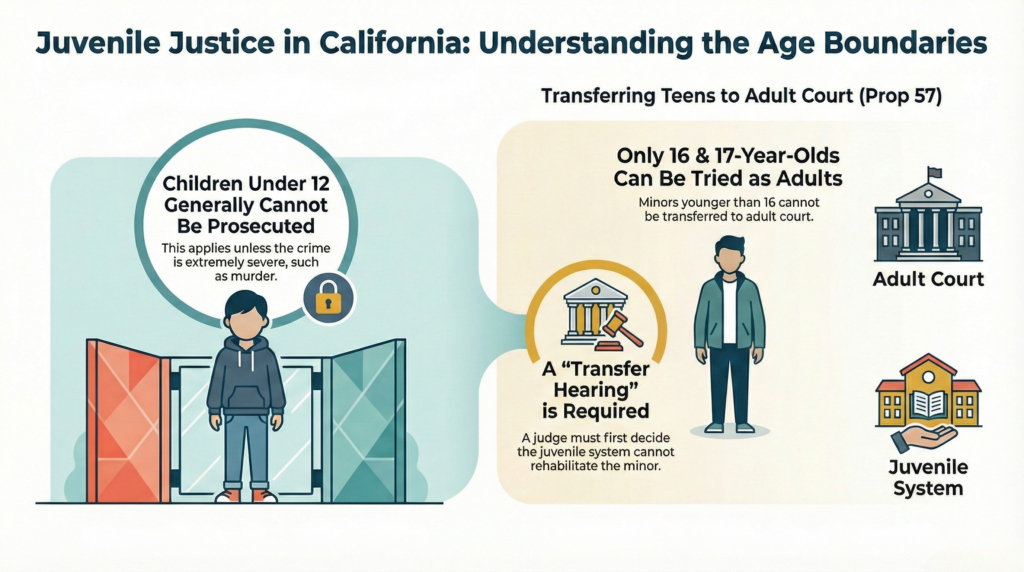
California has significantly raised the bar for “transferring” minors to adult court.
- Senate Bill 439: Children under the age of 12 generally cannot be prosecuted in juvenile court at all, unless the crime is extremely severe (like murder or forcible sexual assault).
- Prop 57: Only 16 and 17-year-olds can be transferred to adult court, and only after a formal “Transfer Hearing” where a judge decides the juvenile system cannot rehabilitate the minor.
The “Mitigation Packet” Strategy for Juveniles
At Grace Legal Group Inc., we believe a child is more than their worst mistake. Prosecution files usually only contain a one-sided police report. We counter this with a Mitigation Packet.
This packet is a comprehensive portfolio we present to the District Attorney and the Judge. It includes:
- Character Letters: Testimonials from teachers, coaches, and pastors.
- Academic Records: Proof of educational goals and achievements.
- Mental Health Assessments: Professional evaluations that may explain “impulse control” issues or trauma-related triggers.
- Community Engagement: Proof of volunteer work or extracurricular activities.
By humanizing the minor, we often convince the court to opt for diversion or house arrest rather than “Juvenile Hall” or camp placement.
Parental Liability: Financial and Legal Risks
Many parents are surprised to learn they can be held financially responsible for their child’s assault.
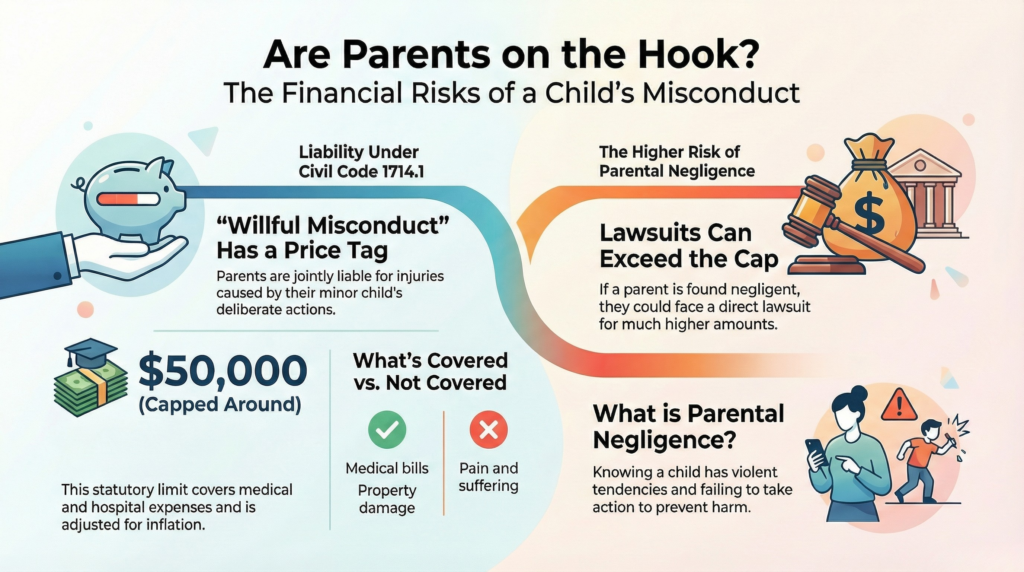
Civil Code 1714.1
Under this law, if a minor commits “willful misconduct” that results in injury, the parents or guardians are jointly liable for damages.
- The Limit: California caps this liability at $25,000 (this amount is adjusted for inflation and is currently closer to $50,000 for medical and hospital expenses).
- What is Covered: This covers medical bills and property damage, but usually does not include “pain and suffering.”
- Parental Negligence: If a parent knew the child had a violent tendency and did nothing to stop it, they could potentially face a direct lawsuit for much higher amounts.
Potential Defenses Against Juvenile Assault Charges
Defending a minor requires a nuanced approach. Common defenses include:
- Self-Defense: The minor reasonably believed they were in imminent danger and used only the force necessary to stop the threat.
- Defense of Others: Intervening to stop a bully from hurting a friend or sibling.
- Lack of Intent: The physical contact was an accident (e.g., during a crowded hallway transit or a sports game).
- False Allegations: Schools are hotbeds for rumors; sometimes “assault” claims are fabricated as a form of social retaliation.
Protecting Your Child’s Future: Sealing Juvenile Records
A common myth is that juvenile records “disappear” when a child turns 18. This is false. They must be sealed.
- WIC 781: This allows a person to petition the court to seal their records five years after their case ends or once they turn 18.
- Why it Matters: Sealing a record means that for most background checks (jobs, housing), the arrest effectively never happened.
- Automatic Sealing: Under WIC 786, if a minor successfully completes probation, the court may automatically seal the record. However, you should always have an attorney verify this was done correctly.
Why Choose Grace Legal Group Inc. for Juvenile Defense?
Facing the juvenile justice system is terrifying for any family. Grace Legal Group Inc. provides more than just legal defense; we provide a pathway to redemption.
- Faith-Based Advocacy: We treat every client with the dignity they deserve as a human being.
- Investigative Excellence: Our team includes former law enforcement who know exactly where police reports often get the story wrong.
- Strategic Teamwork: We put two lawyers on every case, ensuring no detail is missed in your child’s defense.
People Also Ask (FAQ)
1. Does a juvenile assault charge stay on my child’s record forever? No, but it does not disappear automatically. You must ensure the record is sealed through a WIC 781 or WIC 786 petition. Once sealed, the record is no longer accessible to the public.
2. Can my child go to jail for a school fight? Minors are sent to “Juvenile Hall” or “Camps” rather than adult jail. While possible for serious assaults, a first-time simple battery usually results in probation or diversion programs.
3. Do I need a lawyer if the school says it’s “just a suspension”? Yes. School suspensions for “assault” are often the first step toward a police report or a permanent expulsion hearing. Early legal intervention can prevent the school from involving law enforcement.
4. Can I be sued for my child’s fight at school? Yes. Under California Civil Code 1714.1, parents are financially liable for medical bills and damages up to a state-mandated cap if the child’s act was willful.
5. What is the “Minimum Age” a child can be charged in California? As of 2019 (SB 439), California generally does not prosecute children under age 12 in the juvenile court system, opting for community-based counseling instead.
6. Can a minor be charged with assault if they didn’t actually hit anyone? Yes. Under PC 240, “assault” is the attempt to commit a violent injury. If your child threw a punch and missed, they could still be charged with assault.
Secure Your Child’s Second Chance
If your child is facing assault charges or a school expulsion hearing, the stakes couldn’t be higher. One bad afternoon should not define the rest of their life. At Grace Legal Group Inc., we specialize in aggressive, empathetic defense designed to keep families together and futures bright.
Don’t wait for the court to decide your child’s fate. Contact Grace Legal Group Inc. today at 818.697.8664 for a 100% free consultation.