
A character letter for court is a written statement from someone who knows the defendant personally, submitted to the judge as part of the sentencing or mitigation process. Give the finished letter to the defendant’s attorney now, not to the court directly, so it can be filed properly and reviewed before the hearing.
Start here — four things to do right now:
- Contact the defendant’s attorney to confirm the deadline, the judge’s name, and any specific formatting requirements for that court.
- Decide who is writing: choose someone with firsthand knowledge of the defendant over at least one to two years, with no conflict of interest in the case.
- Draft the letter first, then send the draft to defense counsel for review before signing.
- Sign, date, and include your full contact information before handing the final version to the attorney.
Minimum formatting checklist:
- Address the judge as “The Honorable [Full Name]” in the header and “Dear Judge [Last Name]” in the salutation.
- Keep the letter to 1–2 pages and ideally under 500 words. Judges read many submissions, so brevity signals respect for their time.
- Type the letter in 12-pt font on standard paper with normal margins.
- Include your full name, address, phone number, and email at the top.
- Sign and date the letter by hand.
Table of Contents
- What is a character letter for court, and when do courts use it?
- How to write a character letter for court: a step-by-step process
- Ready-to-use sample character letters and fill-in-the-blank templates
- How to format and submit your letter correctly
- What not to put in a character letter for court
- One-page quick checklist and copyable template
- How defense attorneys and courts actually use character letters
- Key Takeaways
- A perspective on what actually moves judges
- Gracelegalgroup can help you prepare mitigation materials
- Useful sources and further reading
What is a character letter for court, and when do courts use it?
A character letter for court, also called a character reference or court character statement, is a personal letter from someone who knows the defendant that gives the judge a fuller picture of who that person is outside the courtroom. It is not a legal argument. It is human context.
Judges use these letters most often at sentencing, where they weigh them alongside the presentence report and other mitigation materials. They also appear in bail hearings, probation reviews, and expungement petitions. In family court, a letter of character support can speak to a parent’s fitness or a party’s reliability. The common thread is that the letter is asking the court to consider the whole person, not just the charge.
One important caveat: if the case is still in the pre-trial phase and no plea has been entered, check with defense counsel before writing anything. A letter submitted at the wrong stage can create complications.
The letter goes to the defense attorney, who packages it with other mitigation materials and files it with the court. The judge reads it privately before the hearing. Judges typically read character letters as part of the mitigation packet rather than aloud in the courtroom, so the letter needs to stand on its own without any verbal explanation from the writer. That is why clarity and specificity matter so much.
Defense counsel also screens letters before filing. If a letter contains something potentially damaging — an inadvertent admission, a factual inconsistency, or language that undermines the case — the attorney will catch it. That is another reason to send a draft early.
How to write a character letter for court: a step-by-step process
Step 1: Set up the header
At the top of the page, put your full name, address, phone number, email, and the date. Below that, address the letter to “The Honorable [Judge’s Full Name], [Court Name].” Start the body with “Dear Judge [Last Name].”
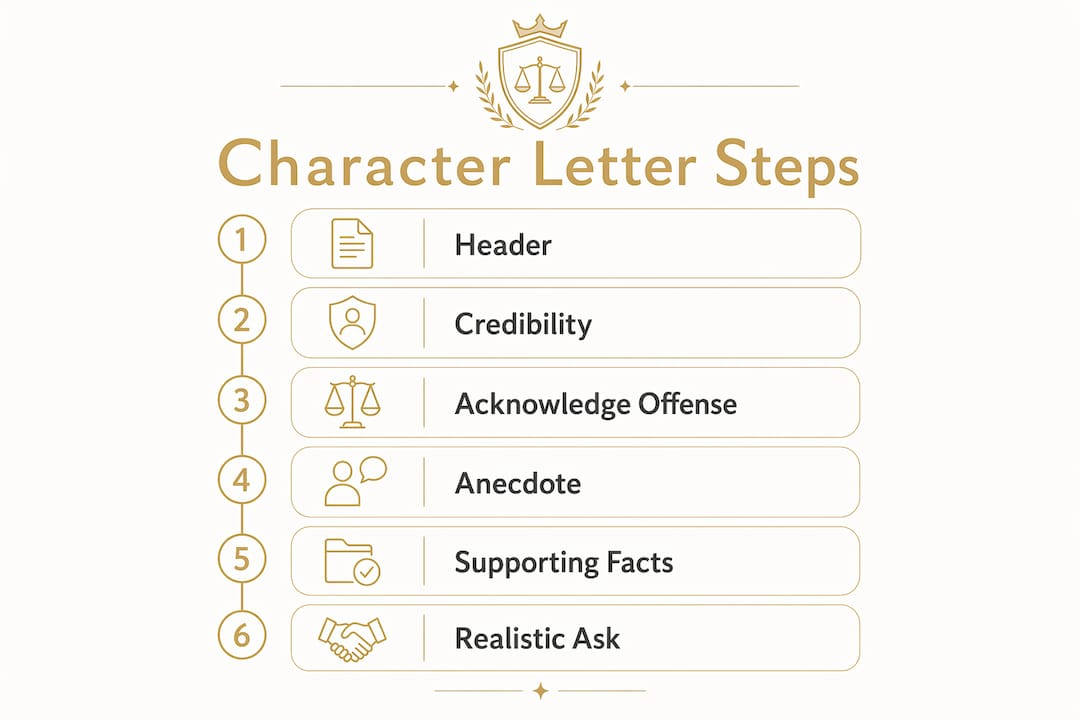
Step 2: Establish your credibility in the opening paragraph
Letters are most persuasive when the writer immediately establishes who they are, their relationship to the defendant, and how long they have known them. Do not make the judge guess.
Sentence starter: “My name is [Your Name]. I am a [your occupation] and have known [Defendant’s Name] for [X years] as [relationship — coworker, neighbor, family friend].”
Step 3: Acknowledge the offense briefly
Skipping the offense entirely reads as evasive. A single sentence acknowledging that you are aware of the charges, and that you take them seriously, tells the judge you are being honest rather than just lobbying for a friend. Failure to acknowledge the offense can reduce the letter’s credibility.
Sentence starter: “I understand that [Defendant’s Name] is before the court regarding [general description of the charge], and I do not take that lightly.”
Step 4: Give one specific anecdote
This is the most important paragraph. One concrete story outperforms a page of adjectives. Structure it in three beats: what happened, what the defendant did, and why it matters.

Example: “Last winter, my elderly mother fell ill and could not leave her apartment for three weeks. Without being asked, [Defendant’s Name] brought groceries twice a week and drove her to two medical appointments. That kind of quiet, consistent reliability is who he is.”
Dates, places, and specific actions make the story verifiable and memorable.
Step 5: Add supporting facts — only what you know firsthand
If the defendant is employed, caring for dependents, participating in treatment, or contributing to the community, mention it here — but only if you have direct knowledge. Secondhand information weakens the letter. If the defendant has taken concrete steps since the incident (counseling, community service, restitution), note them briefly.

Step 6: Close with a realistic ask
Do not tell the judge what sentence to impose. Ask the judge to consider the defendant’s character and circumstances when making the decision. Offer to be contacted if the court has questions.
Sentence starter: “I respectfully ask the Court to consider [Defendant’s Name]’s character and the support system available to him as you determine an appropriate outcome. I am happy to speak with anyone who has questions and can be reached at [phone/email].”
Pro Tip: Never argue innocence in a character letter. That is the attorney’s job. Your job is to speak to who the person is, not to relitigate the facts of the case. Always send the draft to defense counsel before signing.
Ready-to-use sample character letters and fill-in-the-blank templates
Employer template
[Your Name]
[Your Title], [Company Name]
[Address] | [Phone] | [Email]
[Date]The Honorable [Judge’s Full Name]
[Court Name]Dear Judge [Last Name],
My name is [Your Name], and I am the [title] at [Company Name], where [Defendant’s Name] has worked as a [position] for [X years]. I am writing to share my direct observations of [his/her/their] character and work ethic.
I am aware that [Defendant’s Name] is before the court on [general charge description]. I want to be clear that this letter reflects my honest assessment, not an attempt to minimize the seriousness of the matter.
During [his/her/their] time with us, [Defendant’s Name] has consistently [specific behavior — arrived on time, mentored new staff, handled client complaints with patience]. One instance that stands out: [brief anecdote with date and detail]. That moment showed me the kind of person [he/she/they] is when no one is watching.
[He/She/They] supports [dependents, if applicable] and has continued to fulfill [his/her/their] responsibilities at work throughout this difficult period. I believe [he/she/they] has the character to move forward constructively.
I respectfully ask the Court to consider this context. I am available at [phone/email] if you have questions.
Sincerely,
[Signature]
[Printed Name]
Friend or neighbor template
[Your Name]
[Address] | [Phone] | [Email]
[Date]The Honorable [Judge’s Full Name]
[Court Name]Dear Judge [Last Name],
My name is [Your Name]. I have known [Defendant’s Name] for [X years] as [neighbor/friend/fellow volunteer]. I am writing because I believe the Court should know the person I have observed over that time.
I understand [Defendant’s Name] is facing [general charge]. I take that seriously, and I want to be honest with the Court rather than simply advocate without reflection.
What I can speak to directly is [specific quality]. For example, [anecdote: what happened, what the defendant did, why it matters]. That is not an isolated moment — it reflects a pattern I have seen consistently.
I ask the Court to weigh this context in its decision. Please feel free to contact me at [phone/email].
Respectfully,
[Signature]
[Printed Name]
Family member template
[Your Name]
[Relationship to Defendant]
[Address] | [Phone] | [Email]
[Date]The Honorable [Judge’s Full Name]
[Court Name]Dear Judge [Last Name],
My name is [Your Name], and I am [Defendant’s Name]’s [mother/brother/aunt/etc.]. I have known [him/her/them] for [his/her/their] entire life and am writing to offer context about [his/her/their] character.
I am aware of the charges before the Court and understand the gravity of this situation. I am not writing to excuse what happened, but to give you a fuller picture of who [Defendant’s Name] is.
[Specific anecdote demonstrating responsibility, care for others, or personal growth.] Since this incident, [he/she/they] has [specific steps taken — enrolled in counseling, maintained employment, cared for children]. I have seen genuine remorse and a real effort to do better.
I respectfully ask the Court to consider [his/her/their] character and the support our family is prepared to provide. I can be reached at [phone/email].
With respect,
[Signature]
[Printed Name]
Quick fill-in-the-blank template (one page, urgent use)
[Your Name] | [Address] | [Phone] | [Email] | [Date]
The Honorable [Judge’s Full Name], [Court Name]
Dear Judge [Last Name],My name is [Name]. I am a [occupation] and have known [Defendant’s Name] for [X years] as [relationship].
I understand [he/she/they] is before the Court regarding [charge description]. I take this seriously and write only to share what I have personally observed.
[One specific anecdote: what happened, what the defendant did, why it matters.]
I ask the Court to consider [Defendant’s Name]’s character and circumstances. I am available at [contact info] if the Court has questions.
Respectfully, [Signature] / [Printed Name]
Choose the template that matches your relationship to the defendant. An employer letter carries weight on work ethic and reliability; a family letter speaks to personal history and support systems; a friend or neighbor letter covers daily character and community ties. When multiple letters are submitted, each should add a distinct perspective rather than repeat the same points.
How to format and submit your letter correctly
Best-practice formatting is straightforward: type the letter in 12-pt font, use standard 8.5 x 11 paper with one-inch margins, and keep it to one or two pages. Include your full name, address, phone number, and email at the top. Sign and date it by hand.
Address the judge formally. In the header, write “The Honorable [Full Name].” In the salutation, write “Dear Judge [Last Name].” Never address the letter to “To Whom It May Concern” or use the judge’s first name.
On submission, the rule is simple: never send the letter directly to the judge or the court clerk. Route everything through the defense attorney.
Judges read character letters privately as part of the mitigation packet before sentencing — not aloud in the courtroom. Give your letter to defense counsel well before the hearing date so it can be filed and considered. Mailing or hand-delivering a letter directly to the court can result in it being discarded and may create procedural problems for the defendant.
The attorney will tell you the exact deadline. As a general rule, earlier is better. A letter received the morning of sentencing is far less useful than one filed a week in advance. Keep a signed copy for your own records.
Understanding how sentencing factors work can also help you frame the letter’s content more precisely.
What not to put in a character letter for court
Most letters that fail do so for the same handful of reasons. Avoid every item on this list:
- Arguing innocence or disputing the facts of the case. That is the attorney’s role. A letter that says “I don’t believe he did this” undermines your credibility and can irritate the judge.
- Flowery hyperbole. Phrases like “the most generous soul I have ever met” or “an absolute saint” read as coached and unconvincing. Judges value honesty and objectivity; specific examples and balanced language carry far more weight.
- Unverified facts. Only write what you personally witnessed or know to be true. Secondhand information that turns out to be wrong damages the defendant’s case.
- Threats, promises, or conditions. Do not tell the court what will happen if the defendant receives a harsh sentence. Do not promise outcomes you cannot guarantee.
- Legal strategy or sentencing recommendations. Do not suggest a specific sentence, cite case law, or reference what you think the law requires.
- Admitting facts not yet established. Be careful with phrasing. Saying “even though he made a terrible mistake” can inadvertently confirm disputed facts.
- Omitting your contact information. Common mistakes that reduce a letter’s weight include missing contact details, spelling errors, and writing from someone with an obvious conflict of interest.
Who should not write the letter: recent acquaintances (less than a year of contact), co-defendants, anyone with a financial stake in the outcome, and anyone with a serious criminal record of their own. A letter from the wrong person can do more harm than no letter at all.
Weak vs. strong phrasing:
| Avoid | Use instead |
|---|---|
| “He is a great guy.” | “He coached my son’s Little League team for three seasons without missing a game.” |
| “She would never do something like this.” | “In seven years of working together, I have never seen her act dishonestly.” |
| “I think the judge should go easy on him.” | “I respectfully ask the Court to consider his character and support system.” |
One-page quick checklist and copyable template
Pre-submission checklist
| Task | Done? |
|---|---|
| Typed in 12-pt font, 1–2 pages | ☐ |
| Header includes your full name, address, phone, email, and date | ☐ |
| Addressed to “The Honorable [Full Name]” and “Dear Judge [Last Name]” | ☐ |
| Offense acknowledged briefly and honestly | ☐ |
| One specific, firsthand anecdote included | ☐ |
| No claims of innocence or legal arguments | ☐ |
| Proofread for spelling and grammar | ☐ |
| Signed and dated by hand | ☐ |
| Draft reviewed by defense counsel before final signing | ☐ |
| Copy kept for your own records | ☐ |
| Delivered to defense attorney, not mailed to the court | ☐ |
If multiple people are writing letters for the same defendant, coordinate briefly so each letter covers a different aspect of the person’s life. An employer letter, a family letter, and a community letter that all say the same thing add less value than three letters that each bring something new.
How defense attorneys and courts actually use character letters
Character letters do not stand alone. Defense attorneys package them with employment verification, therapy records, community service documentation, and other supporting materials to build a complete mitigation picture. The letters add what documents cannot: a human voice describing who the defendant is to the people who know them.
Defense attorneys view character letters as a core part of mitigation packets because they provide context on support systems, employment stability, and rehabilitation efforts that a presentence report often glosses over. A judge weighing sentencing factors has to consider both the offense and the offender. Letters speak directly to the offender side of that equation.
Credibility across the packet matters. If the employer letter says the defendant has been sober for two years and the therapy notes say treatment began three months ago, that inconsistency will be noticed. Counsel will typically review all letters before filing to catch these gaps, which is another reason to send drafts early rather than a signed final copy.
The most effective letters tend to share a few traits: the writer is clearly credible (established relationship, specific details), the tone is measured rather than pleading, and the anecdote is concrete enough to be verifiable. A letter that says “she has volunteered at St. Anthony’s Food Pantry every Saturday for four years” is far stronger than “she is a giving person.”
For cases involving mental health history or treatment, including a brief reference to documented support can strengthen the mitigation packet. Understanding how mental health intersects with criminal justice can help writers frame that context appropriately. For sensitive charge types like domestic cases, the phrasing requires extra care — defense counsel guidance on domestic violence charges is worth reviewing before drafting.
Criminal defense attorneys at firms like Oldham Law PLLC routinely advise clients on coordinating character letter submissions as part of broader defense preparation, which underscores how standard this practice is across U.S. jurisdictions.
Key Takeaways
A well-written character letter for court is concise, anecdote-driven, and always routed through defense counsel before it reaches the judge.
| Point | Details |
|---|---|
| Keep it under 500 words | Aim for 1–2 pages; judges read many submissions and reward brevity and clarity. |
| Route through defense counsel | Never mail directly to the court; always give the letter to the attorney for filing. |
| Acknowledge the offense | Skipping it reads as evasive and reduces your credibility with the judge. |
| Use one specific anecdote | Structure it as: what happened, what the defendant did, and why it matters. |
| Gracelegalgroup’s role | Grace Legal Group reviews and coordinates character letters as part of full mitigation packet preparation for clients facing serious charges. |
A perspective on what actually moves judges
Writing a character letter feels like a small act. It is not. A well-constructed letter from the right person, filed at the right time, can genuinely shift how a judge perceives a defendant at the moment that matters most.
The conventional advice is to “be honest and specific.” That is correct, but it misses the deeper point. What judges are actually looking for is evidence that the defendant has a real life outside the courtroom — people who depend on them, relationships they have maintained, moments where they chose to do the right thing when no one required it. The anecdote is not decoration. It is the proof.
The letters that fail are almost always the ones that try too hard. Three pages of superlatives, a parade of credentials, a writer who clearly rehearsed every sentence. Judges read these submissions constantly. They recognize coached language immediately, and it does the opposite of what the writer intended.
The letters that land are usually shorter than the writer expected, more specific than they thought necessary, and written in a voice that sounds like a real person rather than a legal brief. One honest paragraph about a specific Tuesday afternoon will outperform four paragraphs of general praise every time.
The other thing most guides understate: timing is not just a courtesy. A letter filed the day before sentencing may not be read at all. Give defense counsel at least a week, ideally two. The attorney needs time to review it, flag anything problematic, and ensure it is properly included in the mitigation packet. That window is not bureaucratic overhead. It is what separates a letter that gets considered from one that gets set aside.
Gracelegalgroup can help you prepare mitigation materials
When someone you care about is facing serious charges, a character letter is one piece of a larger picture. Gracelegalgroup assembles complete mitigation packets for clients facing criminal charges in Los Angeles, including letter review, supporting document coordination, and in-depth case analysis by attorneys with law enforcement backgrounds.

Two dedicated attorneys work each case, which means nothing falls through the cracks when it comes to gathering the materials that can influence a judge’s decision. The firm reviews character letters for tone, factual consistency, and anything that could inadvertently harm the case before they are filed. Consultations are confidential, and the first step is straightforward.
If you are supporting someone facing assault, drug, DUI, or related charges, schedule a free consultation with Gracelegalgroup to discuss how mitigation materials fit into the broader defense strategy. You can also review common defense options to understand the full picture before the first appointment.
Useful sources and further reading
The sources below cover U.S. and general common-law guidance on character letters. Always check your specific court’s local rules and follow your defense attorney’s instructions, which take precedence over any general guidance.
| Source | What it covers |
|---|---|
| Maryland Federal Defender — Writing a Character Letter | Practical federal court guidance on format, content, and submission from a public defender’s office |
| Victoria Legal Aid — Writing a Character Reference | Detailed content checklist and a full annotated example letter (common-law jurisdiction; adapt for U.S. courts) |
| Schwartz Cohen Law — Character Witness Letter | Attorney-written overview of format, tone, and what judges look for |
| McConathy Law — How to Write a Character Letter for a Judge | Credibility tips, length guidance, and sentence-starter examples |
| Your state’s court website | Local rules on filing deadlines, required formatting, and submission procedures |
| Your defense attorney | The single most authoritative source for your specific case and jurisdiction |
This article is general information, not legal advice. Court rules and procedures vary by jurisdiction. Confirm requirements with your defense attorney or the relevant court before submitting any document.