
California Penal Code § 415 prohibits three specific forms of conduct: unlawful fighting or challenging someone to fight in a public place, making loud and unreasonable noise maliciously and willfully, and using offensive words in public that are likely to provoke an immediate violent reaction. A conviction carries up to 90 days in county jail, a fine up to $400, or both — though prosecutors can also charge the offense as an infraction, which typically means a lower fine and no jail time. If you have just been cited or arrested, the most important thing you can do right now is stay calm and say nothing substantive to police until you have spoken with an attorney.
If you are cited or detained under PC 415, do this immediately:
- Stay calm and do not physically resist, even if you believe the citation is wrong.
- Assert your right to remain silent. Politely decline to answer questions beyond providing your name.
- Ask the officer for the citation paperwork and note the badge number.
- Photograph or preserve any video evidence on your phone before it is lost or overwritten.
- Contact a criminal defense attorney as soon as possible. Gracelegalgroup handles PC 415 cases in Los Angeles and can advise on your specific situation.
California’s Noise Control Act under Health and Safety Code Division 28 runs parallel to PC 415 — it frames excessive noise as a public health hazard and delegates enforcement specifics to local governments. That distinction matters when you are trying to figure out whether you are facing a criminal charge or a civil code violation.
Table of Contents
- What does Penal Code § 415 actually say?
- Common scenarios that actually lead to PC 415 charges
- Penalties, sentencing, and collateral consequences
- What defenses actually work against a PC 415 charge?
- What happens after you are cited or arrested for PC 415?
- Local noise ordinances vs. PC 415: which one applies to you?
- When do offensive words become a criminal offense under PC 415?
- Key Takeaways
- A practitioner’s perspective on PC 415 cases
- Gracelegalgroup can help you fight a PC 415 charge
- Useful sources and further reading
What does Penal Code § 415 actually say?
The statute reads, in relevant part:
Source: California Penal Code § 415.
Breaking down each prong in plain English:
- Prong 1 — Fighting or challenging to fight: The act must occur in a public place. A verbal challenge counts, even without physical contact. Prosecutors must show the defendant initiated or actively participated in the confrontation.
- Prong 2 — Loud and unreasonable noise: The noise must be both loud and unreasonable in context, and the defendant must have acted maliciously and willfully — meaning on purpose, not accidentally. A car alarm going off by itself does not meet this standard.
- Prong 3 — Offensive words: The words must be spoken in public and must be inherently likely to provoke an immediate violent reaction. This is a narrow standard, not a general prohibition on offensive speech.
On the charging decision: prosecutors can file PC 415 as a misdemeanor or as an infraction. The misdemeanor path opens up formal arraignment, plea negotiations, and a potential jury trial. An infraction is handled more like a traffic ticket, with fines typically capped at $250 and no jail exposure. Your prior record and the specific facts of the incident usually drive that choice.
Common scenarios that actually lead to PC 415 charges
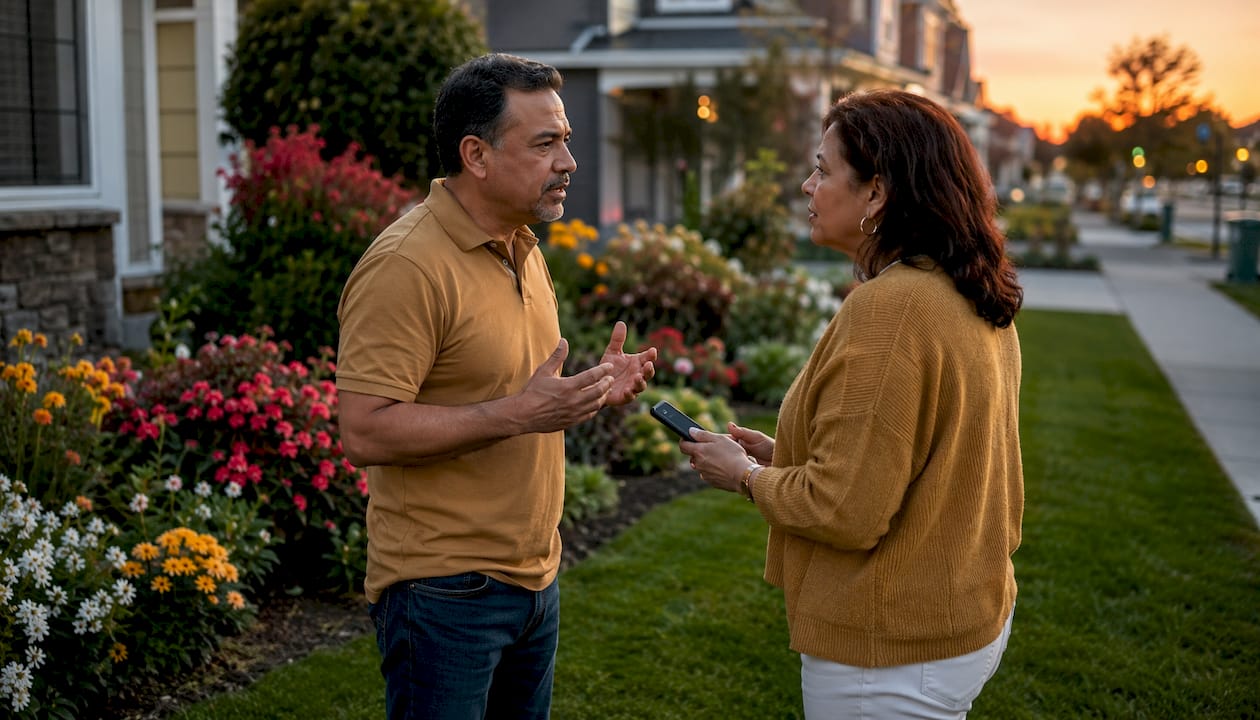
Understanding the statute is one thing. Seeing how it plays out in real situations is where most people find their footing.
Scenarios that commonly result in a 415 charge:
- A bar argument escalates and one person shoves another in the parking lot. Even if no punches land, the physical confrontation in a public space fits Prong 1.
- A house party runs past midnight with music loud enough to draw multiple neighbor complaints. If the host continues after being warned, the willfulness element for Prong 2 is easy to establish.
- Someone shouts a direct, threatening challenge at a rival in a crowded park — “Come at me right now” — and the crowd reacts with alarm. That fits Prong 3 more cleanly than most people expect.
- A driver rolls down a window during a road rage incident and screams a racial slur while gesturing aggressively. Depending on context, that can satisfy both the offensive-words and the challenge-to-fight prongs.
Protected vs. unprotected speech — a quick contrast:
Political protesters chanting outside a government building, even loudly, are generally protected under the First Amendment. A comedian using profanity on a public stage is protected. What strips that protection is imminence: words directed at a specific person in a charged situation, where violence is the likely immediate result, can cross the line under PC 415’s offensive-words standard.
Quick self-assessment checklist:
- Was the conduct in a public place or within earshot of the public?
- Was there a real likelihood of immediate violence, not just offense or discomfort?
- Did the person act deliberately, not accidentally?
- Was there physical contact, a direct challenge, or words aimed at a specific person?
If you answered yes to most of these, the conduct is at least in the range prosecutors consider chargeable.
Penalties, sentencing, and collateral consequences
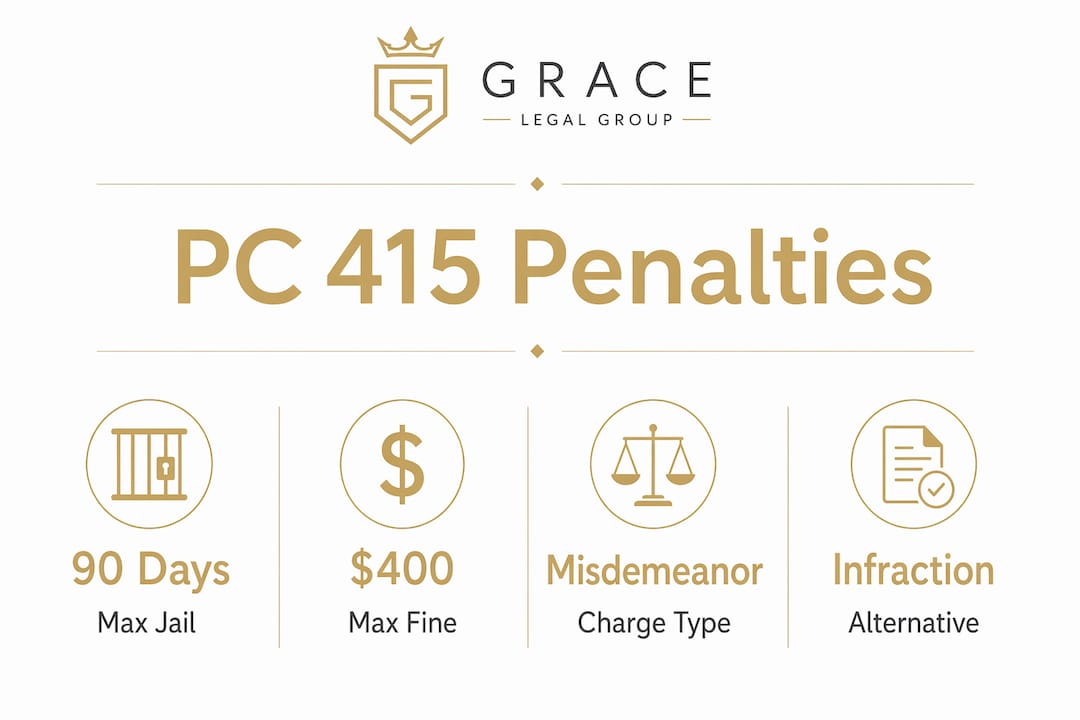
The statutory ceiling for a misdemeanor includes possible jail and fines as prescribed by law. In practice, first-time offenders with no prior record often resolve PC 415 cases through probation, community service, or diversion programs rather than jail time. The infraction route, when available, avoids a criminal record entry entirely.
| Charge Form | Jail Exposure | Typical Fine | Criminal Record? |
|---|---|---|---|
| Misdemeanor | Up to 90 days in county jail | Fine up to $400 | Yes |
| Infraction | None | Fine typically up to $250 | No |
| Probation (misdemeanor) | Suspended/none | Varies | Yes, unless later expunged |
Collateral consequences that go beyond the courtroom:
- Immigration: A misdemeanor conviction can trigger adverse immigration consequences for non-citizens, including visa issues or removal proceedings. Even a plea to a lesser charge warrants review by an immigration attorney.
- Employment: Background checks flag misdemeanor convictions. Jobs requiring security clearances or professional licenses are particularly vulnerable.
- Professional licensing: Certain California licensing boards (nursing, teaching, real estate) require disclosure of misdemeanor convictions and may take disciplinary action.
- Expungement: A PC 415 misdemeanor conviction may be eligible for expungement under Penal Code § 1203.4 after probation is completed successfully. Expungement does not erase the record entirely but removes the conviction from most background checks. For more on record-clearing options, California Penal Code § 851.91 also provides a pathway for arrest records that did not result in conviction.
Prior convictions can push a prosecutor toward the misdemeanor filing rather than an infraction, and a pattern of similar conduct can influence sentencing even within the misdemeanor range. If you have prior strike offenses on your record, that context shapes how aggressively the DA’s office approaches the case.
What defenses actually work against a PC 415 charge?
The defenses that hold up are the ones grounded in what the statute actually requires prosecutors to prove. For a misdemeanor, that standard is beyond a reasonable doubt. For an infraction, the burden is lower, but prosecutors still must establish the elements.
Defense checklist:
- Lack of intent (mens rea): Prong 2 requires malicious and willful conduct. If the noise was accidental or the result of a mechanical failure, the intent element is missing. Evidence: maintenance records, witness statements that the defendant tried to stop the noise.
- Constitutionally protected speech: If the words were political, artistic, or general expression without a specific target and without imminence of violence, the First Amendment limits prosecution under Prong 3. Evidence: video of the broader context, witness accounts of the crowd’s reaction.
- Self-defense or defense of others: If the defendant was responding to an immediate physical threat, the fighting element under Prong 1 may be legally justified. Evidence: surveillance footage, medical records showing injuries, witness statements about who initiated contact.
- Mistaken identity or false accusation: In chaotic public situations, police sometimes cite the wrong person. Evidence: alibi witnesses, phone location data, video showing the defendant was not the aggressor.
- Lawful assembly: Participation in a permitted protest or public gathering, even a loud one, is generally protected. Evidence: permit documentation, news coverage, organizational records.
For a deeper look at available criminal defenses in California, the specific facts of your case determine which of these applies and how strongly.
On the prosecution’s burden: For a misdemeanor PC 415 charge, the DA must prove every element beyond a reasonable doubt. That is a high bar, and a defense attorney who identifies a weakness in even one element can often negotiate a reduction or dismissal.
What happens after you are cited or arrested for PC 415?
The procedural path from citation to resolution is more predictable than most people expect, and knowing it helps you make better decisions at each step.
Typical timeline:
- Citation or arrest: Police issue a citation (most common for noise complaints) or make an arrest for more serious incidents like public fighting. An arrest may involve booking and a brief hold.
- Arraignment: Your first court appearance, usually within a few days of arrest or on the date listed on a citation. You enter a plea (not guilty, guilty, or no contest).
- Plea negotiations: Most PC 415 cases resolve here. The DA may offer a reduction to an infraction, a diversion program, or a dismissal with conditions.
- Trial: If no plea is reached, the case proceeds to a bench or jury trial. Misdemeanor jury trials are relatively rare for PC 415 but are a constitutional right.
- Sentencing or resolution: Probation, fines, community service, or jail — depending on the outcome and the judge’s discretion.
Immediate steps to protect your case:
- Preserve all video and audio from your phone or nearby cameras before it is deleted or overwritten.
- Write down the names and contact information of any witnesses while the incident is fresh.
- Do not post about the incident on social media. Prosecutors routinely review public posts.
- Request a copy of the citation and any police report as soon as it is available.
- Contact a defense attorney before your arraignment date, not after.
Gracelegalgroup assigns two attorneys to each case and builds a mitigation packet that tells the client’s full story to prosecutors — context about character, circumstances, and any mitigating factors that a bare police report never captures. That approach, developed with input from former law enforcement professionals on staff, can shift how a prosecutor evaluates the case before charges are even formally filed. For a detailed look at how a defense is built from day one, the firm’s process starts at the evidence-preservation stage.
Pro Tip: If a neighbor or business filed a noise complaint that led to your citation, request the municipal code citation number from the officer. A local ordinance violation handled administratively is a different track than a criminal PC 415 charge — and that distinction can be used in plea negotiations to argue the conduct was civil, not criminal, in nature.
Local noise ordinances vs. PC 415: which one applies to you?
There is no single statewide quiet-hours rule in California. The Noise Control Act establishes state policy that excessive noise is a public health hazard, but it explicitly leaves the specifics — hours, decibel thresholds, enforcement mechanisms — to cities and counties. Los Angeles, San Diego, and San Francisco each have their own municipal codes with different quiet-hour windows and decibel limits.
Practical breakdown of when each framework applies:
- Local ordinance (civil/administrative): A neighbor complains about your music at 11 PM. Code enforcement responds, issues a warning or a civil fine. No criminal record results. This is the most common outcome for residential noise disputes.
- PC 415 (criminal): The noise is extreme, repeated after warnings, or accompanied by threatening behavior. Police respond and determine the conduct rises to the level of malicious and willful disturbance. A criminal citation or arrest follows.
- Both simultaneously: A loud party that draws police can result in both a municipal code citation and a PC 415 charge if the responding officer decides the conduct meets the criminal threshold.
How to find your local rules:
- Search your city or county name plus “municipal code noise ordinance” on the city’s official website.
- The NPC Law Library’s California noise laws page aggregates state-level noise policy and links to local resources.
- If police cited you under a local ordinance rather than PC 415, the citation will reference a municipal code section number, not the Penal Code.
When a local ordinance citation is the only charge, you typically resolve it through the city’s administrative process, not criminal court. That is a meaningful distinction worth clarifying with an attorney if you are unsure which track you are on.
When do offensive words become a criminal offense under PC 415?
The “offensive words” prong of PC 415 is the narrowest of the three, and it is frequently misunderstood. California courts have interpreted it in light of First Amendment doctrine, which means the bar for prosecution is genuinely high.
The statutory language requires that the words be inherently likely to provoke an immediate violent reaction. That phrase does two things: it limits prosecution to words directed at a specific person in a specific charged context, and it requires that violence be the likely immediate result, not just a theoretical possibility. General profanity, political speech, and even deeply offensive expression aimed at no one in particular does not meet this standard under PC 415’s offensive-words prong.
Protected speech examples:
- Protesters chanting loudly outside a government building, even using profanity.
- A street preacher making inflammatory statements to passersby who choose to engage.
- Heated arguments between strangers that involve insults but no specific threat of immediate violence.
Unprotected examples under PC 415:
- A direct, face-to-face verbal challenge in a crowded bar that immediately precedes a brawl.
- Racial slurs screamed at a specific individual in a context where the crowd is already agitated and violence is seconds away.
- Words paired with physical gestures (raised fists, blocking exits) that together signal an imminent attack.
The legal concept here traces back to the “fighting words” doctrine established in Chaplinsky v. New Hampshire (1942) and refined in subsequent cases. California’s PC 415 Prong 3 is the state’s codification of that narrow category. If you are facing charges under this prong, the constitutional dimension of the defense is worth exploring with counsel — it is one of the more defensible positions in a PC 415 case.
Key Takeaways
California Penal Code § 415 covers three specific forms of conduct, carries up to 90 days in jail and a $400 fine as a misdemeanor, and can often be resolved short of conviction with early attorney involvement and a strong mitigation strategy.
| Point | Details |
|---|---|
| Three statutory forms | PC 415 covers public fighting, malicious loud noise, and offensive words likely to provoke immediate violence. |
| Penalty range | Misdemeanor: up to 90 days jail and $400 fine; infraction: typically up to $250 fine, no jail. |
| Local vs. state law | No statewide quiet hours exist; local ordinances set noise rules, and a civil citation differs from a criminal PC 415 charge. |
| Record-clearing options | A PC 415 misdemeanor conviction may qualify for expungement under PC § 1203.4 after probation; consult counsel early. |
| Gracelegalgroup | Assigns two attorneys per case and builds mitigation packets to present your full story to prosecutors before charges solidify. |
A practitioner’s perspective on PC 415 cases
The cases that go badly for defendants are almost never the ones where the conduct was clearly criminal. They are the ones where someone said the wrong thing to police at the scene, deleted a video that would have helped them, or waited three weeks to call an attorney. By then, the DA has a one-sided police report and no competing narrative.
What most people do not realize about PC 415 is that the charging decision — misdemeanor or infraction — is made early, often before the DA has seen anything beyond the officer’s notes. A mitigation packet submitted before that decision is made can genuinely change the outcome. It is not about making excuses. It is about giving the prosecutor a complete picture: who the person is, what actually happened, and why the criminal track is disproportionate to the conduct.
The offensive-words prong is also more defensible than it looks on paper. California courts have consistently required that the words be inherently provocative in context, not just offensive in the abstract. That constitutional limit is real, and it has resulted in dismissals in cases where the initial citation looked solid. The statute’s narrowness is a defense tool, not just a legal technicality.
If you are reading this because you or someone you know was cited under PC 415, the single most useful thing you can do is contact a defense attorney before the arraignment date. Everything after that is harder to fix.
Gracelegalgroup can help you fight a PC 415 charge
A PC 415 citation feels minor until you see what a misdemeanor conviction actually costs — a criminal record that follows you through job applications, licensing renewals, and immigration proceedings. Gracelegalgroup is a Los Angeles criminal defense firm built specifically for situations like this: real charges with real consequences, where the difference between a dismissal and a conviction often comes down to how quickly and thoroughly your defense is built.
The firm assigns two attorneys to every case, draws on former law enforcement professionals to analyze the evidence, and prepares a detailed mitigation packet that puts your story in front of the prosecutor before the case hardens into a conviction. That is not a standard approach. Most defendants show up to arraignment with no context provided and no narrative competing with the police report.

If you are facing a disturbing the peace charge or any related criminal matter in California, schedule a free consultation with Gracelegalgroup today. Come prepared with your citation paperwork, any video or photos from the incident, and a list of potential witnesses. The firm reviews cases promptly and can advise you on what defenses are available for your specific situation.
This article is general legal information, not legal advice. Laws and their application vary by situation. Consult a qualified California criminal defense attorney to evaluate your specific case.
Useful sources and further reading
- California Penal Code § 415 — California Legislative Information: The primary statutory source. Read the exact text of the three prongs and the penalty provisions directly from the legislature’s official site.
- Health and Safety Code Division 28 — Noise Control Act: State policy framework for noise as a public health issue. Explains why local governments, not the state, set quiet hours and decibel limits.
- FindLaw — Penal Code § 415: Plain-language summary of the statute with examples. Useful for understanding how the elements are applied in practice.
- Justia — California Penal Code § 415: Secondary statutory reproduction with cross-references. Commonly cited by attorneys for quick verification of statutory language.
- NPC Law Library — California noise laws: Aggregates California state noise policy and links to local ordinance resources. Useful starting point for finding your city or county’s specific noise rules.
- Gracelegalgroup — Free Consultation: Contact page for readers who want to speak with a California criminal defense attorney about a PC 415 charge or related matter.
Recommended
- What to Do If You’re Charged with PC 29800 in California – Grace Legal Group
- What to Do If You’re Charged with PC 25400 in California – Grace Legal Group
- What are Considered Strike Offenses in California? | Grace Legal
- Regain Your Privacy and Move Forward: Understanding California Penal Code 851.91 – Grace Legal Group