
California allows most DUI convictions to be set aside under Penal Code 1203.4 after probation is complete. This is not a true erasure of the record — the California Courts Self-Help Center is explicit that “true expungement does not exist in California” — but a court dismissal under PC 1203.4 changes how the conviction appears and how you can legally describe it to most private employers. If you completed probation, paid all fines, and finished your DUI program, your next step is to file a Petition for Dismissal (Form CR-180) in the county where you were convicted, or call Gracelegalgroup for a case review.
Three quick checks before you go further:
- Probation completed or formally discharged (including informal probation)
- No state prison sentence served on this conviction
- Fines, restitution, and DUI school all paid and completed
If all three apply, you likely qualify. Keep reading for the exact forms, steps, and limits.
Table of Contents
- Who qualifies for a California DUI set-aside?
- What a set-aside actually does — and what it doesn’t
- How to file a DUI expungement petition in California
- When a DUI cannot be expunged or relief is limited
- How a court dismissal interacts with your DMV record
- Common reasons petitions are denied — and how to avoid them
- When to hire a DUI expungement lawyer and what Gracelegalgroup does
- Key Takeaways
- Why this process matters more than most people realize
- Gracelegalgroup can review your case today
- Useful sources and official forms
Who qualifies for a California DUI set-aside?
The statutory basis is Penal Code 1203.4, which covers most misdemeanor and some felony DUI convictions. The primary rule is straightforward: you must have completed probation, or the court must have discharged you from it early.

“Completed probation” means more than just serving the time. You need to have paid all fines and fees, finished any court-ordered DUI education program, paid any restitution owed to victims, and not violated probation terms in a material way. Courts look at the full picture, not just whether the probation period ended.
The most common disqualifier is a state prison sentence. If your DUI conviction carried a sentence to state prison (as opposed to county jail), PC 1203.4 does not apply. Certain other statutory exceptions under PC 1203.4(b) also block eligibility, including some sex offenses and specific vehicle code violations involving injury.
To verify your sentence terms, contact the clerk’s office in the court where you were convicted. Ask for your minute orders and the abstract of judgment. Those documents tell you exactly what sentence was imposed and whether probation was granted.
What a set-aside actually does — and what it doesn’t
When a judge grants your petition, the court withdraws your guilty plea (or sets aside the guilty verdict) and dismisses the case. For most private employment purposes, you can legally state that you were not convicted of that offense. That is the core benefit.
But the limits are real and worth understanding before you file:
- DUI priors still count. Even after a dismissal under PC 1203.4, a prior DUI conviction can still be used to enhance penalties if you are charged with a subsequent DUI. The court dismissal does not erase the prior for future prosecution purposes.
- DMV records are separate. A court order does not remove license suspensions, SR-22 requirements, or administrative actions from your California DMV driving record. Those tracks run independently.
- Immigration consequences are not automatically cured. Federal immigration law operates on its own framework. A state court dismissal may not resolve immigration consequences tied to the original conviction. Anyone with immigration concerns needs specialized counsel before filing.
- Professional licensing boards have their own rules. Agencies like the California Department of Consumer Affairs or the State Bar may still consider the underlying conduct even after a dismissal.
The practical upside is clearest in private employment. Many background check companies report dismissed convictions differently, and California law limits what employers can ask about in many contexts. For a fuller picture of how long a DUI stays on your record across different record types, the distinction between your court record and your DMV record matters enormously.
How to file a DUI expungement petition in California
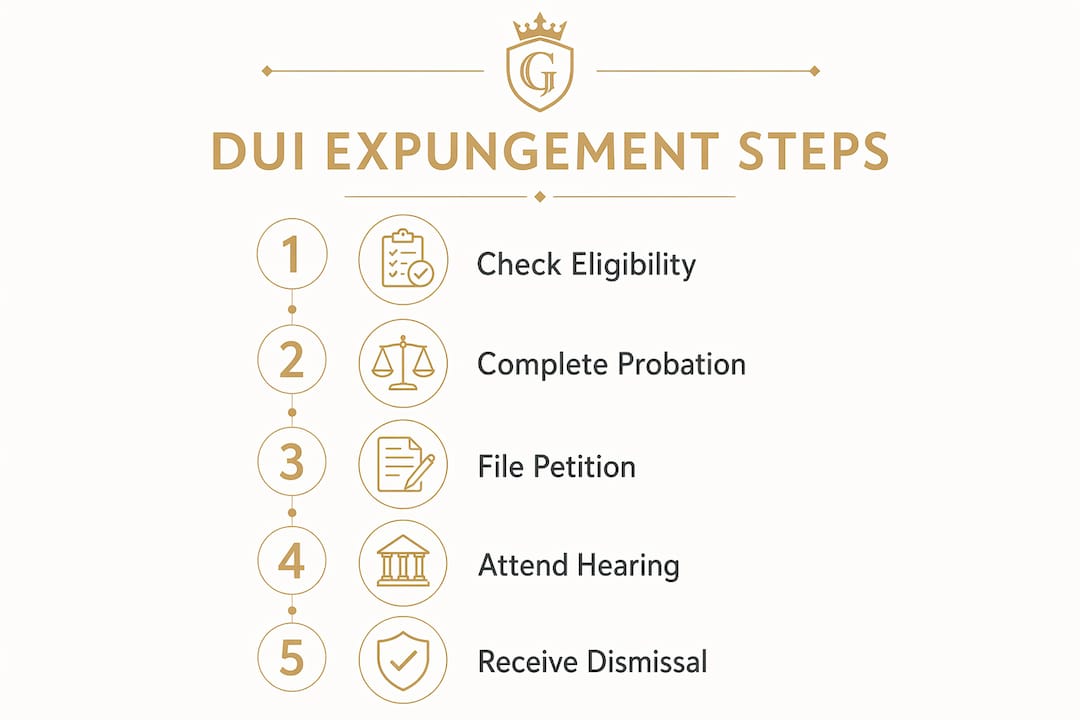
Filing a Petition for Dismissal under PC 1203.4 follows a defined sequence. Courts require proof, not just paperwork. Here is the step-by-step process:
- Gather your case documents. Pull your minute orders, sentencing documents, proof of DUI program completion, proof of fine payment, and any restitution receipts. These are your evidence of compliance. Gracelegalgroup’s post-conviction guidance on what happens after a DUI lists exactly which documents courts typically require.
- Obtain the correct petition packet. In San Diego County, that is SDSC Packet PKT-026 for misdemeanors and PKT-027 for felonies. In most other counties, Form CR-180 is the base petition. Check your county court’s self-help page for local attachments.
- Complete the petition in full. Incomplete forms are a leading cause of denial. Fill out every field, attach all supporting documents, and include a Financial Declaration (SDSC Form ADM-227 in San Diego, or the local equivalent) if you are requesting a fee waiver.
- File with the court clerk. File in the court where you were originally convicted. Pay the filing fee or submit your fee-waiver request at the same time.
- Serve the district attorney. This step is non-negotiable. You must serve the prosecuting agency with a copy of your petition and file proof of service with the court. Failure to serve the DA is one of the most common reasons petitions are denied or delayed.
- Wait for the hearing or ruling. Some courts schedule a hearing; others rule on the papers. Processing times vary by county and current court calendar. Expect several weeks to a few months.
- Receive the signed court order. If granted, the judge signs an order setting aside the conviction. Keep certified copies. You will need them for employers, the DMV, and licensing boards.
Forms reference
| Form | Purpose | Where to get it |
|---|---|---|
| CR-180 | Base Petition for Dismissal (PC 1203.4) | California Courts website or county clerk |
| PKT-026 | San Diego misdemeanor petition packet | San Diego Superior Court self-help |
| PKT-027 | San Diego felony petition packet | San Diego Superior Court self-help |
| ADM-227 | Financial Declaration / fee waiver (San Diego) | San Diego Superior Court self-help |
Timeline is honest: simple misdemeanor cases in cooperative counties can move within a few weeks to a couple of months. Contested petitions or counties with backlogged calendars can take longer. Do not file before probation is formally complete — courts will reject premature petitions outright.
When a DUI cannot be expunged or relief is limited
Not every DUI conviction qualifies for a PC 1203.4 dismissal. The statute itself lists exceptions at PC 1203.4(b), and courts apply them strictly.
State prison sentences are the clearest bar. If the court sentenced you to state prison rather than county jail or probation, you are not eligible for a standard set-aside. The remedy in that situation is different: a Certificate of Rehabilitation or a Governor’s Pardon. Orange County Superior Court’s self-help materials explain both paths for people who served state prison time. These are longer, more involved processes, but they exist.
Felony DUI cases that resulted in state prison are also worth reviewing for potential charge reduction under AB 321 before pursuing post-conviction relief. Some felony DUIs can be reduced to misdemeanors depending on the facts, which can open the door to a standard dismissal petition.
For immigration and professional licensing, the message is the same: a PC 1203.4 dismissal is a state court remedy, not a federal one. Immigration courts and licensing boards apply their own standards. Anyone in either category should get specialized advice before filing, because a granted petition alone may not deliver the relief they expect.
How a court dismissal interacts with your DMV record
The court and the DMV run on separate tracks. A signed PC 1203.4 order does not automatically update your DMV driving record, remove a license suspension, or end an SR-22 insurance requirement. Those administrative actions were imposed independently of the criminal conviction, and they follow their own timelines.
If you need a clean driving record, the court order is not enough on its own. Contact the California DMV directly to request a copy of your driving record and review what administrative actions remain. Some suspensions expire on their own schedule; others require a separate DMV hearing or compliance step to lift. The DMV’s record of a DUI-related suspension typically stays for a fixed period regardless of what happens in criminal court.
Pro Tip: Keep at least two certified copies of your signed court order. Employers, licensing boards, and the DMV may each want one, and getting additional certified copies later costs time and money.
Common reasons petitions are denied — and how to avoid them
Most denials come down to a short list of preventable mistakes. Court guidance is consistent: proving full compliance and properly serving the DA are the two factors that most often decide whether a petition succeeds or fails.
- Failure to prove probation completion. The court wants documentation, not your word. Obtain your minute orders and a certificate of completion from your DUI program provider before you file.
- Failing to serve the district attorney. Service is mandatory. Use the correct method for your county (personal service or mail with proof), and file the proof of service with the clerk on time.
- Outstanding fines or restitution. Any unpaid balance is grounds for denial. Get a receipt or a balance-zero confirmation from the court’s financial department.
- Incorrect or incomplete forms. Using an outdated form, skipping attachments, or leaving fields blank will get your petition rejected at the counter or denied by the judge.
- Filing in the wrong county. You must file in the court where the conviction was entered, not where you currently live.
Pro Tip: Before you file anything, pull your minute orders and read the sentencing language carefully. Courts have denied petitions because the petitioner did not realize they owed restitution or had a probation violation on record. A one-hour attorney review of your case file can catch these issues before they become a denial.
When to hire a DUI expungement lawyer and what Gracelegalgroup does
Straightforward misdemeanor cases with clean probation records can sometimes be handled without an attorney. But several situations make legal help worth the cost:
- Your probation completion is unclear or disputed
- You have unpaid restitution or a probation violation on record
- Your case involved a felony or a state prison sentence
- You have immigration concerns tied to the conviction
- A prior petition was denied
- You are unsure which county or which form applies
An attorney handles the tasks that most commonly trip up self-represented petitioners. That means obtaining minute orders, preparing a complete petition and mitigation packet, serving the DA correctly, attending any hearing, and navigating county-specific procedural requirements that are not always obvious from the court’s website.
Gracelegalgroup is a Los Angeles-based criminal defense firm with former law enforcement professionals on staff and two-attorney teams assigned to each case. That combination matters for expungement work: the firm’s ex-law enforcement staff know how prosecutors and courts read compliance documentation, and the two-attorney structure means your petition gets reviewed from more than one angle before it is filed. The firm’s track record includes numerous dismissals and sentence reductions across DUI and other criminal matters.
For a case review, contact Gracelegalgroup with your case number, sentencing documents, and any certificates of completion you already have. The earlier you bring those materials, the faster the firm can assess your eligibility and flag any issues before filing.
Key Takeaways
A California DUI conviction can be set aside under Penal Code 1203.4 after probation is complete, but the dismissal does not erase DMV records, cure immigration consequences, or prevent the prior from counting in a future DUI case.
| Point | Details |
|---|---|
| Eligibility baseline | Probation completed, no state prison sentence, all fines and DUI school finished. |
| The right form | File Form CR-180 (or the county packet) in the court where you were convicted. |
| Serve the DA | Serving the prosecuting agency and filing proof of service is mandatory — skipping it is the top denial reason. |
| What it doesn’t fix | DMV suspensions, SR-22 requirements, immigration consequences, and DUI priors for future charges remain unaffected. |
| Gracelegalgroup | The firm prepares complete petition packets, serves the DA correctly, and attends hearings — contact them for a case review if your situation is complex. |
Why this process matters more than most people realize
Most people who search for “DUI expungement California” want a simple yes or no. The honest answer is closer to: yes, but the details determine whether the petition actually sticks.
What I see consistently in this area of law is that people underestimate the compliance documentation step and overestimate what the dismissal accomplishes. They file, get the order, and then discover their DMV record still shows the suspension, or that a licensing board is treating the underlying conduct as if the dismissal never happened. The court order is real and valuable. It just does not do everything people assume it does.
The other thing worth saying plainly: the forms are not the hard part. Proving that you actually completed every condition of probation — with paper to back it up — is where most self-represented petitions fall apart. Courts are not going to take your word for it. If you finished DUI school three years ago and cannot locate the certificate, that is a problem you need to solve before you file, not after.
For cases with any complication at all, the cost of a limited attorney review is almost always less than the cost of a denial and a second filing. That is not a sales pitch — it is just the math.
Gracelegalgroup can review your case today
A DUI conviction does not have to follow you forever. Gracelegalgroup gives clients something most firms don’t: two attorneys reviewing every case, former law enforcement insight into how prosecutors read your file, and a mitigation packet built around your specific circumstances.

If you completed probation and want to know whether you qualify for a set-aside, the next step is a case review with the firm. Bring your case number, any minute orders you have, and proof of program completion. Gracelegalgroup will assess your eligibility, identify any compliance gaps, and handle the full petition process from forms to hearing.
Schedule a free consultation today and find out exactly where you stand.
Useful sources and official forms
| Resource | What you’ll find there |
|---|---|
| California Courts Self-Help Center | Decision flows for record-cleaning options and links to court forms statewide |
| San Diego Superior Court — Petition for Dismissal | County petition packets (PKT-026, PKT-027), form ADM-227, and service rules |
| Orange County Superior Court — Cleaning Your Record | Eligibility summary, Certificate of Rehabilitation info, and alternative remedies |
| Form CR-180 | Base Petition for Dismissal — available from any California county court clerk or the California Courts website |
| Gracelegalgroup — DUI record help | Compliance checklist, documentation guidance, and firm contact for a case review |
This article is general legal information, not legal advice for your specific situation. Eligibility rules, court procedures, and local requirements vary. Confirm current rules with the court clerk or a qualified California criminal defense attorney before filing.
Recommended
- Clearing Your Criminal Record: California Expungements Offer a Fresh Start – Grace Legal Group
- How to Get a DUI Off Your Record in California
- What a DUI Defense Lawyer in California Looks for to Protect Your License and Freedom – Grace Legal Group
- What Happens After a DUI in California? 2026 Legal Guide