
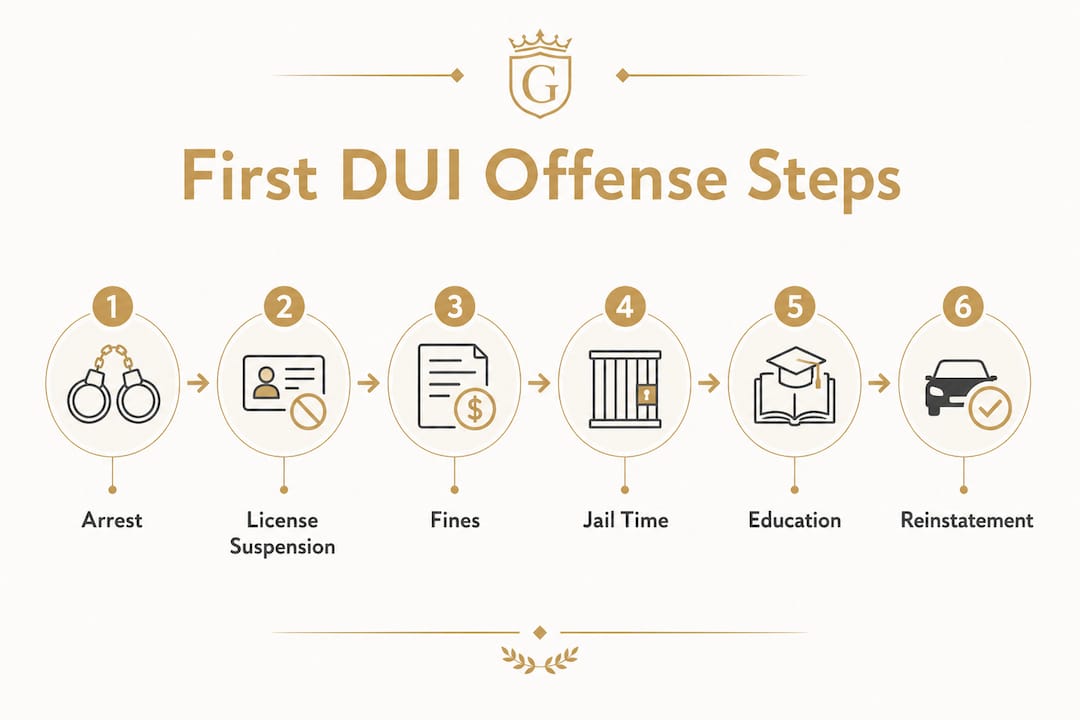
A first DUI offense in the U.S. carries mandatory penalties that take effect immediately, before you ever set foot in a courtroom. Across all 50 states, a first charge is classified as a misdemeanor, but “just a misdemeanor” understates what you’re actually facing. Here’s what typically follows a first DUI arrest:
- Fines: statutory fines vary depending on state and BAC level
- Jail time: jail sentences vary by state and offense, though many first offenders avoid active jail through probation
- License suspension: license suspensions vary by state and offense, typically lasting several months or longer for test refusal
- Mandatory DUI education program: varies by state, with California requiring longer programs depending on BAC
- Ignition interlock device (IID): required in many states for first offenders
- Probation: probation lengths vary by state and case
- SR-22 insurance filing: commonly required in many states post-conviction
The total financial hit goes well beyond the fine printed on your citation. Attorney fees, court costs, license reinstatement fees, a DUI education program, and a sharp spike in your auto insurance premiums can push the real cost into the thousands. State law governs almost every detail, so the specific numbers you face depend heavily on where you were arrested.
State-by-state penalties for a first DUI offense
No two states handle a first DUI charge exactly the same way. The table below covers three states that represent the range of approaches you’ll find across the country.
| State | Fines | Jail time | License suspension | Education program | Test refusal suspension |
|---|---|---|---|---|---|
| California | $390–$1,000 | 96 hours–6 months | 4 months (BAC ≥0.08%) | 3–9 months depending on BAC | 1 year |
| Georgia | Varies by court | Up to 12 months | 12 months | Risk Reduction Program required | 1 year, no limited permit |
| Pennsylvania | $300–$5,000+ | Up to 6 months (varies by tier) | 0–12 months depending on BAC tier | Alcohol highway safety school | Highest BAC tier penalties apply |
California: Vehicle Code 23152
Under California Vehicle Code Section 23152, a first DUI conviction carries 96 hours to 6 months in county jail and fines of $390–$1,000. The California DMV imposes a separate 4-month license suspension for a BAC of 0.08% or higher. Refuse the chemical test, and that suspension jumps to 1 year, handled entirely by the DMV independent of any court ruling.
Education requirements scale with your BAC. A first offender below 0.20% BAC must complete at least 30 hours of a licensed program over 3 months or more. At 0.20% or above, or if you refused testing, the court refers you to a 9-month program with at least 60 hours of activities. That’s a meaningful difference in time and cost.
Georgia: implied consent and the 120-day rule
Georgia’s Department of Driver Services suspends a first offender’s license for 12 months. The practical relief: after 120 days, you can apply for reinstatement if you complete a DDS-approved DUI Alcohol or Drug Use Risk Reduction Program and pay the reinstatement fees. Miss those conditions, and you wait out the full year.
Georgia’s Implied Consent Law adds a sharp edge for anyone who refuses chemical testing. Refusal triggers a minimum 1-year suspension, and critically, it makes you ineligible for a limited driving permit even if you’re later convicted of a first DUI. That’s a consequence many drivers don’t anticipate until it’s too late.
Pennsylvania: the three-tier BAC system
Pennsylvania restructured its DUI law around a tiered BAC enforcement model that produces very different outcomes depending on where your BAC lands. Three tiers govern penalties:
- General Impairment (0.08%–0.099% BAC): No license suspension for a first offense, up to 6 months probation, $300 fine, alcohol highway safety school, and 1-year IID requirement.
- High BAC (0.10%–0.159% BAC): 12-month license suspension, 48 hours to 6 months in prison, $500–$5,000 fine, alcohol highway safety school, and 1-year IID.
- Highest BAC (0.16% and above) or controlled substance: 12-month license suspension, 72 hours to 6 months in prison, $1,000–$5,000 fine, and 1-year IID.
Drivers who refuse breath or chemical testing in Pennsylvania face the Highest BAC tier penalties automatically, regardless of their actual BAC. Minors, commercial drivers, and anyone involved in an injury accident can also be bumped to a higher tier even if their BAC falls in the General Impairment range.
What a first DUI conviction actually costs you beyond the fine
The statutory fine is the smallest part of the financial damage. A first DUI conviction triggers a cascade of costs that most people don’t see coming until they’re already dealing with them.
Insurance is where the real money goes. A DUI conviction triggers an average insurance premium increase of 88%, and most states require an SR-22 filing, which is a certificate your insurer files with the DMV confirming you carry the minimum required coverage. SR-22 requirements typically last 3 years. Some insurers drop clients outright after a DUI conviction, forcing you into a high-risk pool with even steeper rates.
Beyond insurance, the non-financial consequences can follow you for years:
- Employment: Many employers run background checks, and a DUI conviction appears on your criminal record. Jobs requiring a commercial driver’s license, security clearance, or work with vulnerable populations are particularly at risk.
- Travel: Canada bars entry to individuals with DUI convictions, treating them as criminal inadmissibility. Other countries have similar restrictions.
- Professional licenses: Nurses, teachers, attorneys, and others in licensed professions may face disciplinary review or license suspension.
- Record visibility: A first DUI misdemeanor stays on your driving record for years, and in many states, it counts as a prior offense for 10 years if you’re charged again.
Diversion programs offer a way out for some first offenders. States like Connecticut and Illinois allow case dismissal upon successful completion of diversion requirements, which typically include education, treatment, and no new arrests during the program period. Not every state offers diversion, and eligibility often depends on your BAC, the specific charges, and your attorney’s ability to negotiate.
Pro Tip: If your state offers a diversion program, ask your attorney about eligibility before your first court appearance. Prosecutors sometimes close that door once proceedings are underway.
How to protect yourself after a first DUI arrest
The first 10 days after a DUI arrest are the most consequential. Two separate legal processes start simultaneously, and missing a deadline in either one can cost you your license before a judge ever rules on your case.

The dual-track system
A DUI arrest triggers both a criminal case and an administrative license suspension, and they run independently of each other. The administrative suspension is handled by your state’s DMV or motor vehicle agency, not the court. If you do nothing, the suspension takes effect automatically, often within 30 days of your arrest. Most states give you a window of 10–30 days to request a hearing to contest the administrative suspension. Request it, and you may be able to drive legally while your case is pending. Miss the deadline, and you lose that option entirely.
Steps to take immediately
- Request your DMV hearing within the deadline. Your arrest paperwork should specify the window. In California, you have 10 days from the arrest date to contact the DMV.
- Hire a DUI defense attorney before your arraignment. An attorney can appear at your arraignment, negotiate with prosecutors, and handle the DMV hearing simultaneously.
- Preserve all evidence. Save any dashcam footage, witness contact information, or documentation of the stop conditions.
- Do not discuss your case on social media. Prosecutors can and do use social media posts as evidence.
- Understand your plea options. Depending on your state and the facts of your case, a skilled attorney may negotiate a reduction to a “wet reckless” (reckless driving involving alcohol), which carries lighter penalties than a DUI conviction.
Pro Tip: A mitigation packet prepared by your attorney, documenting your character, employment, community ties, and circumstances, can shift how a prosecutor views your case before they make a charging decision.
Retaining a DUI defense lawyer early also opens the door to challenging the stop itself, the accuracy of the breathalyzer, or the chain of custody for blood test results. These aren’t long shots. They’re standard defense strategies that experienced attorneys evaluate in every case. For guidance specific to Rhode Island, post-arrest steps follow a similar dual-track structure with state-specific deadlines.
What Gracelegalgroup’s DUI defense attorneys want you to know
Gracelegalgroup is a Los Angeles-based criminal defense firm whose attorneys have handled first DUI cases across a range of circumstances, from standard BAC stops to refusal cases and accidents. Two attorneys work each case, and the team includes former law enforcement professionals who understand exactly how the prosecution builds its evidence.
The firm’s approach centers on the mitigation packet, a document that tells the client’s full story to the prosecutor before charges are formally set. It covers employment history, family responsibilities, community involvement, and the specific circumstances of the arrest. Prosecutors are people. When they see a complete picture of who you are, not just a BAC number, their discretion often shifts.
Common defense strategies Gracelegalgroup attorneys evaluate in first DUI cases:
- Challenging the traffic stop: Was there reasonable suspicion to pull you over? An unlawful stop can suppress all evidence gathered afterward.
- Field sobriety test accuracy: These tests are subjective and affected by medical conditions, footwear, road surface, and officer instruction quality.
- Breathalyzer calibration and maintenance records: Devices must be regularly calibrated. Gaps in maintenance logs are legitimate grounds for challenge.
- Blood test chain of custody: Improper storage or handling of a blood sample can render results inadmissible.
- Rising BAC defense: If you were driving before your BAC peaked, your BAC at the time of driving may have been below the legal limit even if it tested above it later.
If you’re facing a first DUI charge and want to understand what defenses are available in your specific situation, Gracelegalgroup offers consultations to review the facts and identify the strongest path forward. The first DUI misdemeanor question comes up often, and the answer is consistently the same: yes, you need an attorney, and the earlier you retain one, the more options remain open.

Key Takeaways
A first DUI offense carries mandatory penalties in every state, but the outcome depends heavily on how quickly and strategically you respond after arrest.
| Point | Details |
|---|---|
| Misdemeanor classification | A first DUI is a misdemeanor in all states, with fines ranging from $500 to $6,250 and jail time between 48 hours and 6 months, depending on the state. |
| License suspension deadlines | Most states require a DMV hearing request within 10–30 days to contest automatic license suspension. |
| California-specific penalties | California imposes a 4-month suspension for BAC ≥0.08% and a 1-year suspension for test refusal under Vehicle Code 23152. |
| Insurance cost spike | A first DUI conviction triggers an average 88% increase in auto insurance premiums, plus mandatory SR-22 filing. |
| Diversion is possible | States like Connecticut and Illinois offer diversion programs that can result in case dismissal for eligible first offenders. |