
Transporting a firearm in California requires strict adherence to specific storage laws to avoid serious criminal charges. Whether you are heading to the shooting range or moving to a new home, understanding the legal difference between a “locked container” and a “utility compartment” is essential for every gun owner. If you find yourself facing a technical violation of these complex rules, Grace Legal Group Inc. offers the specialized criminal defense you need to protect your rights and your future.
The Core Rule: California Penal Code 25610
Under California law 25610, any law-abiding citizen over the age of 18 may legally transport a handgun in a motor vehicle, provided it is unloaded and stored in a locked container.
The term “unloaded” is strictly enforced. In California, a firearm is considered loaded if there is unexpended ammunition in the chamber or in a magazine or clip that is attached to the firearm in any manner. Even if the chamber is empty, an inserted magazine makes the weapon “loaded” in the eyes of the law.
The “Locked Container” Requirement
According to Penal Code 16850, a “locked container” must be:
- Fully enclosed: The container must completely surround the firearm.
- Securely locked: It must be secured with a padlock, key lock, combination lock, or similar device.
- Separate from the vehicle: While the trunk counts as a locked container, the interior compartments of the car do not.
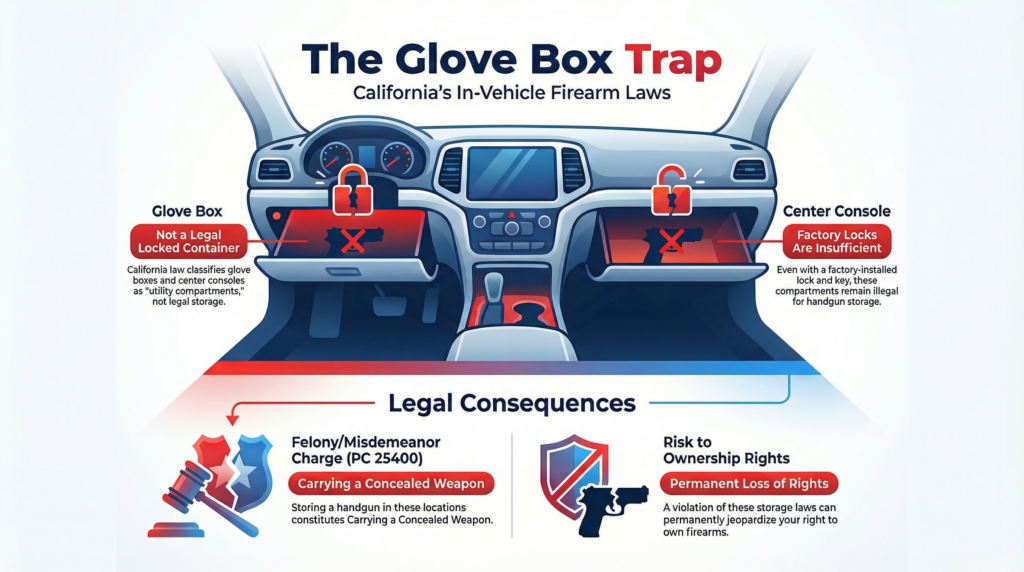
The “Utility Compartment” Mistake: Glove Boxes and Consoles
A common and costly mistake made by many California drivers is assuming that a locked glove box or center console satisfies the law.
By law, a glove box or center console is NOT a legal locked container. Even if these compartments have a factory-installed lock and key, they are classified as “utility compartments.” Storing a handgun in these locations can lead to a charge of Carrying a Concealed Weapon (PC 25400), a serious offense that can jeopardize your right to own a firearm.
The Trunk Exception: Your Safest Legal Bet
The trunk of a vehicle is legally recognized as a “locked container.” For most sedans and coupes, placing an unloaded firearm directly in the trunk satisfies the legal requirement. It is the simplest way to remain compliant during transport.
Hatchbacks, SUVs, and Minivans
If you drive a vehicle without a traditional separate trunk, such as an SUV or a hatchback, the law requires extra caution. Because the cargo area is technically part of the passenger cabin, you cannot simply “toss” the gun in the back.
- The Solution: You must use a separate, hard-sided locked case.
- Placement: Place the locked case in the rearmost part of the vehicle, as far from the driver’s reach as possible.
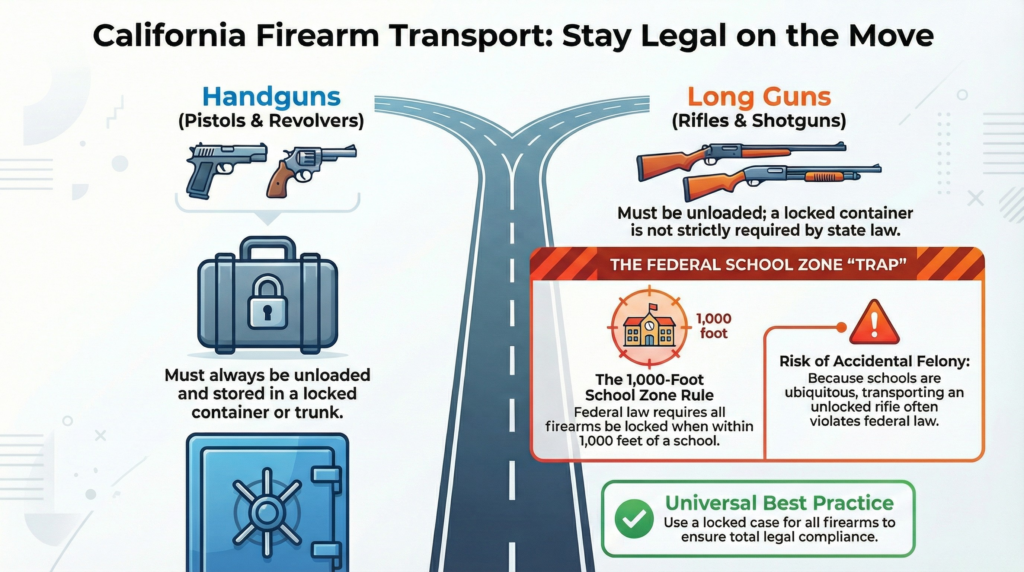
Transporting Handguns vs. Long Guns
The rules differ slightly depending on the type of firearm you are carrying:
- Handguns (Pistols & Revolvers): These must always be unloaded and in a locked container or trunk.
- Long Guns (Rifles & Shotguns): Generally, long guns only need to be unloaded during transport and do not strictly require a locked container under state law.
The School Zone Trap: However, federal law (the Gun-Free School Zones Act) requires that all firearms—including rifles and shotguns—be in a locked container or a locked firearms rack if you are within 1,000 feet of a school. Since schools are everywhere in California, Grace Legal Group Inc. strongly recommends using a locked case for all long guns to avoid an accidental felony.
Ammunition Laws: The “Attached” Rule
A common question gun owners ask is whether they can store ammunition in the same case as the firearm.
The Answer: Yes, but with conditions.
- Separation: Ammunition can be in the same locked container as the gun, but it cannot be attached to the weapon.
- Magazines: You can have loaded magazines in the same locked case, but the magazine must not be inserted into the firearm.
- The Proximity Risk: If an officer finds loose ammunition or magazines scattered near an unlocked firearm, they may attempt to charge you with carrying a “loaded” weapon under a theory of Constructive Possession.
CCW Holders and Law Enforcement Interactions
If you hold a valid California Concealed Carry Weapon (CCW) permit, the rules for “loaded” transport change significantly. You are permitted to carry a loaded handgun on your person or concealed within your vehicle.
Interacting with Police
If you are pulled over while transporting a firearm:
- Keep Hands Visible: Place your hands on the steering wheel.
- Disclose Your Permit: If you have a CCW, it is often a condition of the permit to inform the officer you are armed.
- The Plain View Doctrine: If an officer sees an empty holster, a box of ammo, or a gun case in plain view, they may have “probable cause” to search the rest of your vehicle without your consent.
Vehicle-Specific Legal Solutions
Modern transportation requires modern legal solutions. Here is how to handle different vehicle types:
- Pickup Trucks: If you don’t have a trunk, a permanently affixed, locking metal toolbox in the truck bed is a legal “locked container.”
- Motorcycles: A locked saddlebag or a mounted travel safe is required. A backpack or “messenger bag” does not count as a locked container unless it contains a secondary locked case inside.
- RVs and Motorhomes: When you are driving, the RV is a vehicle, and transport laws apply. When you are parked and using it as a residence, different storage laws apply.
The Grace Legal Group Approach: Defending the “Technicality”
Many “firearms crimes” in California are actually crimes of technicality. You might be a responsible, law-abiding citizen who simply used the wrong type of lock or placed a case in the wrong part of your SUV.
At Grace Legal Group Inc., we understand that these mistakes shouldn’t define your life. We specialize in “The Transport Trap” defense. We look at:
- Fourth Amendment Violations: Did the police have a legal reason to stop or search your car?
- Motion to Suppress: If the search was illegal, we fight to have the evidence thrown out entirely.
- Restorative Justice: We believe in second chances and work to ensure that a simple storage mistake doesn’t result in a permanent criminal record.
Consequences of a Conviction & Restoration of Rights
A conviction for illegal transport (PC 25400 or PC 25850) can result in jail time, heavy fines, and a lifetime ban on owning firearms.
However, if you have already been convicted of a “wobbler” felony (a crime that could have been a misdemeanor), Grace Legal Group Inc. can help. We utilize Penal Code 17(b) to petition the court to reduce your felony to a misdemeanor. In many cases, a successful 17(b) motion can restore your Second Amendment rights, allowing you to legally own and transport firearms once again.
People Also Ask (FAQ)
1. Can I transport a gun in my car if I don’t have a trunk? Yes. You must place the firearm in a separate, hard-sided locked container and store it in the rear cargo area of your vehicle, away from the driver and passengers.
2. Is a locked glove box a legal “locked container” in CA? No. California Penal Code specifically states that a glove box or center console does not count as a locked container, even if it is locked with a key.
3. Does the ammunition have to be in a separate locked box from the gun? No. Under state law, you can keep the ammunition in the same locked box as the firearm, as long as the ammunition is not “attached” to the gun (e.g., no magazine in the magwell).
4. Can a felony gun charge be removed from my record? If the charge is a “wobbler,” an attorney from Grace Legal Group Inc. may be able to file a PC 17(b) motion to reduce it to a misdemeanor, which can help restore your rights.
5. Do I need to tell a police officer I have a gun in the car? If you have a CCW permit, you are generally required to disclose it. If you do not have a CCW and are transporting the weapon legally (unloaded/locked), you generally have a right to remain silent, but it is often safer to cooperate if the officer asks.
6. What is a “wobbler” offense in California? A wobbler is a crime that a prosecutor can charge as either a felony or a misdemeanor. Many firearm transportation violations are wobblers, giving your attorney room to negotiate for a lesser charge.
Your Second Chance Starts Here
If you have been caught in the “Transport Trap” or are facing firearms charges in California, don’t let a technicality ruin your future. At Grace Legal Group Inc., we offer faith-based, professional, and aggressive advocacy to help you navigate the justice system. We believe in redemption and are dedicated to protecting your constitutional rights.
Contact Grace Legal Group Inc. today at (818) 650-1744 for a free consultation. Let us help you find your way back to a clean record.