
A DUI conviction can feel like a heavy weight, but understanding the timeline for its removal is the first step toward moving forward. How long a DUI stays on your record depends on whether you are looking at your driving history or your permanent criminal file. At Grace Legal Group, we help individuals navigate these complex records to secure the second chance they deserve.
The Two Types of Records: DMV vs. Criminal
When people ask how long a DUI lasts, they are often surprised to learn they actually have two distinct records.
- Driving Record (DMV/MVR): This record tracks your history as a motorist. In many states, a DUI will remain on your motor vehicle report for 5 to 10 years. Insurance companies and employers typically look here first.
- Criminal Record: A DUI is a criminal offense—usually a misdemeanor, but sometimes a felony. Unlike a driving record, a criminal conviction is permanent. It does not simply “drop off” after a decade; it remains on your record for life unless you take specific legal action.
- Misdemeanor vs. Felony DUI: A misdemeanor DUI is common for first-time offenders. However, if the incident involved an injury or was a third offense, it may be charged as a felony. Felony convictions carry much harsher penalties and stay visible on deeper background checks longer.
The “Look-Back Period” (Washout Period) Explained
The “look-back period” is a window of time where the state can “look back” at your history to see if you have prior offenses. If you get a second DUI within this window, the penalties are much more severe.
- Common Timeframes: Most states use a 5-year or 10-year look-back period. If you have a DUI in 2015 and get another in 2026, the second might be treated as a “first offense” because the 10-year window has closed.
- States with Lifetime Look-Backs : It is a common myth that all DUIs eventually stop counting against you. In states like Texas, Illinois, and Colorado, there is no “washout” period for sentencing. A DUI you received at age 21 can be used to increase your jail time if you receive another one at age 60.
State-by-State Breakdown: Duration of a DUI
Every state handles DUI records differently. Here is how the timelines generally look in high-traffic areas:
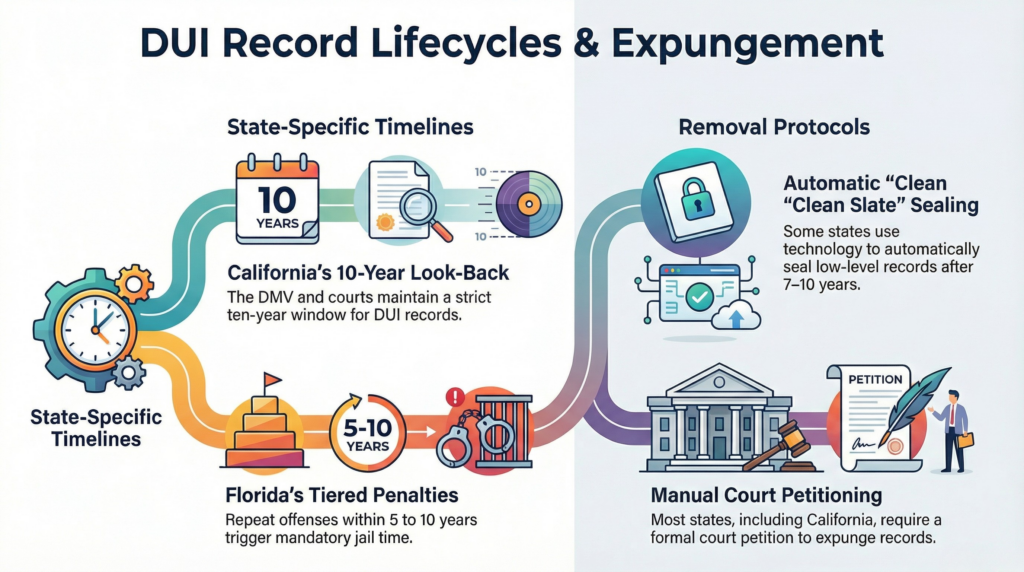
- California: California has a strict 10-year look-back period for both the DMV and the courts.
- Florida: Florida uses a tiered system. A second conviction within 5 years or a third within 10 years triggers mandatory jail time.
- Automatic vs. Petitioned Removal: Some states are passing “Clean Slate” laws. These laws use technology to automatically seal certain low-level records after a period of good behavior (usually 7–10 years). However, in most states—including California—you must still “petition” or ask the court to expunge your record; it does not happen on its own.
How a DUI Affects Your Life (Beyond the Courtroom)
The legal fines are often only the beginning. A DUI on your record affects your daily life in several ways:
- Insurance Rates & SR-22: You will likely be required to file an SR-22 (a certificate of financial responsibility). This marks you as a “high-risk” driver. While the DUI stays on your record for 10 years, the insurance hike usually lasts between 3 and 5 years.
- Employment & Background Checks: * The 7-Year Rule: Under the Fair Credit Reporting Act (FCRA), many third-party background check companies are not supposed to report certain criminal convictions older than seven years for jobs paying under a certain salary. However, this rule has many exceptions.
- Professional Licensing: If you are a nurse, teacher, or lawyer, a DUI must often be reported to your licensing board, which can lead to suspension or probation.
- Housing Options: Private landlords often run criminal background checks. A recent DUI can be seen as a “character issue,” leading to denied rental applications in competitive markets.
The Impact on Commercial Drivers (CDL)
If you drive for a living, a DUI is a career-threatening event. Commercial Driver’s License (CDL) holders are held to a much stricter standard than the general public.
- The 0.04% Rule: While the legal limit for most is 0.08%, for CDL holders, it is 0.04%.
- Lifetime Disqualification: Under federal law, if a commercial driver receives a second DUI—even while driving their personal car on their day off—they face a lifetime ban from operating a commercial vehicle.
- Federal Records: Even if a state court allows you to expunge a DUI, that information may remain in the federal Commercial Driver’s License Information System (CDLIS), making it difficult to find trucking work.
International Travel Restrictions
One of the most surprising “gaps” in people’s knowledge is how a DUI affects travel. Your record doesn’t just stay in your home state; it follows you to the border.
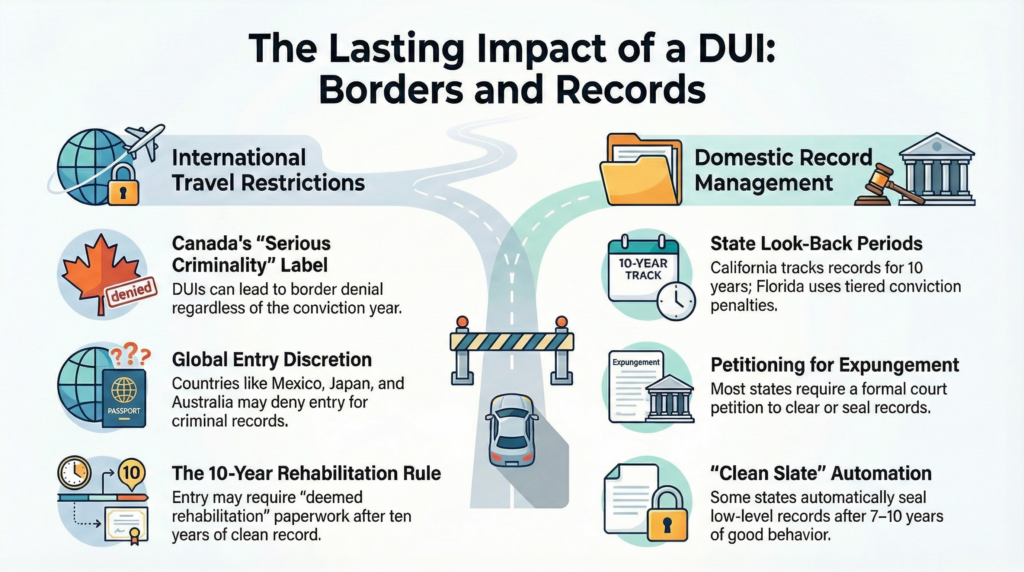
- Canada’s Strict Rules: Canada considers a DUI a “serious criminality.” If you have a DUI on your record from any year, you can be turned away at the border. You may need to apply for “Temporary Resident Quality” or “Criminal Rehabilitation” to enter.
- Other Countries: Countries like Mexico, Japan, and Australia have the right to deny entry to anyone with a criminal record. While they don’t always check for misdemeanors, a felony DUI is a major red flag for customs agents.
- Deemed Rehabilitation: In some cases, if 10 years have passed since you completed your sentence, you may be “deemed rehabilitated” for travel purposes, but this often requires extensive paperwork.
How to Get a DUI Off Your Record
You do not have to live with a permanent shadow over your future. There are several ways to clear or hide a DUI.
- Expungement: In states like California, you can petition the court for an expungement. This reopens your case, sets aside the conviction, and dismisses the charges. On most job applications, you can then truthfully say you were not convicted.
- Sealing Records: Sealing makes the record invisible to the public and most employers, though law enforcement and government agencies can still see it.
- The Cost of Clearing a Record : Many people avoid expungement because they fear the cost. While attorney fees can range from $1,000 to $4,000 depending on the complexity, this is an investment in your future earnings. Clearing a record can be the difference between a minimum-wage job and a high-salaried professional career.
Frequently Asked Questions (People Also Ask)
Does a DUI show up on a background check after 10 years?
It depends on the check. A standard employment check might not see it after 7–10 years, but a “LiveScan” or FBI-level check for government jobs will show it forever unless it is expunged.
Can I join the military with a DUI on my record?
Yes, but you will likely need a “moral character waiver.” Each branch of the military has different rules, and a recent DUI can make enlistment very difficult.
How long does a “Wet Reckless” stay on my record compared to a DUI?
A “Wet Reckless” is often a plea deal that carries lesser penalties, but for DMV purposes and look-back periods, it usually stays on your record for the same amount of time as a standard DUI (10 years in California).
Will a DUI from another state follow me if I move?
Yes. Most states participate in the Driver License Compact (DLC). This means they share data. If your license is suspended in one state, you generally cannot get a new license in another state until that issue is resolved.
Can I get a DUI expunged if I served jail time?
It is more difficult, but possible. Expungement is generally available for those who were granted probation. If you were sentenced to state prison, you may need to seek a Certificate of Rehabilitation or a Governor’s Pardon instead.
Take Control of Your Future with Grace Legal Group
A DUI doesn’t have to define the rest of your life. Whether you are facing new charges or looking to clear an old conviction from your record, you need an advocate who understands the system and believes in second chances.
At Grace Legal Group, we provide compassionate, restorative defense strategies designed to protect your rights and your reputation. We don’t just fight for “not guilty”—we fight for your future.
Contact Grace Legal Group today for a free consultation. Let’s start the process of clearing your name.