
California law requires certain DUI offenders to install an ignition interlock device (IID) on every vehicle they operate before they can legally drive again. An IID is a breathalyzer wired directly into a vehicle’s ignition system. The driver must provide a clean breath sample to start the car, and the device demands periodic rolling retests while driving. Under Vehicle Code 23575.3, the California Department of Motor Vehicles (DMV) records the mandatory IID term after receiving the court’s conviction abstract, and the device must remain certified and functioning for the entire required period.
Here is what triggers an IID mandate and what the requirement actually means:
- Mandatory installation applies to DUI convictions under Vehicle Code 23152 and 23153, with term length scaling by offense count and severity.
- Court and DMV both play a role: the court orders the IID restriction; the DMV records it and enforces it on your driving record.
- The IID restriction is vehicle-specific: you may only drive vehicles equipped with a certified, functioning device.
- A valid driver’s license is still required. Installing an IID does not authorize you to drive if your license is suspended or revoked.
- Tampering or bypassing the device is a criminal offense, not just a program violation.
- Refusal to install within the required timeframe is a misdemeanor under Vehicle Code 23247, punishable by up to six months in county jail, a fine up to $5,000, or both.
- Governing statutes: Vehicle Code sections 23575, 23575.3, 23247, and 23578 set the core IID framework in California.
Table of Contents
- What does California’s ignition interlock program actually require?
- What happens after a DUI conviction in California?
- How does the IID installation and maintenance process work?
- What does an IID cost in California, and can you get help paying for it?
- How Gracelegalgroup supports clients facing IID and DUI charges
- Key Takeaways
What does California’s ignition interlock program actually require?
The IID program in California is jointly administered by the courts and the DMV. When a judge enters a DUI conviction, the court notifies the DMV, which then places the IID restriction on the driver’s record. From that point, the driver cannot legally operate any motor vehicle in California unless it is equipped with a certified ignition interlock device.
Which offenses trigger a mandatory IID?
The program covers a range of DUI convictions, and the required installation term grows with each prior offense:
- First-offense DUI (no injury): The court may order an IID for a term determined by the court. Heightened consideration applies when the driver’s blood alcohol content (BAC) was high at arrest, when multiple prior moving violations exist, or when the driver refused chemical testing.
- First-offense DUI with injury (VC 23153): Mandatory IID, with the term set by the court.
- Second DUI conviction: Mandatory IID for a court-determined term.
- Third and subsequent convictions: Mandatory IID, with longer terms reflecting the repeat offense history.
- Driving on a DUI-suspended license (VC 14601.2): Court must order IID installation for up to three years.
Program rules every participant must follow:
- Arrange IID installation on every vehicle you operate, not just the one you drive most often.
- Service and recalibrate the device every 60 days at a certified provider.
- Never tamper with, remove, or attempt to bypass the device.
- Never ask another person to provide a breath sample on your behalf.
- Report any device malfunction to your installer promptly.
Out-of-state residents face the same restriction while driving in California. An out-of-state resident who qualifies for an IID-restricted license must have a functioning device on any vehicle operated within the state. Vehicles they own but never drive in California are exempt from the installation requirement.
What happens after a DUI conviction in California?
Two separate legal tracks start running the moment you are arrested for DUI, and confusing them is one of the most costly mistakes drivers make.
The administrative track (DMV) begins immediately at arrest. You receive a 30-day temporary driving privilege, but you must request a DMV hearing within 10 days of arrest. Miss that window and the DMV automatically suspends your license when the 30-day period expires. This suspension is entirely separate from any criminal court outcome.
The criminal track (court) determines guilt, sentencing, and whether the court orders an IID. A conviction triggers the DMV to record the IID restriction and update your driving record accordingly.
IID mandatory periods by conviction count
| Conviction | Mandatory IID term |
|---|---|
| First offense, no injury | court-determined term |
| First offense with injury | Court-determined mandatory term |
| Second conviction | Court-determined mandatory term |
| Third or subsequent conviction | Court-determined mandatory term (longer) |
| Driving on DUI-suspended license | court-determined term |
Key figure: Under Vehicle Code 23247, willfully failing to install a court-ordered IID is a misdemeanor carrying up to six months in county jail and fines up to $5,000.
Breath test refusal adds its own penalties. California’s implied consent law under Vehicle Code 23612 requires any driver arrested for DUI to submit to chemical testing. Refusing that test triggers an automatic administrative license suspension and becomes evidence against you in court. DUI refusal penalties are distinct from the DUI charge itself and stack on top of any criminal sentence.
Post-conviction steps to keep in mind:
- Request your DMV hearing within 10 days of arrest to preserve your right to contest the administrative suspension.
- Enroll in a court-approved DUI program as required for license reinstatement.
- Obtain SR-22 insurance and provide proof to the DMV.
- Arrange IID installation and submit proof of installation (form DL 920) to the DMV.
- Pay applicable DMV reissue and restriction fees.
- Maintain the IID for the full mandatory term; any period of noncompliance does not count toward that term.
One more thing worth knowing: the IID restriction does not restore a suspended license. You need a valid license to drive, period. The device only governs how you may drive once your license is reinstated or restricted.
How does the IID installation and maintenance process work?
Getting the device installed is straightforward, but the ongoing compliance requirements are where many drivers slip up.

Installation
You must use a DMV-certified provider. The installer mounts the device to your vehicle’s ignition system following DMV standards and manufacturer specifications. After installation, the provider gives you form DL 920, which you submit to the DMV and, if court-ordered, to the court. The court has its own monitoring forms and procedures to track compliance.
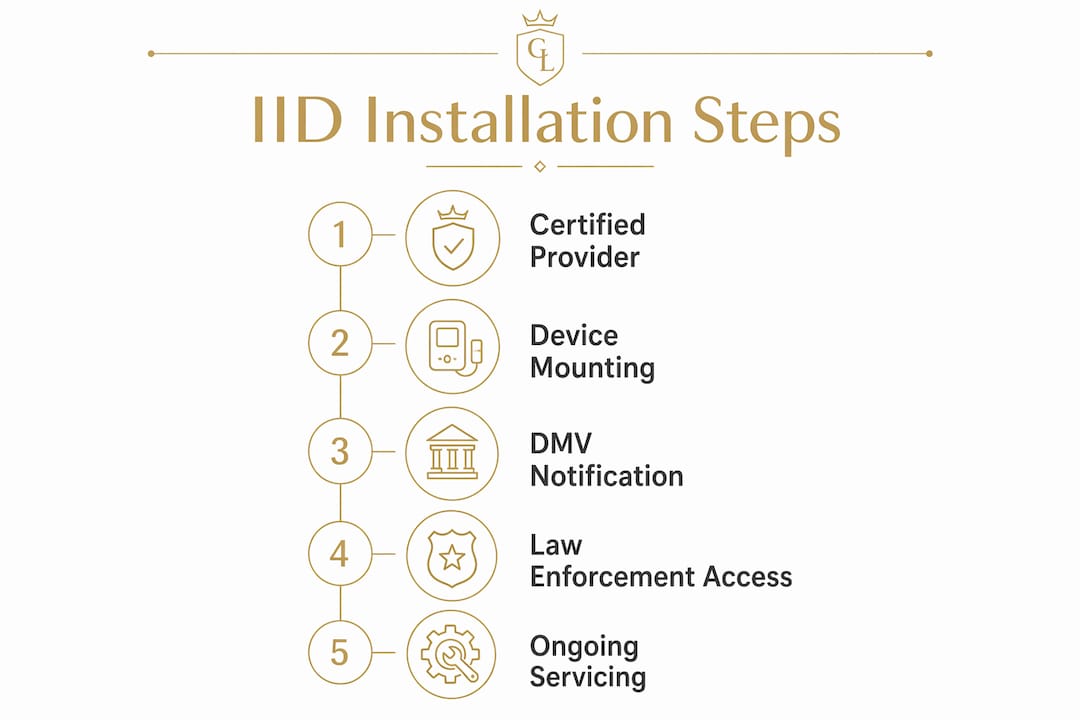
Once the DMV is notified, the IID restriction appears on your driving record. Law enforcement officers can see it if you are stopped.
Ongoing servicing
The IID must be serviced and recalibrated every 60 days. At each service visit, the provider downloads usage data from the device, checks for tampering, recalibrates the sensors, and submits a compliance report to the DMV and the court. This is not optional maintenance. Any period during which the device is out of compliance does not count toward your mandatory IID term, which means your clock stops until you get back into compliance.
What the data captures
The device logs every breath test, every failed attempt, every rolling retest, and any attempt to tamper with or circumvent the system. Courts and the DMV review this data. A pattern of failed tests or missed service appointments can trigger additional penalties or extend your restriction period.
Prohibited actions:
- Tampering with, removing, or disabling the device.
- Asking another person to blow into the device for you.
- Operating a vehicle without a functioning IID when your restriction requires one.
- Driving a vehicle that is not equipped with a certified device during your restriction period.
Pro Tip: Ask your installer about income-based cost assistance at the time of installation. By law, certified installers must inform eligible consumers about fee reduction programs. If you qualify, you can reduce your monthly costs significantly before you sign any service agreement.
Removing the device
Once you have completed the full mandatory IID term and met all other reinstatement requirements, contact your installer to schedule removal. The installer submits a removal report to the DMV. Keep documentation of the removal for your records, and confirm with the DMV that the restriction has been lifted from your driving record before you drive without the device.
What does an IID cost in California, and can you get help paying for it?
The IID is not a one-time expense. Drivers typically pay an installation fee plus a monthly rental and monitoring fee for the duration of the restriction. Exact pricing varies by provider and vehicle type, but the ongoing monthly cost is the larger burden for most people, especially those facing multi-year restriction terms.
The 2026 income-based cost reduction program
Starting in March 2026, California consumers who meet income eligibility criteria can qualify for up to a 90% reduction in IID program costs. The program is administered through the Bureau of Automotive Repair (BAR) and applies to both installation and monthly service fees.
Eligibility is based on two criteria:
- Federal Poverty Level (FPL): Consumers at or below 400% of the FPL may qualify for cost reductions, with the percentage of reduction scaling based on income band.
- CalFresh benefits: Active CalFresh recipients automatically qualify for the maximum cost reduction tier.
The reduction tiers work as follows, with lower-income participants paying a smaller share of total program costs, down to as little as 10% of the standard fee at the lowest income band.
Documentation required to apply for cost assistance:
- Most recent federal tax return or W-2 forms.
- Recent pay stubs (typically the last two to three months).
- CalFresh benefit verification letter, if applicable.
- Any other documentation the installer or BAR requires to verify household income.
A legal requirement, not a courtesy
Automotive repair dealers certified to install IIDs are required by law to inform program participants about fee reduction assistance when the consumer appears to be income-eligible. If your installer did not mention this program, ask directly. The cost savings can be substantial over a multi-year restriction term.
Key cost facts at a glance:
- Installation and monthly rental fees apply for the full mandatory IID term.
- Income-eligible consumers may pay as little as 10% of standard program costs.
- The 400% FPL threshold and CalFresh enrollment are the two primary eligibility pathways.
- Installers must provide income verification documentation and inform eligible consumers of the program.
- Cost assistance does not reduce the mandatory IID term; it only reduces what you pay.
How Gracelegalgroup supports clients facing IID and DUI charges
Navigating California’s IID requirements is not just a paperwork problem; for comprehensive legal guidance and case insights, visit the CarCollisionLawyer Blog. The decisions made in the first 10 days after a DUI arrest, and the quality of legal representation at every stage, directly affect how long you carry an IID restriction, whether your license gets suspended, and what your driving record looks like for years afterward.
Gracelegalgroup is a Los Angeles-based criminal defense firm with a team that includes former law enforcement professionals. That background matters in DUI cases because the attorneys understand exactly how officers document arrests, how BAC evidence is gathered, and where procedural gaps can be challenged. Every client gets two dedicated attorneys on their case, not a single overloaded lawyer passing files to a paralegal.
The mitigation packet is often the difference between a conviction that carries a mandatory multi-year IID term and one that does not. Gracelegalgroup prepares detailed mitigation packets that present the client’s full story to prosecutors and judges, addressing aggravating factors before they harden into sentencing decisions. Under Vehicle Code 23578, factors like high BAC, injuries, or the presence of minors escalate penalties significantly. Getting ahead of those factors with documented context can shift outcomes.
The firm’s DUI defense approach covers both the criminal court process and the parallel DMV administrative track. Missing the 10-day hearing request window is one of the most common and most preventable mistakes drivers make after a DUI arrest. Gracelegalgroup handles that request immediately and represents clients at DMV hearings to contest automatic license suspension.
For clients already under an IID order, the firm provides guidance on compliance requirements, the 2026 cost reduction program, and options for challenging or modifying restriction terms where the law permits.
Legal services relevant to IID and DUI cases:
- DMV hearing representation to contest administrative license suspension.
- Criminal DUI defense for first-time and repeat offenses, including felony DUI with injury.
- Mitigation packet preparation to address aggravating factors before sentencing.
- Guidance on IID compliance, service requirements, and the 2026 fee reduction program.
- Defense against IID tampering or failure-to-install charges.
- License reinstatement strategy following DUI suspension.
The firm stays current on the latest IID program rules, including the March 2026 cost reduction provisions, so clients are not navigating those changes alone. If you are facing a DUI charge or an IID order in California, getting legal counsel involved early, before the 10-day DMV deadline, is the single most protective step you can take. You can also explore what defenses are available in criminal cases to understand your options from the start.

Key Takeaways
California’s ignition interlock program requires certified IID installation on every vehicle a DUI offender operates, with mandatory terms, 60-day service intervals, and income-based cost reductions of up to 90% available starting March 2026.
| Point | Details |
|---|---|
| IID is vehicle-specific | You must install a certified device on every vehicle you operate, not just one. |
| 10-day DMV hearing deadline | Request a DMV hearing within 10 days of arrest or face automatic license suspension. |
| 60-day service requirement | The IID must be recalibrated every 60 days; noncompliance periods do not count toward your mandatory term. |
| Up to 90% cost reduction available | Income-eligible consumers at or below 400% FPL or on CalFresh may qualify for up to 90% reduction in IID program costs starting March 2026. |
| Failure to install is a misdemeanor | Willfully skipping a court-ordered IID can mean up to six months in jail and fines up to $5,000. |