
Determining if it is illegal to brandish a gun depends on the context of the situation, but in California, even showing a weapon in a threatening way can lead to serious criminal charges. Under California Penal Code 417, the act of “brandishing” is a high-stakes legal issue that requires an immediate and strategic defense. If you find yourself facing these allegations, Grace Legal Group Inc. provides the experienced advocacy needed to protect your future.
What is the Legal Definition of Brandishing (PC 417)?
In plain English, brandishing means showing or drawing a weapon in a way that is rude, angry, or threatening. You do not have to point the gun at someone or fire it to be charged with this crime.
The Three Legal Elements the Prosecution Must Prove
To get a conviction for brandishing under PC 417, the prosecutor must prove three specific things:
- You drew or exhibited a deadly weapon or firearm in the presence of another person.
- You did so in a rude, angry, or threatening manner.
- You did not act in lawful self-defense or the defense of another person.
What Qualifies as “Rude, Angry, or Threatening” Behavior?
The law does not provide a specific list of behaviors, which makes this a “gray area.” Generally, if a reasonable person would feel intimidated or threatened by how you handled the weapon, it qualifies. This could include slamming a gun onto a table during an argument or lifting your shirt to show a firearm tucked into your waistband while shouting.
Does the Gun Have to Be Loaded or Functional?
Surprisingly, no. Under California law, a firearm does not need to be loaded for a brandishing charge to stick. It also doesn’t necessarily have to be functional. As long as the object looks like a lethal weapon and is displayed in a threatening way, you can face the same legal consequences.
Does the Other Person Need to See the Weapon?
One of the biggest misconceptions is that the “victim” must see the gun. In reality, the law only requires that the weapon be drawn “in the presence” of another person. If you pull a gun behind someone’s back in a threatening manner, or if they are aware you have drawn it even if they didn’t look directly at the barrel, a prosecutor may still file charges. The focus is on your intent and the act of displaying the weapon, not just the visual confirmation by the other party.
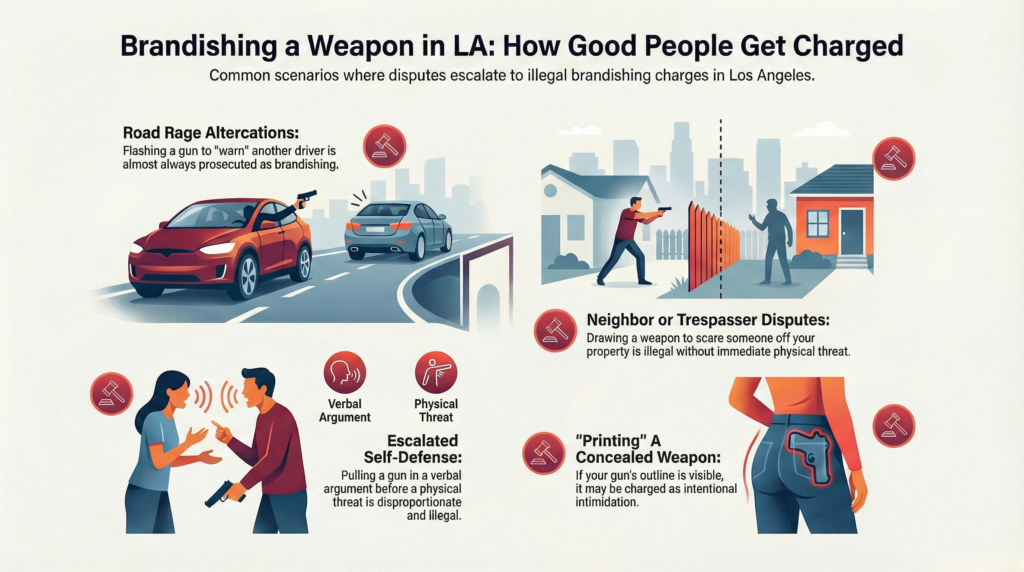
Common Scenarios That Lead to Brandishing Charges in Los Angeles
Los Angeles is a high-density environment where tempers can flare quickly. Most brandishing charges don’t come from hardened criminals, but from Justice Firearm Laws citizens who make a split-second mistake during a moment of stress.
Road Rage and Traffic Altercations
This is perhaps the most common scenario for PC 417 charges. Following a cut-off or a near-accident, a driver might flash a handgun to “warn” the other driver to back off. In the eyes of the law, this is rarely seen as self-defense and is almost always prosecuted as brandishing.
Disputes with Neighbors or Trespassers
Arguments over property lines, noise, or unwanted visitors often escalate. While you have the right to protect your home, simply drawing a weapon to scare someone off your lawn can be considered brandishing if there was no immediate physical threat to your safety.
“Printing” vs. Brandishing: When Concealed Carry Becomes a Crime
For those with a Concealed Carry Weapon (CCW) permit, “printing” is a major concern. Printing occurs when the outline of a gun is visible through clothing. While printing itself is generally not a crime, it can lead to a brandishing charge if someone notices the weapon and claims you intentionally displayed it to intimidate them. Distinguishing between an accidental reveal (printing) and an intentional threat (brandishing) is a critical part of a legal defense.
Self-Defense Situations That Escalate Too Far
You have the right to defend yourself, but that right has limits. If a verbal argument turns heated and you pull a gun before the other person has shown any signs of physical violence, the court may rule that your use of the firearm was “disproportionate” to the threat, leading to a brandishing arrest.
Penalties and Long-Term Consequences of a Conviction
A conviction for brandishing is not just a “slap on the wrist.” It carries penalties that can alter the course of your life, your career, and your civil liberties.
Misdemeanor vs. Felony: When Brandishing Becomes a “Wobbler”
Most brandishing charges are misdemeanors, carrying a minimum of 30 to 90 days in county jail. However, if the incident happened on the grounds of a day care center or involved a peace officer, it becomes a “wobbler.” This means the prosecutor can choose to charge it as a felony, which carries much stiffer prison sentences.
Mandatory Minimum Jail Time and Fines
California is strict regarding firearm offenses. Even a standard misdemeanor brandishing conviction often carries a mandatory minimum jail sentence. Additionally, court fines and victim restitution can cost thousands of dollars.
Aggravating Factors: Brandishing at Peace Officers or in Daycares
If a firearm is brandished in the presence of a police officer performing their duties, the penalties escalate significantly. Felony convictions in these cases can lead to years in state prison.
Lifetime Loss of Firearm Rights and CCW Revocation
Beyond jail time, a brandishing conviction often triggers a 10-year or lifetime ban on owning or possessing firearms in California. If you currently hold a CCW permit, it will be revoked immediately upon conviction. For many, the loss of the right to protect their family is the most devastating consequence of all.

Beyond the Charge: How Grace Legal Group Inc. Protects Your Future
At Grace Legal Group Inc., the team understands that you are a person, not just a case number. They go beyond standard legal tactics to provide a comprehensive defense.
The GLG Mitigation Packet: Telling Your Side of the Story
The prosecution usually only sees the police report, which is often one-sided. Grace Legal Group Inc. creates a “Mitigation Packet” for their clients. This is a professional portfolio that includes character letters, proof of community involvement, and a personal narrative. By humanizing you to the prosecutor before the trial begins, they can often secure a reduction or dismissal of charges.
Faith-Based Representation: Why Character and Redemption Matter
Grace Legal Group Inc. operates on the principle that everyone deserves a second chance. Their faith-based approach means they advocate for your redemption and focus on the “grace” in the legal process. They look at the whole person, ensuring that your character is a central part of the defense strategy.
Investigation by Former Law Enforcement: Finding Flaws in Police Reports
Police officers are human and make mistakes. Grace Legal Group Inc. utilizes investigators who are former law enforcement. These experts know exactly how to spot “holes” in a police report, identify biased witness statements, and find surveillance footage that the police may have missed.
Related Offenses Often Charged Alongside Brandishing
It is rare to be charged only with brandishing. Usually, prosecutors “stack” charges to increase their leverage during plea negotiations.
- Assault with a Deadly Weapon (PC 245): If the prosecutor believes you attempted to use the gun to commit a violent injury.
- Criminal Threats (PC 422): If you accompanied the display of the gun with a verbal threat to kill or seriously injure the person.
- Disorderly Conduct: Often used as a lesser charge in plea deals.
Legal Defenses: How to Fight a Brandishing Charge
Just because you were arrested does not mean you are guilty. There are several Lawful Self-Defense available.
Lawful Self-Defense and Defense of Others
If you drew your weapon because you reasonably believed you or someone else was in imminent danger of being killed or seriously injured, you have a valid legal defense.
Lack of Intent: Accidental Exposure vs. Intentional Display
If your shirt caught on your holster or the gun fell out of your pocket, you did not “exhibit” the weapon in a rude or angry manner. Lack of intent is a strong defense. Grace Legal Group Inc. works to prove that the exposure was accidental rather than a deliberate threat.
The “Imminent Fear” Requirement: Was Your Reaction Proportional?
To claim self-defense, your fear must be “reasonable.” If someone is yelling at you from 50 feet away and you pull a gun, the court may say your fear wasn’t “imminent.” However, if they were charging at you with a blunt object, drawing your firearm may be seen as a proportional response.
Challenging the Witness Testimony: When Allegations are Fabricated
In many brandishing cases, there is no physical evidence—just one person’s word against another. People lie or exaggerate during arguments. Our team cross-examines witnesses to find inconsistencies in their stories, often proving that the “victim” had a motive to fabricate the incident.
Take Action: Secure Your Second Chance
A brandishing charge is a fork in the road. One path leads to a permanent criminal record and the loss of your rights; the other leads to a strategic defense and the possibility of a clean slate.
Why You Need a Local Los Angeles Gun Crimes Lawyer
The court systems in Los Angeles and the surrounding areas have specific local rules and personality quirks. You need an attorney who knows the local prosecutors and judges. Grace Legal Group Inc. has the local presence and the reputation necessary to navigate these complex waters.
How Flexible Payment Plans Can Help You Start Your Defense Today
Legal emergencies are rarely planned. Many people hesitate to hire a top-tier lawyer because of the cost. Grace Legal Group Inc. offers flexible payment plans to ensure that financial stress doesn’t stand in the way of a high-quality defense. They believe everyone should have access to the best legal representation regardless of their current bank balance.
People Also Ask (FAQ)
1. Can I be charged with brandishing if the gun was a toy or a replica? Yes. If the replica is displayed in a threatening manner and looks like a real firearm to a reasonable person, you can be charged under California law.
2. Is brandishing a “strike” under California’s Three Strikes Law? A standard misdemeanor brandishing charge is not a strike. However, if it is charged as a felony (such as brandishing at a police officer), it could potentially count as a strike depending on the specific circumstances.
3. What happens if I brandish a gun on my own property? You can still be charged. While you have more leeway to possess a weapon in your home, “exhibiting” it in a rude or threatening manner toward someone else—even a trespasser—can still result in a PC 417 charge if the threat was not legally justified.
4. Will I lose my CCW permit if I am only charged, not convicted? In many jurisdictions, the issuing agency (like the Sheriff’s Department) may suspend your CCW permit immediately upon an arrest for a firearm-related crime pending the outcome of the case.
5. Can a brandishing charge be reduced to a lesser offense? Yes. Through the use of a “Mitigation Packet” and aggressive negotiation, Grace Legal Group Inc. often works to get brandishing charges reduced to “Disturbing the Peace” or other non-firearm-related misdemeanors.
6. Does brandishing apply to knives too? Yes. California Penal Code 417 applies to “deadly weapons,” which includes knives, swords, and even other blunt objects if they are used in a threatening way.
Contact Grace Legal Group Inc. Today
If you or a loved one are facing charges for brandishing a firearm, don’t wait for the prosecution to build their case. You deserve an advocate who believes in second chances and has the professional experience to fight for your rights.
Call Grace Legal Group Inc. at 818-697-8664 or visit gracelegalgroup.com to schedule your 100% free consultation. With Grace, there is always a second chance.