
Vandalism is often viewed as a minor prank, but under the law, it can quickly escalate into a life-altering felony conviction. Whether a charge remains a misdemeanor or becomes a felony usually depends on the dollar amount of the damage and the type of property involved. If you or a loved one are facing these accusations, Grace Legal Group can provide the aggressive defense needed to protect your future.
What is Vandalism?
In legal terms, vandalism is often referred to as “malicious mischief.” It occurs when someone intentionally defaces, damages, or destroys property that does not belong to them.
- Defining Malicious Mischief: The core of the crime is the “malicious” intent. This means the act was done on purpose to annoy or injure the owner, rather than by accident.
- Real vs. Personal Property: Vandalism covers both “real property” (buildings, land, or anything permanently attached to them) and “personal property” (cars, electronics, or clothing).
- The Element of Intent: If you accidentally trip and break a store window, it is a civil matter, not a crime. To be convicted of vandalism, the prosecution must prove you intended to cause the damage.
- Common Examples: This includes everything from traditional graffiti and “keying” a car to more modern examples like etching a name into a computer screen or intentionally flooding a rented apartment.
Misdemeanor vs. Felony Vandalism: The “Wobbler” Rule
In many states, including California, vandalism is considered a “wobbler.” This means the prosecutor has the discretion to charge it as either a misdemeanor or a felony based on the facts of the case.
- The Monetary Threshold: The primary factor is the cost of the damage. For example, in California, if the damage is valued at $400 or more, the charge can “wobble” up to a felony.
- The Prosecutor’s Choice: Prosecutors look at the severity of the act and your criminal history. If you have a clean record, your attorney at Grace Legal Group may be able to negotiate a felony charge down to a misdemeanor.
- Aggregate Damage: One common question is whether multiple small acts can lead to a felony. If a person vandalizes three different cars in one night, prosecutors often “aggregate” or add those costs together. If the total repair bill exceeds the felony threshold (like $400), the individual can face a single felony charge instead of three separate misdemeanors.
Factors That Elevate Vandalism to a Felony
While the dollar amount is the most common factor, other circumstances can trigger a felony charge regardless of the cost:
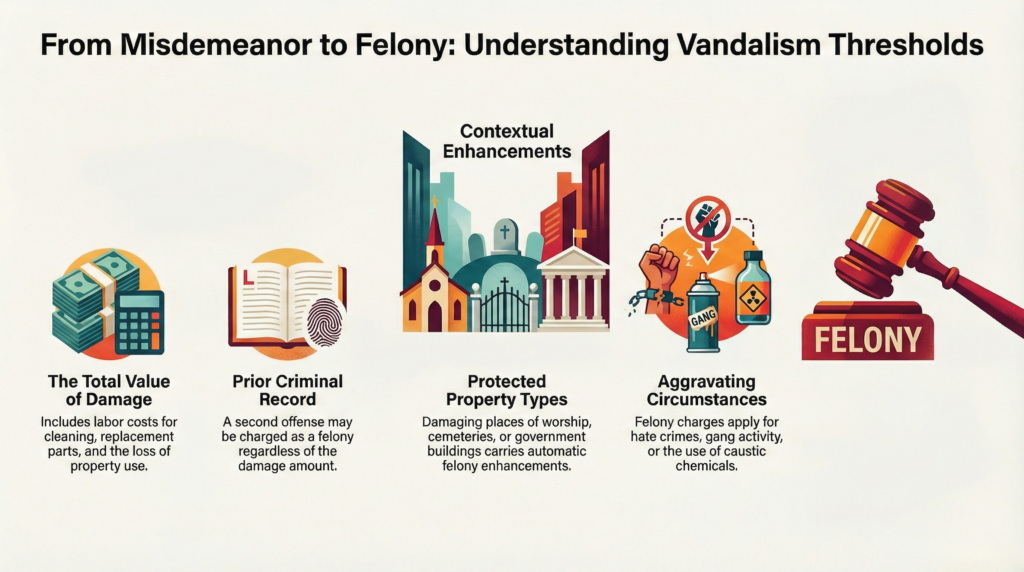
- The Value of Damage: This includes the cost of labor to clean graffiti, the price of replacement parts, and the loss of use of the property.
- The Type of Property: Damaging a place of worship (church, synagogue, mosque), a cemetery, or a government building often carries automatic felony enhancements.
- Prior Criminal Record: If you have been convicted of vandalism in the past, a second offense—even for a small amount of damage—is much more likely to be charged as a felony.
- Aggravating Circumstances: Using caustic chemicals or committing the act as part of a hate crime or gang activity can lead to severe sentencing enhancements.
State-by-State Felony Thresholds
The definition of a “felony” varies wildly depending on where the crime occurred. What is a misdemeanor in one state might be a prison-eligible felony just across the border.
| State | Felony Threshold Amount |
| California | $400 |
| Florida | $1,000 |
| Texas | $2,500 |
| New York | $250 (For 3rd Degree) |
| Pennsylvania | $5,000 (Or any amount if intent is to disrupt public service) |
Because these laws are so specific, it is vital to work with a local firm like Grace Legal Group that understands the nuances of your specific jurisdiction.
Potential Penalties for Felony Vandalism
The consequences of a felony conviction are far more than just a “slap on the wrist.” They can include:
- Prison and Jail Time: A felony vandalism conviction can result in a sentence of 16 months, 2 years, or 3 years in state prison.
- Hefty Fines: Fines can reach up to $10,000, and if the damage was extensive (over $10,000), the fine could grow to $50,000.
- Formal Probation: Unlike “summary” probation for misdemeanors, felony probation involves a probation officer, regular check-ins, and strict travel restrictions.
- The “Strike” System: In states with “Three Strikes” laws, certain types of felony vandalism (especially those involving gangs or hate crimes) can count as a strike, leading to much longer sentences for any future crimes.
Beyond Jail: The Long-Term Consequences
Even after you finish your sentence, a felony stays with you.
- Mandatory Restitution: You will be ordered to pay the victim back in full. This isn’t just a fine to the court; it is a debt you owe the owner that can follow you until it is paid off.
- Driver’s License Suspension: In many cases, the court can suspend your license for up to two years. If you don’t have a license yet, your ability to get one can be delayed.
- Clean-up Orders: You may be required to personally clean or repair the damage you caused, or spend hundreds of hours in a graffiti abatement program.
- Civil Lawsuits: A criminal conviction makes it much easier for the victim to win a civil lawsuit against you for additional “pain and suffering” or punitive damages.
Vandalism and Juvenile Offenders
Vandalism is one of the most common charges for minors. While the juvenile system focuses more on rehabilitation than punishment, the stakes are still high.
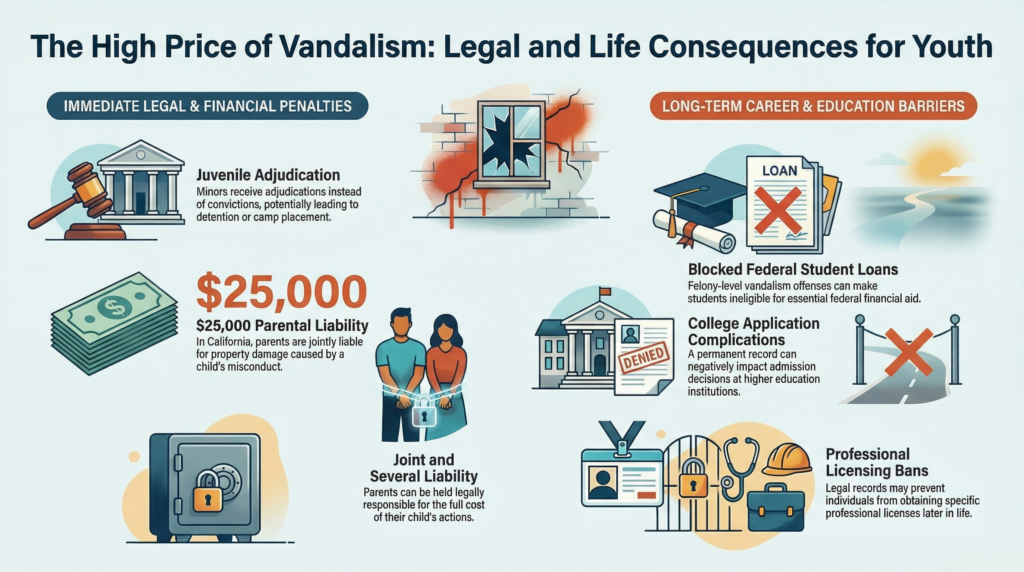
- Juvenile Adjudication: Instead of a “conviction,” a minor receives an “adjudication.” However, this can still result in time at a juvenile camp or detention center.
- Parental Liability: Parents can be held “jointly and severally” liable for their child’s actions. In California, for example, parents can be sued for up to $25,000 for property damage caused by their child’s willful misconduct.
- Future Education: A felony-level offense on a record can complicate college applications and make a student ineligible for certain federal student loans or professional licenses later in life.
Common Legal Defenses for Vandalism Charges
An arrest is not the same thing as a conviction. There are several ways to fight these charges:
- Lack of Malice: If the damage was truly an accident, it does not meet the legal definition of vandalism.
- Claim of Right: If you honestly believed the property was yours (perhaps during a domestic dispute), you cannot be convicted of vandalizing your own property.
- Mistaken Identity: Many vandalism cases rely on blurry security footage or unreliable witnesses.
- Disputing the Valuation: This is a critical defense. Owners often provide “replacement” values for old items or inflated repair quotes. Grace Legal Group can hire independent appraisers to prove the damage is actually below the $400 threshold, potentially getting a felony dropped to a misdemeanor.
Next Steps: Protecting Your Future
A felony vandalism charge can prevent you from getting a job, renting an apartment, or owning a firearm. It is a serious mark on your permanent record that requires a serious defense.
The team at Grace Legal Group specializes in de-escalating these situations. Whether it’s negotiating with prosecutors to reduce charges or proving your innocence in court, we are here to support you.
FAQ: People Also Ask
Can I go to prison for a first-time vandalism charge?
Yes. If the damage is high enough or involves a “protected” property like a church, even a first-time offender can face prison time if charged as a felony.
Is “keying” a car a felony?
It depends on the repair cost. Modern automotive paint is expensive; a deep scratch across multiple panels can easily cost over $1,000 to fix, which is well above the felony threshold in most states.
What happens if I can’t pay the restitution?
Restitution is a court order. Failing to pay can result in a probation violation, which might lead to jail time. However, an attorney can sometimes help set up a manageable payment plan.
Can a vandalism conviction be expunged? A
In many cases, yes. If you successfully complete your probation and pay all your fines/restitution, you may be eligible to have the conviction dismissed from your record later.
If I was with a group but didn’t do the spray painting, can I still be charged?
Yes. Under “aiding and abetting” laws, you can be charged with the same crime as the person who held the spray can if you encouraged or assisted the act.
Contact Grace Legal Group Today
Don’t let one mistake define the rest of your life. If you are facing vandalism charges, you need an advocate who knows how to navigate the system and fight for a reduction or dismissal.
Contact Grace Legal Group today or visit Grace Legal Group for a confidential consultation.