
Los Angeles Superior Court’s Mental Health Division runs the only centralized Mental Health Courthouse in California, and likely the only one of its kind in the country. It handles everything from Lanterman-Petris-Short (LPS) conservatorships and competency hearings to CARE Court petitions and criminal diversion under Penal Code 1001.36. If you or someone you care about may qualify, here are your immediate next steps:
- Contact the Court Linkage Program (CLP) through the Los Angeles County Department of Mental Health (LACDMH). Clinicians are stationed at courts countywide and can assess needs and connect people to services on-site.
- Retain or consult a criminal defense attorney who knows the LA Mental Health Division before any hearing date.
- Gather all medical and psychiatric records now. A strong clinical history is the foundation of any diversion petition or mitigation packet.
- Call 211 LA for immediate local mental health resource referrals, housing leads, and program navigation.
Gracelegalgroup is a Los Angeles-based criminal defense firm that handles mental health diversion cases and can help you build the clinical record and petition your case needs from day one.
Table of Contents
- What cases does the LA Mental Health Court handle?
- How does the Mental Health Court operate day to day?
- Who is eligible and how does a case get referred?
- What forms and services does the court provide?
- Where is the Mental Health Courthouse and who do you call?
- What are the realistic outcomes at Mental Health Court?
- How can a defense attorney help in Mental Health Court?
- Key Takeaways
- What working in this court actually looks like
- Gracelegalgroup can help you navigate Mental Health Court right now
- Authoritative sources and where to find official forms
What cases does the LA Mental Health Court handle?
Los Angeles is unique: its Mental Health Courthouse serves the entire county from a single, centralized facility. No other California county routes all mental health legal matters through one dedicated court. That centralization matters because it concentrates specialized judges, clinical staff, and diversion resources in one place.

The court hears a broad range of case types:
| Case Type | Governing Statute or Program |
|---|---|
| Involuntary detention and conservatorship | Lanterman-Petris-Short (LPS) Act |
| Criminal mental health diversion | Penal Code 1001.36 |
| CARE Court petitions | CARE Act / AB 133 |
| Developmental disability matters | Welfare and Institutions Code |
LPS proceedings are civil, not criminal. They govern involuntary psychiatric holds, conservatorships, and hospital placements when someone poses a danger to themselves or others, or is gravely disabled. Criminal diversion under Penal Code 1001.36 is a separate track: a defendant with a qualifying mental health diagnosis can have their criminal case paused while they complete a supervised treatment program. CARE Court, created by AB 133, adds a civil pathway specifically for people with untreated serious mental illness who are not yet in the criminal system.
How does the Mental Health Court operate day to day?
The court runs on a collaborative, problem-solving model built around treatment engagement rather than punishment alone. The judge, clinical staff, prosecutors, and defense counsel all work from the same goal: connect the person to care and monitor whether it’s working.
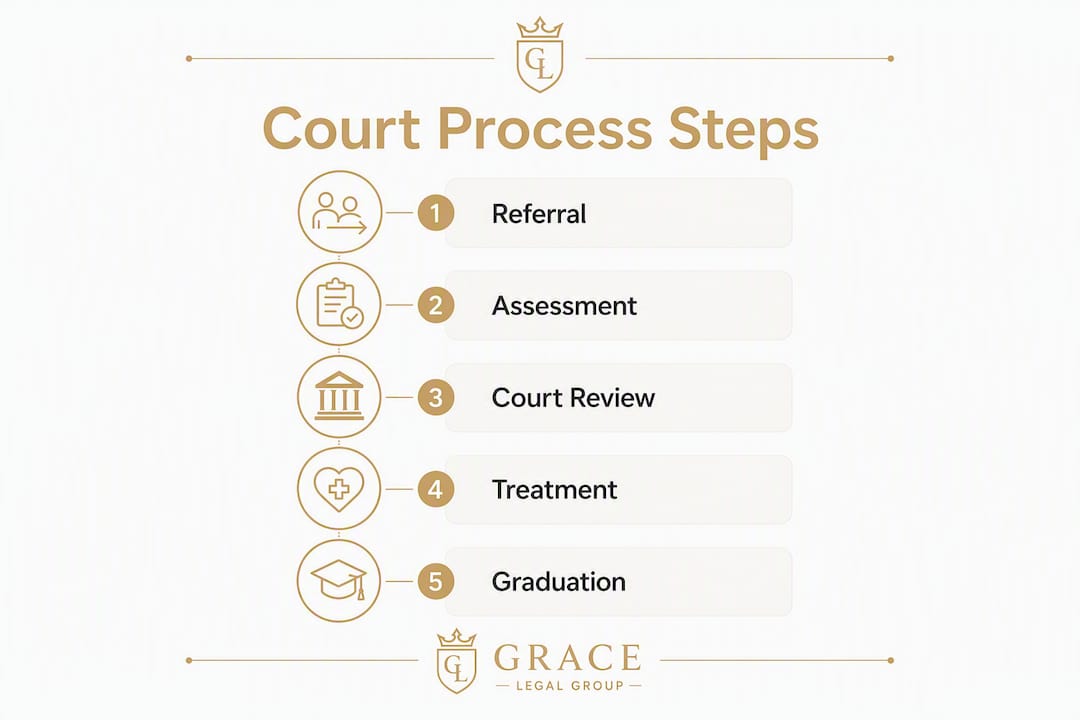
The typical procedural flow looks like this:
- Screening and referral — a defendant is flagged through jail mental health screening, defense counsel, a prosecutor, or a LACDMH court liaison.
- Clinical evaluation — a licensed clinician assesses diagnosis, treatment history, and whether a mental health condition contributed to the alleged conduct.
- Petition and treatment plan — defense counsel files a diversion petition under PC 1001.36 (or the appropriate LPS/CARE Court petition), attaching a proposed treatment plan.
- Court ruling — the judge, after hearing from both sides, grants or denies diversion and sets conditions.
- Status hearings and progress reports — the defendant appears regularly; clinicians and treatment providers submit monthly progress reports.
- Graduation or termination — successful completion leads to dismissal of charges; non-compliance can result in return to regular criminal proceedings.
The Court Linkage Program places clinicians at 22 courts across the county. They conduct on-site assessments, coordinate residential placements, and connect defendants to the Community Reintegration Program (CRP). The Office of Diversion and Reentry (ODR) manages housing and treatment placements at scale. Since 2015, ODR and county diversion services have assisted more than 13,000 people into housing and treatment programs.
Judges play a more active role here than in standard criminal courts. Local reporting on the Hollywood courtroom documents judges who treat defendants as individuals, address substance use as a symptom of underlying mental illness, and prioritize housing alongside treatment. That human element is not incidental. Courts that make defendants feel seen tend to see better engagement.
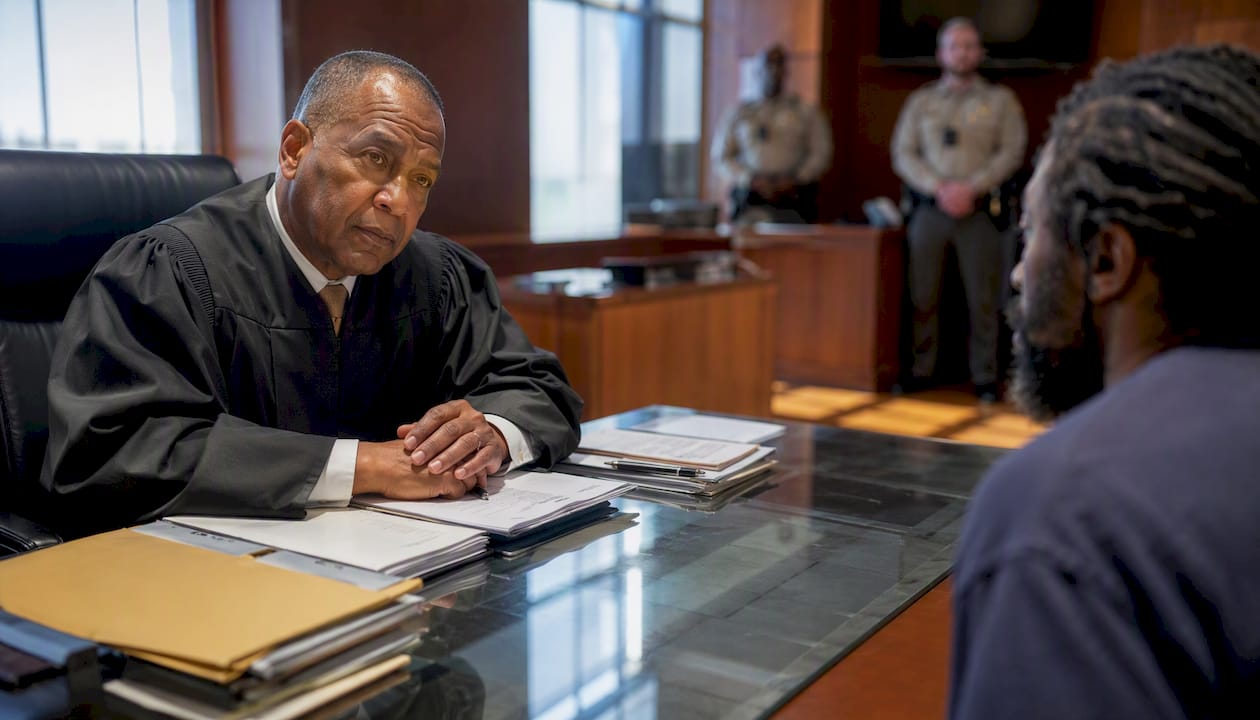
Local reporting puts diversion completion at roughly four out of five participants in the described programs, and graduation ceremonies are held in the courtroom.
Pro Tip: Request a referral to the Court Linkage Program as early as possible after arrest. State court guidance confirms that earlier screening after arrest significantly improves the court’s ability to intervene and maintain continuity of care.
Who is eligible and how does a case get referred?
Entry into mental health diversion typically requires a qualifying diagnosis, a demonstrated connection between that diagnosis and the alleged conduct, and either a judicial referral or a defense motion under Penal Code 1001.36. Involuntary LPS proceedings follow a different path and do not require the person’s consent.
Who can initiate a referral:
- Defense counsel (most common for criminal diversion)
- The prosecutor
- The judge, on their own motion
- Jail mental health screening teams
- LACDMH court liaison staff at the courthouse
For criminal mental health diversion in California, the eligibility checklist under PC 1001.36 includes:
| Eligibility Factor | What the Court Looks For |
|---|---|
| Qualifying diagnosis | A recognized mental disorder (DSM-5) identified by a licensed mental health professional |
| Clinical nexus | The disorder played a significant role in the commission of the charged offense |
| Treatment amenability | The defendant is likely to respond to mental health treatment |
| Public safety | Diversion would not pose an unreasonable risk to public safety |
| Charge eligibility | Most misdemeanors and felonies qualify; certain serious/violent offenses are excluded |
| Consent | Defendant must waive speedy trial rights and agree to treatment conditions |
Competency and LPS matters operate under different standards and do not require the defendant’s agreement in the same way. CARE Court petitions can be filed by family members, first responders, or behavioral health agencies for individuals with untreated serious mental illness.
What forms and services does the court provide?
The paperwork for a mental health diversion case has several required components. While exact forms vary by courtroom and case type, the standard packet under a PC 1001.36 diversion framework typically includes:
- A diversion petition filed by defense counsel
- A proposed treatment plan from a licensed provider, specifying the program, duration, and goals
- Clinical evaluation reports establishing the diagnosis and nexus to the offense
- Monthly progress reports submitted by the treatment provider throughout the diversion period
- A signed diversion agreement from the defendant
Diversion periods can run up to 24 months depending on the program and court order. Monthly progress reporting to the court is standard throughout that period.
To get started on the paperwork and appointments:
- Contact the Court Linkage Program at your assigned courthouse for an on-site assessment and referral to a treatment provider that accepts court placements.
- Request all psychiatric and medical records from current and past providers.
- Ask your attorney to identify a licensed treatment program willing to submit a formal treatment plan to the court.
- Confirm whether your hearing will be in-person or remote, and whether you need an interpreter. The court provides interpreter services; request them in advance.
- File the petition and treatment plan before the next scheduled hearing date, not on the day of.
Remote hearings are available for certain proceedings. For filing questions, the court’s self-help center and online services portal at hrs.courts.ca.gov/la can direct you to the right forms and filing procedures.
Where is the Mental Health Courthouse and who do you call?
The Los Angeles Mental Health Courthouse is located in Hollywood and serves the entire county. It is the central hub for all mental health legal matters in Los Angeles.
| Resource | Contact / Location |
|---|---|
| LA Mental Health Courthouse | Los Angeles Mental Health Courthouse in Hollywood |
| Court Linkage Program (LACDMH) | dmh.lacounty.gov/court-programs/clp |
| 211 LA (resource referral) | Dial 2-1-1 or visit 211la.org |
| Online court services / forms | hrs.courts.ca.gov/la |
| ODR (Office of Diversion and Reentry) | dhs.lacounty.gov/odr |
Call before you visit. Confirm your hearing date, courtroom assignment, and whether an on-site clinician from the Court Linkage Program will be available. If you need an interpreter or have accessibility requirements, note that when you call so staff can arrange it in advance.
What are the realistic outcomes at Mental Health Court?
Outcomes range from full diversion with treatment completion and charge dismissal to LPS conservatorship, competency restoration hospitalization, or return to standard criminal prosecution. Where a case lands depends on the legal findings, the clinical picture, and how well the defendant engages with treatment.
Common scenarios:
Successful diversion and graduation: The defendant completes the treatment plan, submits consistent progress reports, and appears at status hearings. At the end of the diversion period, the court dismisses the charges. Local reporting describes graduation ceremonies held in the courtroom itself.
Partial compliance and continued monitoring: A defendant misses appointments or has a relapse. The court may extend the diversion period, modify the treatment plan, or impose additional conditions rather than immediately terminating diversion. Relapse is common, particularly with methamphetamine, and courts often allow second chances when counsel and the client address the lapse proactively.
Termination from diversion: Repeated non-compliance or a new serious offense can result in the court reinstating the original criminal case. The defendant then proceeds through standard prosecution.
LPS conservatorship or hospitalization: When someone is found gravely disabled or a danger to others, the court can order involuntary placement in a psychiatric facility or establish a conservatorship under the LPS Act.
Competency restoration: A defendant found incompetent to stand trial is typically sent to a state hospital or outpatient program for restoration treatment before criminal proceedings resume.
Diversion programs generally run up to 24 months, with monthly check-ins. Housing placement is often part of the plan, particularly for defendants dealing with homelessness alongside mental illness.
How can a defense attorney help in Mental Health Court?
Experienced counsel increases the likelihood of diversion by doing three things well: assembling the clinical evidence, filing the right petition at the right time, and advocating at every status hearing. The difference between a case that gets diverted and one that doesn’t often comes down to how well the attorney connects the diagnosis to the charged conduct in writing.
Questions to ask any attorney you’re considering:
- How many cases have you handled in the LA Mental Health Division specifically?
- Are you familiar with Penal Code 1001.36 diversion petitions and the court’s current treatment plan requirements?
- Do you work directly with clinicians and ODR to coordinate housing and placement?
- Will two attorneys be assigned to my case, or will I have a single point of contact?
- Can you prepare a mitigation packet that includes a clinical nexus statement?
Understanding how mental health factors into criminal cases is not something every defense attorney prioritizes. In Mental Health Court, it’s the whole case.
Pro Tip: A mitigation packet that explicitly links the clinical diagnosis to the specific conduct charged, includes treatment history, and proposes a concrete housing and treatment placement plan is far more persuasive than a general letter from a therapist. Courts want to see a plan, not just a diagnosis.
Key Takeaways
Los Angeles operates the only centralized Mental Health Courthouse in California, handling LPS conservatorships, competency matters, CARE Court petitions, and criminal diversion under Penal Code 1001.36 from a single countywide facility.
| Point | Details |
|---|---|
| Centralized courthouse | Los Angeles Mental Health Courthouse in Hollywood serves the entire county — no other California county uses this model. |
| Diversion eligibility | Requires a qualifying DSM-5 diagnosis, a clinical nexus to the offense, treatment amenability, and consent under PC 1001.36. |
| Early referral matters | State court guidance confirms earlier screening after arrest improves intervention success and continuity of care. |
| Completion rates | Local reporting puts diversion completion at roughly four out of five participants in described programs. |
| Gracelegalgroup | Gracelegalgroup handles mental health diversion cases in LA, including mitigation packet preparation and two-attorney case assignment. |
What working in this court actually looks like
Mental Health Court is the one place in the criminal system where a judge might ask a defendant how their sleep has been. That’s not a small thing. The collaborative model works precisely because it treats the person as someone capable of getting better, not just someone to be processed.
What gets overlooked in most discussions of this court is how much the outcome depends on preparation before the first hearing. By the time a case reaches a status hearing, the judge has already read the treatment plan, the clinical evaluation, and the progress reports. A defendant whose attorney showed up with a thin file and a vague plan is already behind. The clinical nexus argument, the housing placement, the treatment provider’s credibility — all of that is decided before anyone speaks in the courtroom.
Relapse happens. Courts know it. What courts respond to is whether the defendant and their counsel came back with a revised plan and a renewed commitment, or whether they waited for the court to act first. The difference between a second chance and a termination from diversion is often that one conversation.
Gracelegalgroup can help you navigate Mental Health Court right now
Facing charges when mental health is part of the picture requires more than a standard defense. Gracelegalgroup is a Los Angeles criminal defense firm that builds mental health diversion cases from the ground up: clinical record review, mitigation packet preparation, coordination with treatment providers and ODR, and direct advocacy at every status hearing. Every client gets two attorneys on their case, which matters when you’re managing both a legal strategy and a treatment timeline simultaneously.

If criminal charges are pending and a mental health condition is part of the story, the time to act is before the next court date. Gracelegalgroup handles criminal defense cases across Los Angeles, including cases where diversion or a mental health-based defense may be the strongest path forward. Call for a free consultation or submit an intake request online to get a case review started today.
Authoritative sources and where to find official forms
Use these official pages to verify current forms, filing deadlines, and program phone numbers before you visit or file anything:
- LA Superior Court Mental Health Division — case types, court location, and division overview
- Judicial Branch of California: Mental Health Courts — statewide collaborative justice court framework
- LACDMH Court Linkage Program — clinician contacts, on-site outreach, and CRP referrals
- LA Superior Court online services — forms, remote hearing access, and filing guidance
- Office of Diversion and Reentry (ODR) — housing and treatment placement programs
- Penal Code 1001.36 (California Legislative Information) — full statutory text for mental health diversion eligibility
- CalMatters: LA Mental Health Court reporting — local coverage of court practices and outcomes
This article is general information, not legal advice. Laws and program requirements change; confirm current rules with the court directly or consult a qualified criminal defense attorney before taking any legal action.