
If you are an active-duty service member or veteran facing criminal charges in California, California Penal Code §1001.80 gives you a specific legal pathway to seek pretrial diversion rather than prosecution, provided you can show a service-related condition connected to the charged conduct. The Judicial Council of California administers this program at the superior court level, and it covers misdemeanors and certain felonies.
“A defendant who is a current member or veteran of the United States military and who may be suffering from sexual trauma, traumatic brain injury, post-traumatic stress disorder, substance abuse, or mental health problems as a result of his or her military service is eligible for diversion.” — California Penal Code §1001.80
Your immediate next steps:
- Contact a criminal defense attorney before speaking to law enforcement or the prosecutor again.
- Locate and request your DD214 or current service verification documents.
- Request your VA or military treatment records, especially any mental health evaluations.
- Ask your attorney or the court clerk whether your county has a military diversion referral form.
- Contact Gracelegalgroup for a case review if you need counsel experienced in mitigation-packet preparation.
Table of Contents
- Who qualifies under California’s military diversion program?
- How does the military diversion process actually work?
- What documents and evidence go into a mitigation packet?
- What does participation look like, and how does it compare to Veterans Treatment Court?
- What can go wrong: risks, limits, and collateral consequences
- How an experienced attorney changes the outcome
- What to do right now: your immediate action list
- Key Takeaways
- Why preparation is the real variable in military diversion cases
- Gracelegalgroup can help you pursue military diversion
- Useful sources and county program resources
Who qualifies under California’s military diversion program?
Penal Code §1001.80 sets out two eligibility tracks. Subdivision (b) covers misdemeanor charges. Subdivision © extends eligibility to certain felony charges, though the bar is higher and the court’s discretion is broader. In both tracks, the defendant must be a current or former member of the U.S. military.
The statute lists five qualifying conditions: sexual trauma, traumatic brain injury (TBI), post-traumatic stress disorder (PTSD), substance abuse, and other mental health problems. Each must stem from military service. A diagnosis alone is not enough. The connection between the condition and the charged conduct is what courts and prosecutors actually scrutinize.
Common qualifying conditions and what they look like in practice:
- PTSD: Combat exposure, operational stress, or traumatic incidents during service leading to hypervigilance, aggression, or substance use that contributed to the charged behavior.
- TBI: Head injuries from blast exposure, training accidents, or combat that affect impulse control, judgment, or behavior.
- Military sexual trauma (MST): Sexual assault or harassment during service that resulted in PTSD, depression, or substance use disorder.
- Substance use disorder: Alcohol or drug dependence that developed as a coping mechanism for service-related trauma or injury.
Self-assessment checklist:
- Are you a current service member or honorably/generally discharged veteran? (Discharge characterization matters; consult counsel.)
- Is the charge a misdemeanor, or a felony that does not fall under a statutory exclusion?
- Do you have a documented or diagnosable service-related condition?
- Can a clinician connect that condition to the conduct underlying the charge?
- Are you willing to complete a treatment program and comply with court monitoring?
One critical point: even if an outside agency, a VA benefits examiner, or a veterans’ service organization determines you are eligible, the court’s determination is final. Outside findings are persuasive, not binding. That distinction shapes how you build your case.
How does the military diversion process actually work?
The process moves through six recognizable stages, and knowing where you are in each one helps you prepare the right materials at the right time.
- Referral or request. Either your defense attorney or, in some cases, the prosecutor initiates the diversion request. You cannot simply self-refer at the clerk’s window. The motion is typically filed with the court after arraignment.
- Eligibility screening. The court reviews whether you meet the statutory threshold: military status, nature of the charge, and a preliminary showing of a qualifying condition. Some counties use structured intake forms at this stage.
- Clinical assessment. A licensed clinician evaluates you for service-related conditions. This is not a formality. The assessment must diagnose a qualifying condition, establish its connection to your service, and recommend an appropriate treatment program.
- Mitigation packet submission. Your attorney compiles service records, clinical evaluations, a treatment plan, personal statements, and supporting letters into a packet presented to the prosecutor and the court.
- Prosecutor review and court hearing. The prosecutor may consent or object. The judge then decides whether to grant diversion. If granted, you waive your right to a speedy trial for the diversion period.
- Enrollment, monitoring, and completion. You enter the approved treatment program. The court receives progress reports no less than every six months. The maximum diversion period is two years. Successful completion results in dismissal of the charges.
County-specific procedures matter. San Diego Superior Court uses CRM-284, a mandatory form titled “Request for Military Diversion; Advisal and Waiver of Rights,” which spells out the waiver of speedy trial, the evidence required, and the disclosure cautions. Orange County’s Military Diversion Program page links to an eligibility assessment resources guide and procedural notes. Check your local superior court’s website or ask your attorney for the specific intake form your county uses.
Pro Tip: Request the county’s eligibility assessment resource guide before your first court date. Some counties publish these on their superior court websites, and reviewing them early helps your attorney frame the clinical assessment to match what the local bench expects.
What documents and evidence go into a mitigation packet?
Meeting the technical eligibility standard is necessary but not sufficient. Legal commentary on PC §1001.80 consistently emphasizes that a well-constructed mitigation packet, one that ties a service-related condition directly to the charged conduct, is what separates granted diversions from denied ones. Prosecutors and judges see many of these requests. A thin packet with a generic diagnosis letter rarely moves the needle.
Core mitigation packet items:
- Proof of service: DD214 (Certificate of Release or Discharge from Active Duty), current orders if active-duty, or other official service verification.
- Service treatment records: Military medical records documenting injuries, mental health treatment, or substance use during service.
- VA or DoD clinical evaluation: A formal evaluation diagnosing the qualifying condition and explicitly connecting it to military service.
- Nexus statement: A clinician’s written opinion linking the diagnosed condition to the conduct underlying the charge. This is the most important single document in the packet.
- Recommended treatment plan: A specific, named program (VA outpatient, DoD-affiliated program, or veteran-specialized civilian provider) with a proposed start date and duration.
- Personal statement: Your own account of your service, the condition, and how it contributed to the situation.
- Support letters: Letters from family members, fellow veterans, chaplains, commanding officers, or employers who can speak to your character and the impact of your service.
- Prior counseling or rehabilitation records: Any existing mental health treatment, substance use counseling, or VA services already underway.
The nexus language deserves extra attention. A clinician who writes “the patient has PTSD” is not helping you nearly as much as one who writes “the patient’s PTSD, directly caused by combat exposure during two deployments, contributed to the impulsive behavior underlying the charged offense.” Ask your treating provider explicitly whether they can make that connection in writing. If they cannot, your attorney can help identify a forensic evaluator who can.
Pro Tip: Contact your county veterans’ service officer (VSO) early. VSOs can help expedite VA records requests, identify veteran-specialized treatment programs, and sometimes provide supporting letters. The process for obtaining VA records can take weeks, so start immediately.

What does participation look like, and how does it compare to Veterans Treatment Court?
Once the court grants diversion, you enter a structured treatment period. The statute caps the diversion period at two years, and the court receives progress reports no less than every six months. What that treatment looks like depends on your diagnosis and the program the court approves.
Typical treatment components:
- Individual outpatient therapy (trauma-focused cognitive behavioral therapy, EMDR, or similar evidence-based modalities)
- Substance use disorder treatment (outpatient or residential, depending on severity)
- Psychiatric care and medication management
- Case management through VA or a veteran-specialized community provider
- Peer support groups or veteran-specific group therapy
- Periodic check-ins with a probation officer or court monitor
The statute directs courts to prefer programs with demonstrated experience treating veterans, specifically VA and DoD programs. Naming a VA-affiliated or DoD-affiliated program in your mitigation packet, rather than a generic civilian provider, aligns with the statute’s preference language and strengthens your placement argument.
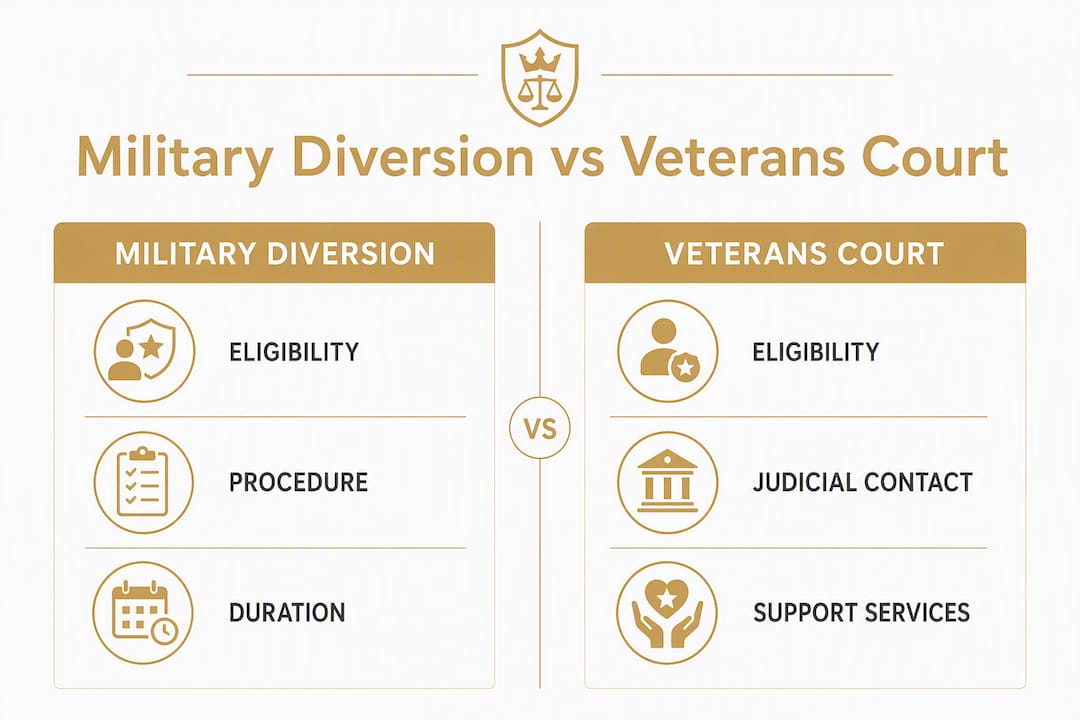
Military Diversion vs. Veterans Treatment Court
| Dimension | Military Diversion (PC §1001.80) | Veterans Treatment Court (VTC) |
|---|---|---|
| Eligibility | Current or former U.S. military with service-related condition | Current or former U.S. military; criteria vary by county |
| Covered charges | Misdemeanors; certain felonies (court discretion) | Varies by county; often includes felonies |
| Required evidence | Service verification, clinical assessment, treatment plan | Similar; VTC may require additional screening |
| Program terms | Up to two years; reports every six months | Typically 12–24 months; more intensive court check-ins |
| Decision-makers | Prosecutor consent + judicial approval | VTC judge and treatment team; more collaborative model |
| Case outcome | Dismissal on successful completion | Dismissal or reduced charges on completion |
Veterans Treatment Court operates as a separate collaborative court model with more frequent judicial contact and a dedicated VTC judge. Military diversion under PC §1001.80 is a pretrial mechanism that does not require the same ongoing court appearances. For some defendants, VTC’s structured accountability is a better fit; for others, the lower court-contact model of PC §1001.80 diversion is preferable. Your attorney can help you evaluate which path fits your situation and your county’s available programs.
What can go wrong: risks, limits, and collateral consequences
Diversion is not a guarantee, and it is not consequence-free. Understanding the limits before you commit is part of making an informed decision.
Risks and limits to know:
- Noncompliance reinstates prosecution. If you fail to comply with treatment requirements, miss progress reporting, or otherwise perform unsatisfactorily, the court can terminate diversion and resume criminal proceedings. The charges come back, and you have waived your speedy trial right for the period you were in diversion.
- New offenses end eligibility. Committing a new offense while in diversion is grounds for immediate termination.
- Statutory exclusions apply. Certain charges are excluded from diversion eligibility by statute. Confirm with your attorney whether your specific charge qualifies before investing in the process.
- Firearm prohibitions may be ordered. The court can impose temporary or ongoing firearm restrictions as a condition of diversion. If you are concerned about diversion and gun charges, discuss this with counsel before agreeing to program terms.
Collateral consequences that survive dismissal:
Even after you successfully complete diversion and the charges are dismissed, the arrest record does not disappear entirely. The San Diego CRM-284 form explicitly advises defendants that the California Department of Justice may disclose the arrest in response to peace officer application requests, and that defendants may be required to disclose the arrest on certain questionnaires. If you are pursuing a law enforcement career, a security clearance, or a professional license, talk to your attorney about what the record looks like after diversion and whether additional record-clearing steps apply to your situation.
Immigration consequences are another area where diversion’s protections have limits. A dismissed charge may still trigger immigration scrutiny depending on the underlying offense. If you are not a U.S. citizen, consult an immigration attorney alongside your criminal defense counsel.
How an experienced attorney changes the outcome
The difference between a granted diversion and a denied one often comes down to preparation, not eligibility. An attorney who knows PC §1001.80 does more than file a motion.
What a skilled defense attorney does in a military diversion case:
- Screens your charges and discharge status for statutory eligibility before any motion is filed.
- Coordinates with VA clinicians, forensic evaluators, and veterans’ service officers to obtain usable, nexus-focused clinical reports.
- Drafts a mitigation packet that tells a coherent story: service history, trauma, diagnosis, nexus to the offense, and a credible treatment path.
- Negotiates with the prosecutor before the hearing to address objections and build consent.
- Prepares expert witnesses or clinicians to testify if the court requires live testimony.
- Advocates at the diversion hearing with specific arguments tied to the statute’s preference language and the evidence in the packet.
The mental health and criminal justice intersection is complex, and courts scrutinize clinical reports with that in mind. Reports drafted for VA benefits purposes use different standards than reports drafted for courtroom use. An attorney who understands both contexts can guide your clinician toward language that survives judicial scrutiny.
Pro Tip: Look for a defense team that includes former law enforcement professionals. They understand how prosecutors and investigators evaluate evidence, and they can identify weaknesses in the packet before the prosecutor does. A multidisciplinary team, attorneys plus investigators plus clinical coordinators, produces stronger packets than a solo practitioner working in isolation.
What to do right now: your immediate action list
Do not wait for your next court date to start this process. The earlier you begin assembling records and engaging counsel, the more time your attorney has to build a complete packet.
- Retain a criminal defense attorney today. Do not make any statements to law enforcement, the prosecutor, or the court without counsel present.
- Request your DD214 or service verification. If you do not have a copy, request one through the National Archives’ eVetRecs system or your branch’s personnel records office.
- Request your VA medical records. Submit a records request through MyHealtheVet or contact your VA facility’s Release of Information office. Start this immediately; it takes time.
- Ask the court clerk or your attorney about the county’s military diversion intake form. In San Diego, that is the CRM-283 information sheet and CRM-284 request form. In Orange County, the Military Diversion Program page links to eligibility resources. Other counties have their own procedures.
- Contact your treating mental health providers. Ask whether they can provide a written evaluation connecting your diagnosis to your military service and to the conduct underlying the charge.
- Do not discuss the case with anyone except your attorney. Statements made to family, friends, or on social media can be used against you.
If you are also exploring related options, understanding California’s pretrial diversion program more broadly can help you see how PC §1001.80 fits within the larger diversion framework.
Key Takeaways
California’s military diversion program under Penal Code §1001.80 gives active-duty service members and veterans a path to dismissal, but only when clinical evidence directly connects a service-related condition to the charged conduct and a credible treatment plan is in place.
| Point | Details |
|---|---|
| Statutory eligibility | Current or former U.S. military with PTSD, TBI, MST, substance use, or related service-connected condition; misdemeanors and certain felonies qualify. |
| Nexus evidence is decisive | A clinical report linking the diagnosis to both military service and the charged conduct is the most important document in the packet. |
| Diversion is discretionary | Courts have final authority; outside eligibility findings are not binding, and prosecutor consent is typically required. |
| Collateral consequences persist | Even after dismissal, arrest records may be disclosed for peace officer applications and certain questionnaires under the San Diego CRM-284 advisal. |
| Gracelegalgroup | Gracelegalgroup prepares mitigation packets with two-attorney support and ex-law enforcement review, giving California service members and veterans a structured path to pursue diversion. |
Why preparation is the real variable in military diversion cases
Most articles about PC §1001.80 stop at eligibility. That is the wrong place to stop. The statute’s eligibility criteria are broad enough that a significant number of veterans and service members technically qualify. What actually determines whether diversion is granted is the quality of the evidence presented, and that is entirely within your control.
Courts see mitigation packets that check boxes: a diagnosis letter, a DD214, a generic treatment referral. Those packets often fail. What works is a packet that reads like a coherent argument, one where the service history, the trauma, the diagnosis, and the charged conduct form a logical chain that a prosecutor and a judge can follow without filling in gaps themselves. That requires coordination between your attorney, your clinicians, and often a veterans’ service officer who knows how to frame service-connected conditions in language courts understand.
The risk mitigation frameworks used in public safety contexts offer a useful parallel: the goal is not just to document a problem but to demonstrate that the proposed intervention, treatment, in this case, reduces the risk of future harm. That framing resonates with prosecutors who are weighing whether diversion serves the public interest.
Gracelegalgroup’s approach, two attorneys on each case, former law enforcement investigators reviewing the evidence, and a mitigation-packet focus, is built around exactly this kind of preparation. The faith-based perspective the firm brings also matters in ways that are easy to underestimate: it shapes how the client’s story is told, and storytelling is a real part of what moves a prosecutor from objection to consent.
Gracelegalgroup can help you pursue military diversion
Facing criminal charges as a service member or veteran is a different kind of pressure. You have already carried more than most people will ever understand, and the last thing you need is a defense team that treats your case like a standard file.

Gracelegalgroup is a Los Angeles-based criminal defense firm built for exactly this kind of case. Two attorneys work every file, and the team includes former law enforcement professionals who know how prosecutors evaluate evidence from the inside. The firm’s mitigation-packet process is designed to do one thing: change how the prosecutor and judge see your situation before they make a decision. That means coordinating clinical evaluations, drafting nexus statements, and presenting your service history as the context it actually is.
To start, bring your charge paperwork, DD214, any existing VA or military medical records, your court dates, and contact information for any treating clinicians. A case review will tell you quickly whether PC §1001.80 diversion is a realistic path and what the packet needs to make it work.
Explore your available defense options or contact Gracelegalgroup directly to request a case review.
Useful sources and county program resources
County procedures vary more than most guides acknowledge. The statute is uniform; the intake forms, eligibility guides, and referral processes are not. Always verify your local superior court’s current procedures.
| Resource | Type | What it offers |
|---|---|---|
| California Penal Code §1001.80 (leginfo) | Primary statute | Full statutory text including eligibility, program terms, and VA/DoD preference language |
| Orange County Superior Court — Military Diversion Program | County program page | Eligibility assessment resource guide, procedural notes, and referral information |
| San Diego CRM-284 (Request for Military Diversion) | County intake form | Mandatory advisal and waiver form; lists required evidence and record disclosure cautions |
| San Diego CRM-283 (Military Diversion Information Sheet) | County information sheet | Plain-language overview of the program for defendants in San Diego |
| FindLaw — PC §1001.80 commentary | Legal commentary | Statutory summary and notes on discretionary nature and evidence requirements |
A note on county variation: Orange County and San Diego publish detailed program pages and forms. Many other California counties handle military diversion through their general criminal division with less published guidance. If your county’s superior court website does not have a dedicated military diversion page, call the criminal clerk’s office directly and ask whether a local intake form or eligibility guide exists. Your attorney should also check with the local public defender’s office, which often tracks county-specific practices even when they are not published online.
This article provides general legal information about California’s military diversion program and is not legal advice. Laws and court procedures change, and the facts of your individual case determine what options are available to you. Consult a qualified California criminal defense attorney for guidance specific to your situation.