
A motion to suppress is a formal request asking a judge to exclude specific evidence from your criminal trial because it was obtained in violation of the Constitution or a statute. If the judge grants it, the prosecution cannot use that evidence against you.
Why does that matter? Three reasons:
- A weakened prosecution. Strip out the key evidence and the government’s case often collapses. No gun, no drugs, no confession — no conviction.
- Plea leverage. Even when suppression doesn’t end the case outright, it forces prosecutors to renegotiate. Charges get reduced; sentences shrink.
- Outright dismissal. When the suppressed evidence is central to the charges, prosecutors sometimes dismiss the case entirely rather than go to trial without it.
The constitutional anchors are the Fourth Amendment (unreasonable searches and seizures), the Fifth Amendment (self-incrimination and coerced confessions), and the Sixth Amendment (right to counsel). Gracelegalgroup handles suppression matters as part of its criminal defense practice in Los Angeles.
This article is general legal information, not legal advice. Consult a qualified attorney about the rules in your jurisdiction and the specific facts of your case.
Table of Contents
- What are the legal bases for a motion to suppress?
- What evidence can actually be suppressed?
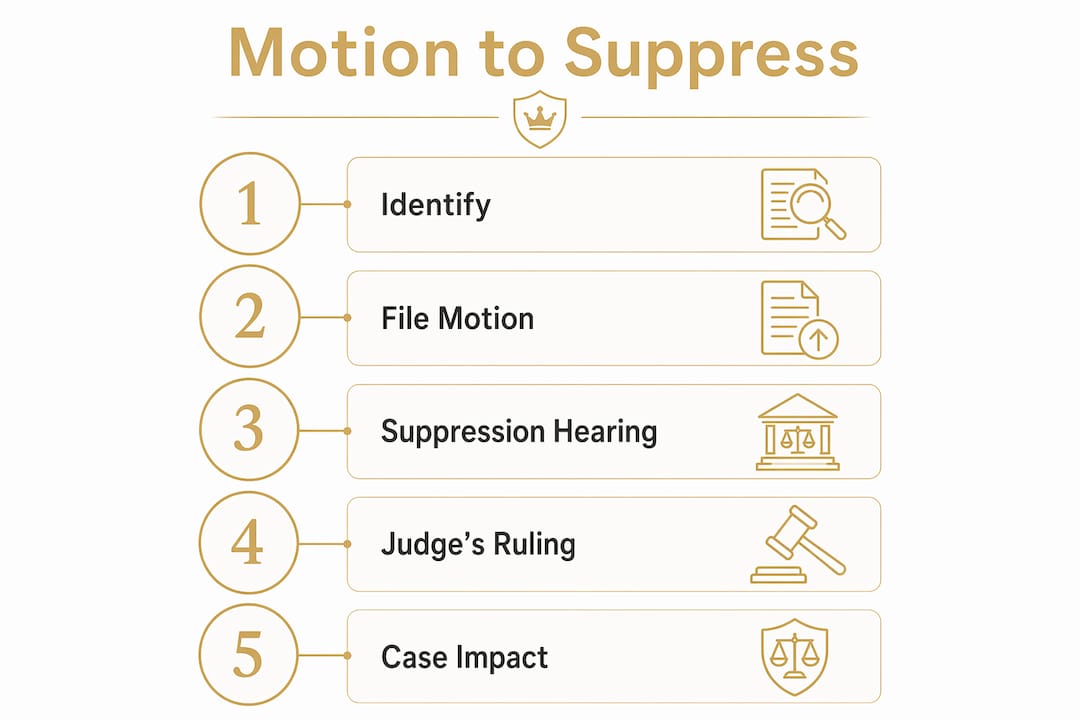
- When and how do you file a motion to suppress?
- What happens at a suppression hearing?
- How does a suppression ruling change your case?
- Why do judges often deny motions to suppress?
- How to prepare a strong motion to suppress
- Key Takeaways
- What most defendants miss about suppression motions
- Grace Legal Group can help you fight for suppression
- Authoritative sources for further reading
What are the legal bases for a motion to suppress?
The exclusionary rule is the engine behind every suppression motion. Established in Mapp v. Ohio (1961), it bars the government from using evidence gathered through unconstitutional means. The rule applies through three constitutional amendments, each covering a different type of violation.
“The right of the people to be secure in their persons, houses, papers, and effects, against unreasonable searches and seizures, shall not be violated.” — U.S. Constitution, Fourth Amendment. Courts have interpreted this to mean that evidence obtained without a valid warrant, or without a recognized exception to the warrant requirement, is subject to exclusion.
Fourth Amendment covers searches and seizures. If police searched your car, home, or phone without a warrant and no exception applies, any evidence found is potentially suppressible. Katz v. United States (1967) extended this protection to anywhere you have a reasonable expectation of privacy, not just physical spaces.
Fifth Amendment covers self-incrimination. Miranda v. Arizona (1966) requires police to advise you of your rights before a custodial interrogation. Statements taken without those warnings, or through coercion, can be excluded. The Fifth Amendment also bars the use of physically coerced confessions under the due process clause.
Sixth Amendment covers the right to counsel. Once formal charges are filed, police cannot deliberately elicit statements from you outside the presence of your attorney. Massiah v. United States (1964) established this rule; a violation opens the door to suppression of any statement obtained that way.
Beyond the federal Constitution, state statutes supply their own suppression vehicles. California Penal Code §1538.5 (the “1538.5 motion”) is one of the most commonly used. New York CPL 710 and Illinois 725 ILCS 5/114-12 are others. These state statutory vehicles often carry their own timing rules and may add grounds like chain-of-custody defects or lab protocol failures that federal doctrine does not cover.
What evidence can actually be suppressed?
Not every procedural misstep leads to suppression, but certain fact patterns come up repeatedly. Here are the most common grounds, each with a concrete example:
- Warrantless search without a valid exception. Police pull you over for a broken taillight, then search your trunk without consent, a warrant, or probable cause. Any contraband found is potentially suppressible.
- Cell phone search without a warrant. Riley v. California (2014) held that police generally need a warrant to search a cell phone incident to arrest. Evidence pulled from your phone without one is a textbook suppression target.
- Custodial statement without Miranda warnings. You’re arrested, taken to the station, and questioned for two hours before anyone reads you your rights. Any incriminating statement you made during that window can be challenged.
- Coerced or involuntary confession. Threats, prolonged sleep deprivation, or promises of leniency can render a confession involuntary under the Fifth Amendment’s due process clause.
- Unlawful Terry stop. An officer stops and frisks you based on nothing more than a hunch. If the stop lacked reasonable articulable suspicion, evidence discovered during it may be excluded.
- Chain-of-custody and lab protocol failures. Drug evidence mishandled between seizure and testing, or analyzed by a lab that failed to follow documented protocols, can be challenged on reliability grounds. State statutes often provide the hook here.
- Derivative evidence (fruit of the poisonous tree). Under Wong Sun v. United States (1963), if an initial illegal stop or search led to other discoveries, the defense can argue that subsequent evidence should be excluded as fruit of the poisonous tree. A single unlawful entry can unravel an entire evidence chain.
Pro Tip: These issues are intensely fact-specific. The difference between a successful and a failed motion often comes down to a single timestamp or a missing signature on a warrant. Flag anything that felt wrong about the stop, search, or interrogation to your attorney immediately — before memories fade and records get harder to obtain.
When and how do you file a motion to suppress?
Timing is one of the most consequential procedural decisions in a suppression case. File too late and you may forfeit the issue entirely.

| Stage | Typical Rule | Key Deadline | Notes |
|---|---|---|---|
| Superior/felony court | Pretrial filing required | Before trial begins | Most jurisdictions require a written motion with a supporting affidavit |
| District/misdemeanor court | Motion ordinarily made at trial | During trial | Some courts allow pretrial hearing with prosecutor and judge consent |
| Late discovery exception | Motion permitted during trial | When facts arise | Allowed when defendant could not reasonably have raised the issue earlier |
| State notice rule (e.g., NC) | 10 working days after state’s notice | After state’s notice | Triggered when prosecution gives formal notice of intent to use evidence |
| Ruling timeline | 1–3 months from filing | Varies by complexity | Simple motions: bench ruling at hearing; complex matters: written decision |
Filing deadlines typically run 30–60 days before trial, but local rules vary significantly. A motion filed in Los Angeles Superior Court follows California Penal Code §1538.5 procedures; a motion in federal district court follows Federal Rule of Criminal Procedure 12(b)(3)©, with a deadline the court sets at arraignment.
Preserving the issue for appeal is just as important as the initial filing. If the judge denies your motion, you must renew the objection at trial when the evidence is offered. A failure to object at trial in the same terms as the suppression motion can waive appellate review. The record created at the suppression hearing, including the transcript of testimony and all admitted exhibits, is what the appellate court reviews. Make it complete.
What happens at a suppression hearing?
A suppression hearing is a mini-trial focused entirely on how evidence was obtained, not on guilt or innocence. Here is the typical sequence:
- Defense files and serves the motion. The written motion, supporting affidavit, and exhibit list are filed with the court and served on the prosecution. The affidavit must contain specific facts, not conclusions.
- Court sets the hearing date. Usually 30–60 days out, though complex matters take longer; for clients navigating these pretrial complexities, reviewing the Bail Reduction Motion Preparation Guide for Ohio can provide helpful context on scheduling and bail alternatives.
- Defense opens and presents its case. The defense goes first. It must show that a search or seizure occurred and that the defendant had standing to challenge it. Standing requires a personal Fourth Amendment interest in the place searched or the item seized.
- Defense introduces evidence. Body-camera footage, dispatch logs, warrant documents, police reports, and forensic lab reports are the most common exhibits. Chronological narratives tied to timestamps are highly persuasive to judges.
- Prosecution responds. Once the defense establishes the basic facts, the burden shifts. The prosecution must prove by a preponderance of the evidence that an exception to the warrant requirement applies, or that the evidence is otherwise admissible.
- Witness testimony and cross-examination. Officers typically testify. The defense cross-examines on the sequence of events, the basis for probable cause, and any inconsistencies with written reports.
- Judge rules. The judge may rule from the bench immediately or take the matter under submission and issue a written decision.
One tactical note worth knowing: in many jurisdictions, testimony a defendant gives at a suppression hearing about the circumstances of the alleged constitutional violation is not admissible against them at trial on the question of guilt. That protection can make it safer for a defendant to testify at the hearing than at trial.
Pro Tip: Prepare a tabbed exhibit binder with one copy for the judge, one for the prosecution, and one for your attorney. Key each tab to the paragraph in the memorandum of law that cites it. Judges and clerks notice organized records, and it reduces friction at the hearing itself.

How does a suppression ruling change your case?
The practical impact of a suppression ruling depends on what gets excluded and how central that evidence is to the prosecution’s theory.
| Ruling | What It Means | Practical Effect |
|---|---|---|
| Full suppression | The challenged item is excluded entirely | Prosecution loses that evidence; case may collapse |
| Partial suppression | Only part of the evidence is excluded (e.g., one statement, not all) | Prosecution proceeds with remaining evidence |
| Limiting order | Evidence admitted but only for a specific purpose | Jury instructed not to use it for guilt determination |
| Denial | Motion rejected; evidence comes in | Case proceeds; issue preserved for appeal |
When the suppressed evidence is central to the charges, prosecutors often dismiss or reduce charges rather than go to trial without it. A drug case built entirely on a warrantless search of a defendant’s home, for example, rarely survives suppression of the drugs. The prosecution has no case-in-chief.
Even when suppression doesn’t end the case, it reshapes plea negotiations. A prosecutor who loses the confession may still have circumstantial evidence, but the calculus changes. Offers that weren’t on the table before the hearing suddenly appear. The tactical goal of a suppression motion is not only to exclude evidence but to demonstrate that admitting it would prejudice the defendant, creating leverage for dismissal or better plea terms.
On appeal, suppression rulings are reviewed under a mixed standard: factual findings are reviewed for clear error, but the legal conclusions drawn from those facts are reviewed de novo. That means an appellate court can reverse a denial even if it accepts the trial court’s factual findings.
Why do judges often deny motions to suppress?
Most suppression motions fail. Understanding why is as useful as knowing the grounds for filing.
Doctrinal exceptions are the most common reason for denial:
- Good-faith doctrine (United States v. Leon, 1984). Officers who rely in good faith on a facially valid warrant are protected even if the warrant is later found defective.
- Independent source. If the prosecution can show it discovered the evidence through a source entirely independent of the constitutional violation, suppression is unavailable.
- Inevitable discovery. Evidence that would have been discovered lawfully anyway, regardless of the violation, is admissible under Nix v. Williams (1984).
- Attenuation. If the connection between the illegal conduct and the evidence is sufficiently remote, the taint is considered dissipated.
- Consent. A voluntary, knowing consent to search defeats a Fourth Amendment challenge. Courts look at the totality of circumstances.
- Search incident to arrest. Officers may search the person and the area within immediate control at the time of a lawful arrest.
- Plain view. Evidence in plain view during a lawful police presence is not subject to suppression.
- Automobile exception. Probable cause to believe a vehicle contains contraband generally permits a warrantless search.
- Terry stops. A brief investigatory stop based on reasonable articulable suspicion does not require probable cause.
Procedural defects kill motions before they reach the merits. Courts require factual support in the form of affidavits and exhibits; conclusory pleadings risk summary denial. Other common defects include lack of standing, untimely filing, and failure to attach the warrant or police report the motion challenges. A motion that says “the search was illegal” without explaining why, with specific facts and dates, will not survive.
How to prepare a strong motion to suppress
A well-prepared motion lives or dies on its factual record. Here is a practical checklist:
- Conduct a thorough fact intake. Write down everything you remember about the stop, search, or interrogation: exact times, locations, officer names and badge numbers, what was said, what was searched, and in what order. Do this immediately.
- Preserve physical and digital evidence. Request body-camera footage, dispatch audio and logs, and any dashcam recordings through a formal preservation letter before they are overwritten. Many agencies have short retention windows.
- Obtain all police reports and warrant documents. The affidavit supporting the warrant is especially important. If it contains false statements, that is a Franks v. Delaware (1978) challenge.
- Pull phone records and GPS data. Timestamps on cell data can contradict an officer’s account of when and where a stop occurred.
- Draft a detailed affidavit. Avoid conclusory statements. Instead of “the officer had no probable cause,” write: “At 11:47 PM on March 3, 2025, Officer Smith stated he smelled marijuana. The vehicle windows were closed. The temperature was 28°F.” Attach supporting documents to the affidavit.
- Build a chronological timeline. Map each event to a specific timestamp. Courts find chronological narratives tied to body-cam frame numbers and dispatch timecodes far more persuasive than narrative summaries.
- Identify your witnesses. Officers who wrote reports, forensic analysts, and any civilian witnesses who observed the stop or search.
- Assemble your exhibit list. At minimum: warrant and supporting affidavit, body-camera footage with relevant stills, dispatch logs, police reports, lab reports, and any chain-of-custody documentation.
- Cite the controlling doctrines. Reference fruit-of-the-poisonous-tree (Wong Sun), Miranda, Massiah, and any applicable state statute (e.g., California Penal Code §1538.5). If derivative evidence is at issue, build a short table showing how each piece of secondary evidence flowed from the initial violation.
- State the specific relief requested. Name the exact evidence you want excluded. “All evidence obtained during and after the warrantless search of the defendant’s vehicle on March 3, 2025” is specific. “All illegally obtained evidence” is not.
Pro Tip: If you suspect the police illegally searched you, read up on what to do after an unlawful search before your first attorney meeting. The more organized your facts, the faster counsel can assess whether a suppression motion is viable.
Understanding how suppression fits within your broader defense strategy is also worth discussing with your attorney early. Suppression is one tool among several, and the strongest defenses often combine multiple approaches.
Key Takeaways
A motion to suppress is most powerful when it targets evidence central to the prosecution’s case, filed on time, and backed by specific facts and documentary exhibits.
| Point | Details |
|---|---|
| Core definition | A motion to suppress asks the court to exclude evidence obtained in violation of the Constitution or a statute. |
| File pretrial | In most courts, suppression motions must be filed before trial; missing the deadline forfeits the issue. |
| Preserve evidence early | Request body-cam footage, dispatch logs, and warrant documents immediately — retention windows are short. |
| Outcomes vary | A granted motion can lead to full suppression, partial exclusion, or a limiting order; central evidence lost often forces dismissal or a better plea. |
| Gracelegalgroup | Grace Legal Group’s two-attorney model and ex-law-enforcement review are designed to identify suppression issues from the first case intake. |
What most defendants miss about suppression motions
The conventional wisdom treats a motion to suppress as a Hail Mary — something you file when you have nothing else. That framing is backwards. The strongest suppression motions are filed early, built on documentary evidence, and used as leverage whether or not the judge grants them.
Here is what actually matters and gets overlooked: the motion’s value is not binary. A partial win, where the judge excludes one statement but not the drugs, can still shift a prosecutor’s calculus enough to produce a plea offer that wasn’t there before. Defendants and their families often fixate on the hearing outcome and miss the negotiating dynamic that plays out in the weeks before it.
The other thing most guides skip: the quality of the affidavit is almost always the deciding factor. Judges can and do summarily deny motions that fail to allege specific facts. A motion that cites the right cases but rests on vague assertions about “improper police conduct” will lose to a motion that attaches the body-cam timestamp showing the officer opened the car door before asking for consent. Specificity is not a drafting nicety. It is the whole game.
Finally, the fruit-of-the-poisonous-tree doctrine is underused. Defendants and even some attorneys focus on the primary violation and forget to map the derivative evidence chain. If an unlawful stop led to a search that led to a phone extraction that led to a warrant for a second location, all of that may be suppressible from a single constitutional error. Building that chain, clearly and visually, in the memorandum of law is often more persuasive than any doctrinal argument.
Grace Legal Group can help you fight for suppression
When evidence in your case was obtained through a questionable stop, a warrantless search, or a custodial interrogation that skipped your Miranda rights, the window to act is short. Gracelegalgroup assigns two attorneys to every case from day one, and both bring a different lens: one focused on legal strategy, the other drawing on ex-law-enforcement experience to spot the procedural gaps police reports often obscure.

That combination matters for suppression work specifically. Former law enforcement know exactly what a valid warrant affidavit looks like, what body-cam footage should show, and where chain-of-custody documentation typically breaks down. Gracelegalgroup also prepares detailed mitigation packets that reframe how prosecutors see a case, which strengthens plea leverage when suppression creates an opening. Whether you’re facing DUI charges where the stop itself may be challengeable, or a drug case built on a questionable search, the earlier you get counsel involved, the more options remain open. Schedule a free consultation with Gracelegalgroup to have your case reviewed.
Authoritative sources for further reading
- Cornell Law School Legal Information Institute — Motion to Suppress. The clearest plain-language definition of the motion and its constitutional foundations; a good starting point before meeting with counsel.
- NIJ Law 101: Legal Guide for the Forensic Expert. Explains hearing procedure, burdens of proof, and the role of forensic evidence in suppression proceedings; written for practitioners but accessible to informed defendants.
- Michigan Criminal Benchbook — Motion to Suppress Evidence. A state court benchbook that explains timing rules, hearing procedure, and the effect of a defendant’s suppression-hearing testimony; useful for understanding how trial judges approach these motions.
- NC PRO — Suppression Motions. A practicing-law guide covering drafting requirements, common procedural defects, and why conclusory motions fail; practical for anyone helping to organize facts for an attorney.
- North Carolina General Statutes Chapter 15A, Article 53. A model state suppression statute showing how timing rules, affidavit requirements, and appeal rights are codified; bring this to your attorney when asking about your state’s equivalent rules.
Bring any of these to your first attorney meeting. Local rules vary, and a good defense attorney will tell you exactly how your jurisdiction’s procedures differ from the general framework described here.