
A Ramey warrant in California is an arrest warrant a judge signs based on a police officer’s sworn declaration of probable cause before a prosecutor files formal charges. It carries the same legal authority as a standard complaint arrest warrant, meaning officers can execute it immediately, including at your home. If you believe one names you, take these steps right now:
- Do not resist. Resisting a lawful arrest creates additional criminal exposure under Penal Code 148(a)(1) and complicates every defense that follows.
- Verify through official channels. Contact your county sheriff’s records division or superior court clerk directly. Do not rely on third-party warrant search websites.
- Call a criminal defense attorney immediately. A lawyer can arrange a coordinated voluntary surrender, pursue bail advocacy, and begin challenging the warrant before you ever see a courtroom.
Table of Contents
- What is a Ramey warrant in California?
- How does a Ramey warrant differ from a standard arrest warrant?
- How does law enforcement obtain a Ramey warrant?
- Does a Ramey warrant authorize a no-knock entry or a search?
- When do police typically seek a Ramey warrant?
- What happens after police arrest you on a Ramey warrant?
- How long does a Ramey warrant stay valid?
- How can you check whether a warrant exists in California?
- What should you do if a Ramey warrant names you?
- What legal defenses apply to a Ramey warrant?
- Key Takeaways
- What working with Grace Legal Group actually looks like
- Grace Legal Group is ready to help you right now
- Authoritative sources and suggested reading
What is a Ramey warrant in California?
The term comes directly from the California Supreme Court’s decision in People v. Ramey, which addressed constitutional limits on warrantless home arrests. The court’s ruling established that police cannot enter a private residence to make an arrest without a warrant absent exigent circumstances, and the procedure that emerged from that holding is what California law enforcement now calls a Ramey warrant.
Procedurally, a Ramey warrant is a probable-cause arrest warrant supported by a sworn affidavit that an officer prepares and presents directly to a magistrate or on-call judge. The officer does not route the paperwork through the District Attorney’s office first. If the magistrate finds probable cause, the judge signs the warrant and it becomes immediately executable.
Two things make this legally distinct. First, the warrant has the same authority for service as a complaint arrest warrant issued by the DA, so officers can arrest you on it just as they would on any other signed warrant. Second, it does not by itself initiate a criminal complaint or start a court case. The arrest happens; the charging decision comes later.
That gap between arrest and formal charges is where defense counsel can do the most work.
How does a Ramey warrant differ from a standard arrest warrant?
The clearest way to see the difference is to compare the two side by side.
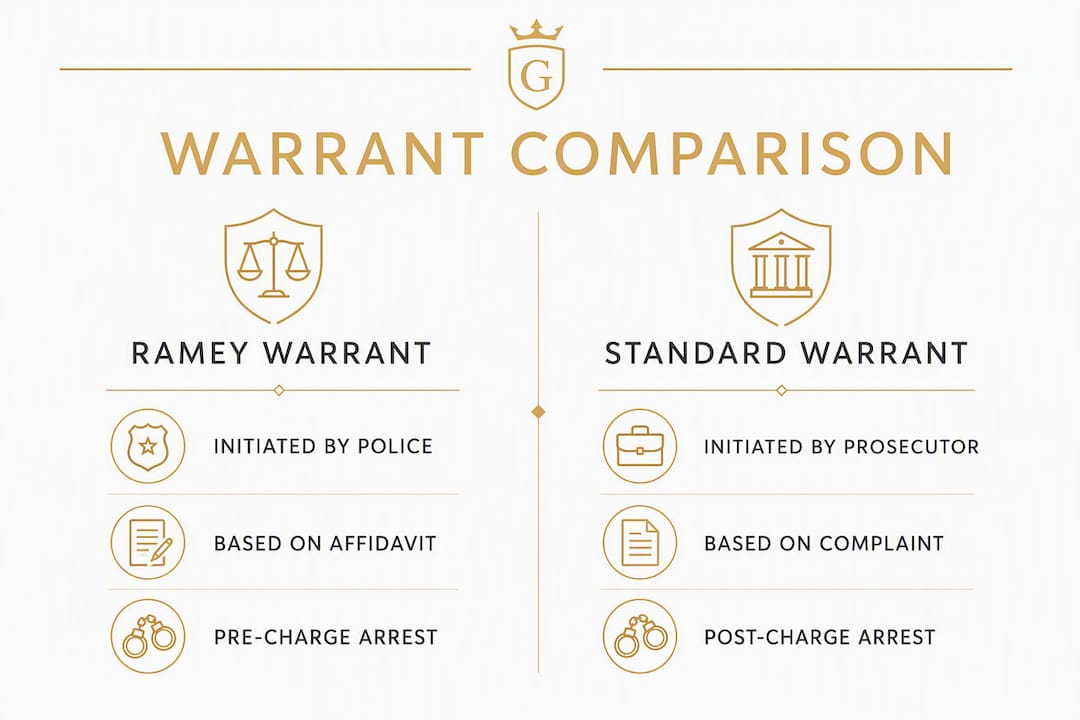
| Feature | Ramey Warrant | Standard Complaint Warrant |
|---|---|---|
| Who initiates | Law enforcement officer | District Attorney |
| DA review before issuance | None | Required |
| When it can be issued | Any time, including nights and weekends | Typically during DA business hours |
| Starts a criminal complaint | No | Yes |
| Probable cause standard | Sworn officer declaration to magistrate | DA complaint filed with court |
| Immediate execution | Yes, once signed | Yes, once signed |
| Post-arrest DA review | Required before charges are filed | Complaint already filed |
The practical consequence of that middle column is significant. A standard complaint warrant means a prosecutor has already reviewed the facts and decided to charge you. A Ramey warrant means a judge found probable cause based on what one officer swore to, and the DA has not yet weighed in. That distinction gives defense counsel a window to influence the charging decision before it is made.
Bail-setting and booking proceed similarly under both warrant types. Once you are in custody, the arraignment clock starts regardless of which warrant brought you in.
How does law enforcement obtain a Ramey warrant?
The process is faster than most people expect. Sacramento’s RM 550.07 policy manual describes the full sequence, and similar procedures apply across California agencies:
- Investigation. Officers develop probable cause through surveillance, witness statements, physical evidence, or a combination of these.
- Sworn declaration. The officer prepares a Complaint Declaration (in Sacramento, form SPD 925) documenting the facts supporting probable cause. This affidavit must be specific enough to satisfy a magistrate.
- Contact a magistrate. The officer reaches an on-call judge, which can happen at any hour. This is the step that makes Ramey warrants operationally valuable: there is no waiting for the DA’s office to open.
- Judicial review. The magistrate reviews the affidavit. If probable cause exists, the judge signs the warrant.
- Execution. Officers serve the warrant immediately. The Certificate of Service (SPD 931) and a copy of the Complaint Declaration go to the DA’s office and the booking facility.
The entire process can be completed in under an hour. Agencies can also enter the warrant into state and national wanted-person systems, including the Automated Wanted Persons System and NCIC, using the agency case number as the warrant number.
Pro Tip: Officers sometimes time Ramey warrant arrests deliberately to occur before a suspect can consult an attorney. An arrest at 2 AM on a Friday means you may sit in custody through the weekend before arraignment. If you have any reason to believe a warrant may be coming, contact a defense attorney now, not after the knock at the door.
Does a Ramey warrant authorize a no-knock entry or a search?
No, and conflating these is a common and costly mistake.
A Ramey warrant is an arrest warrant. Its authority is to take a person into custody. It does not automatically authorize a search of the premises beyond what is lawful incident to the arrest itself, meaning officers can secure the immediate area around the arrest but cannot conduct a general search of your home without a separate search warrant.
The constitutional limits here trace directly back to People v. Ramey. The California Supreme Court held that warrantless home entries are generally unreasonable, and that principle cuts both ways: a Ramey warrant authorizes entry to arrest, but that entry must still comply with constitutional requirements.
A Ramey warrant permits officers to enter a home to make an arrest when they have judicial authorization. It does not convert the home into a searchable space. For a search, officers need a separate warrant supported by its own probable cause showing, or a recognized exception such as consent or exigent circumstances.
On no-knock entries specifically: the warrant itself does not grant no-knock authority. Officers must have independent justification, typically exigent circumstances such as a credible risk of evidence destruction or danger to officers, to enter without announcement. If officers entered your home without knocking and without that justification, that is a constitutional issue your attorney will want to examine immediately.
The same affidavit can sometimes support both an arrest warrant and a search warrant, but those are two distinct judicial orders requiring separate findings.
When do police typically seek a Ramey warrant?
The short answer: when they cannot wait for the DA’s office to open, or when the tactical situation demands immediate arrest authority.
Common scenarios include:
- After-hours arrests. A suspect is located at a residence at midnight. The DA’s office is closed. Officers prepare a Ramey warrant and present it to an on-call judge rather than waiting until morning.
- Active surveillance operations. Officers have eyes on a suspect and need legal authority to move before the suspect relocates or destroys evidence.
- Locating a suspect inside a residence. Without a warrant, officers generally cannot enter a home to make an arrest. A Ramey warrant provides that authority.
- “John Doe” warrants. In some cases, officers know enough about a suspect’s identity to establish probable cause but have not yet confirmed a full legal name. A warrant can be issued based on a physical description or other identifying information.
- Fresh incidents. A violent crime occurs, a suspect is identified quickly, and officers need immediate arrest authority to prevent flight or harm.
Ramey warrants are most common in felony investigations, but local policy guidance confirms they can be used in misdemeanor cases when the circumstances justify it. Do not assume a Ramey warrant only appears in the most serious cases.
What happens after police arrest you on a Ramey warrant?
The arrest is just the beginning of a process that moves quickly and has real deadlines.
- Booking. You are transported to a jail facility, photographed, fingerprinted, and processed. The Certificate of Service and Complaint Declaration are routed to the DA’s office.
- DA review. This is the critical decision point. After a Ramey arrest, officers must seek a complaint from the DA’s office or release the suspect. The DA reviews the facts independently and decides whether to file charges.
- Arraignment. If the DA files a complaint, you will be arraigned. In-custody defendants are typically arraigned within 48–72 hours of arrest, where you will enter a plea and bail may be set.
- Bail determination. Bail can be set at arraignment based on the charge, your criminal history, and arguments from counsel. This is one of the first places a defense attorney can make a concrete difference.
The DA’s post-arrest options are:
- File a complaint. The case proceeds to arraignment and the formal criminal process begins.
- Reject the case. The DA declines to file charges, which typically results in release. Prosecutors may decline to prosecute if the evidence is insufficient, even after a valid arrest.
- Request further investigation. The DA asks officers for additional evidence before making a charging decision, which may extend your time in custody.
Understanding the difference between an arrest warrant and a bench warrant matters here too. A bench warrant is issued by a judge when someone fails to appear in court, while a Ramey warrant is issued before charges are even filed. The post-arrest process differs accordingly.
How long does a Ramey warrant stay valid?
Once a judge signs a Ramey warrant, it does not expire on its own. There is no automatic 30-day or 90-day clock. The warrant remains a valid arrest order until one of the following occurs:
- The warrant is recalled by the issuing agency, typically when the circumstances change or the arrest is no longer warranted.
- A court quashes the warrant, usually after a defense motion challenging probable cause or procedural defects.
- The warrant is superseded by a formal complaint or information filed by the DA, which replaces the Ramey warrant with a court-issued process.
- The DA declines to file, which may lead to release and, in practice, renders the warrant moot.
If you believe a Ramey warrant names you and you have not yet been arrested, your attorney can petition the court to quash it before execution. That requires showing the affidavit lacked probable cause or was procedurally defective. The sooner counsel is involved, the more options exist.
How can you check whether a warrant exists in California?
Use official sources only. Third-party “warrant search” websites are unreliable, often outdated, and sometimes designed to collect your personal information.
- Ask your attorney to check — Defense counsel can access court systems and law enforcement databases that are not publicly available, and they can do so without triggering an arrest.
A Ramey warrant can be entered into the Automated Wanted Persons System and NCIC, so it may appear in any law enforcement database check. That also means a routine traffic stop could surface it.
One caution: asking a friend to “check around” or posting questions on social media about whether a warrant exists can tip off law enforcement to your location or state of mind. Use official channels, and do it through counsel when possible.
What should you do if a Ramey warrant names you?
Act fast, and act smart. Here is the priority order:
- Do not resist arrest. If officers arrive to execute the warrant, comply. Resisting adds charges and eliminates goodwill that matters later. Review what resisting arrest under Penal Code 148(a)(1) actually means legally before you assume any physical response is justified.
- Contact a criminal defense attorney immediately. This is the single most consequential step. An attorney can arrange a voluntary surrender on terms that protect you, begin bail advocacy, and start reviewing the warrant affidavit for defects.
- Arrange a voluntary surrender. Walking in with counsel is almost always better than being arrested at home or in public. It signals cooperation, often results in faster processing, and gives your attorney leverage on bail.
- Preserve evidence and identify witnesses. Do not delete texts, emails, or photos. Write down what you remember about the events in question and share it only with your attorney.
- Say nothing to anyone except your attorney. Not to family members, not to friends, and absolutely not on social media. Anything you say can be used against you, and statements made before arrest are not protected by Miranda.
Pro Tip: In the hours before a voluntary surrender, do not call the investigating officer to “explain your side.” Officers are not required to stop investigating because you called, and anything you say will be documented. Let your attorney make all contact with law enforcement.
What legal defenses apply to a Ramey warrant?
A signed warrant is not the end of the road. Defense counsel will examine several angles:
- Improper home entry — Under People v. Ramey and subsequent case law, courts scrutinize entries into private dwellings. If officers entered without proper authority or without the conditions the warrant required, that entry is challengeable.
The motions your attorney will consider include a motion to quash the warrant, a motion to suppress evidence obtained through an unlawful arrest or entry, and early requests for the warrant affidavit, service logs, and body-worn camera footage. Getting those records fast matters because some are subject to retention limits. If police conducted a search alongside the arrest, the analysis of what constitutes an illegal search and seizure becomes directly relevant to your defense.
Key Takeaways
A Ramey warrant authorizes arrest before formal charges are filed, but it does not guarantee prosecution, and early legal intervention can change the outcome at every stage from booking through the DA’s charging decision.
| Point | Details |
|---|---|
| What a Ramey warrant is | A judge-signed arrest warrant based on a police sworn declaration, issued before the DA files charges. |
| Same authority as a complaint warrant | It carries full arrest authority but does not start a criminal case on its own. |
| DA review follows arrest | After booking, the DA independently decides to file, reject, or investigate further. |
| No automatic expiration | The warrant stays valid until recalled, quashed, or superseded by a court filing. |
| Gracelegalgroup’s role | Grace Legal Group handles coordinated surrenders, bail advocacy, and early motions to quash for clients facing pre-charge arrest situations. |
What working with Grace Legal Group actually looks like
When someone calls our office about a Ramey warrant, the first thing we do is slow the situation down. Not the legal clock, that keeps running, but the panic. Most people who contact us have never been through this before, and the gap between “a warrant exists” and “I understand what happens next” is where mistakes get made.
Grace Legal Group is a Los Angeles-based criminal defense firm. Our attorneys include former law enforcement professionals who have seen the Ramey warrant process from both sides of the table. That background matters when we are reading an officer’s affidavit for probable cause defects, because we know exactly what a well-constructed declaration looks like and what a rushed one looks like.
What we do in the pre-charge phase: we verify the warrant, review the affidavit for legal sufficiency, coordinate a voluntary surrender that protects your interests, advocate for reasonable bail at arraignment, and prepare a mitigation packet designed to influence the DA’s charging decision before a complaint is ever filed. Two dedicated attorneys work each case. That is not a marketing line; it is how we make sure nothing gets missed in the first 72 hours when the decisions that shape the entire case are being made.
If you are reading this because you think a warrant may name you, contact us now. Urgency is not a sales pitch here. It is the reality of how the California Ramey warrant process works.
Grace Legal Group is ready to help you right now
When a Ramey warrant is in play, the hours before arrest matter more than most people realize. Grace Legal Group offers the kind of early intervention that changes outcomes: emergency representation, voluntary surrender coordination, bail advocacy at arraignment, and immediate motions practice to challenge the warrant or suppress evidence obtained through a defective arrest.

Here is what to expect when you call. We triage the case immediately, identify what documents and records we need (the warrant affidavit, any police reports you have access to, a timeline of events), and map out next steps including surrender timing, arraignment preparation, and the DA review window. We handle urgent matters outside standard business hours because Ramey warrants do not wait for Monday morning.
Our attorneys have handled a wide range of serious criminal charges where pre-charge intervention made the difference between a filed complaint and a rejected case. Call Grace Legal Group today and get a defense team working before the DA makes its decision.
This article provides general legal information about California Ramey warrants and is not legal advice for your specific situation. Laws and procedures change; confirm current rules with a qualified California criminal defense attorney before taking action.
Authoritative sources and suggested reading
These are the primary resources referenced throughout this article. Each is worth reviewing directly, though case-specific interpretation requires counsel.
- RM 550.07 “Ramey” Warrant Manual, City of Sacramento Police Department: The most detailed publicly available procedural manual for California Ramey warrant practice. Covers forms (SPD 925, SPD 928, SPD 931), timing, NCIC entry, and post-arrest DA routing. Essential reading for understanding what officers actually do.
- People v. Ramey, California Supreme Court: The foundational case establishing constitutional limits on warrantless home arrests in California. Read this to understand why the warrant procedure exists and what courts look for when evaluating home entries.
- Criminal Justice System Overview, San Diego County District Attorney: Explains the DA’s independent role in reviewing arrests, the arraignment process, and how prosecutors decide whether to file charges. Useful for understanding what happens after booking.
- California Penal Code Section 813, California Legislature: The statutory authority governing arrest warrants in California, including the probable cause and sworn-statement requirements that underpin the Ramey warrant procedure.
For case-specific guidance, none of these sources substitutes for a conversation with a qualified California criminal defense attorney who can review the actual warrant and affidavit in your case.