
Understanding the line between protecting yourself and committing a crime under Self-Defense or Brandishing (PC 417) is vital for any gun owner in California. While the state recognizes your right to defend yourself, simply showing a weapon during a heated moment can lead to a life-altering arrest. If you are facing charges, the team at Grace Legal Group Inc. specializes in protecting your rights and your future.
The Legal Definition of Brandishing in California
In California, “brandishing” a weapon is governed by Penal Code 417. It is often misunderstood as simply “having” a gun, but the legal definition is much more specific. To get a conviction, a prosecutor must prove three specific elements beyond a reasonable doubt.
- Possession: You drew or exhibited a deadly weapon or firearm.
- Manner: You did so in a rude, angry, or threatening manner.
- Context: You did this during a fight or quarrel, and you were not acting in lawful self-defense.
“Rude, Angry, or Threatening”
The law does not require you to point the gun at someone. If you lift your shirt to show a waistband holster during a shouting match over a parking spot, a jury could decide that was “threatening.” The court looks at your body language, your words, and the overall atmosphere of the encounter.
The “In the Presence of Another” Requirement
A common question is: “What if they didn’t see the gun?” Under PC 417, the crime occurs if the weapon is drawn in the presence of another person. While the victim usually sees the weapon, the law focuses on your actions. If you pull a knife behind your back while facing someone, you could still face charges if the intent was to use it as a threat during a quarrel.
Loaded vs. Unloaded
Many people believe that an unloaded gun cannot lead to a brandishing charge because there is “no real danger.” This is a dangerous myth. In the eyes of California law, the threat is created by the appearance of the weapon. Whether the chamber is empty or the magazine is missing, the legal penalties remain the same.
The “Grace Period”: When Self-Defense is a Valid Legal Shield
The most common defense against a PC 417 charge is that you were acting in lawful self-defense. However, this is not a “blank check” to pull a weapon whenever you feel uncomfortable.
The Reasonable Belief Standard
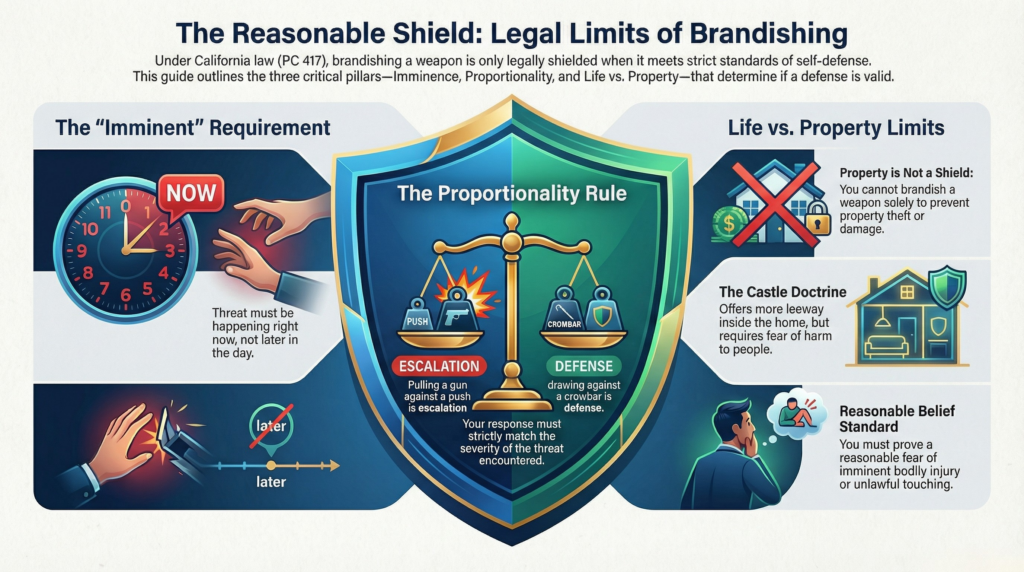
To claim self-defense, you must prove that you reasonably believed you (or someone else) were in imminent danger of suffering bodily injury or being touched unlawfully. “Imminent” means it is happening right now—not something that might happen later in the day.
The Proportionality Rule
Your response must be proportional to the threat. If someone pushes you, pulling a firearm is generally seen as an escalation, not a defense. However, if an attacker is wielding a crowbar and moving toward you, drawing a weapon to stop the advancement may be legally justified.
Defense of Property vs. Defense of Life
California law is very strict regarding property. You generally cannot brandish a firearm solely to protect property, such as stopping someone from keying your car or stealing a bicycle from your lawn. The “Castle Doctrine” allows for more leeway inside your home, but even then, you must have a reasonable fear of imminent harm to people, not just a desire to protect your TV.
Beyond Handguns: What Qualifies as a “Deadly Weapon”?
While most brandishing cases involve firearms, PC 417 applies to any “deadly weapon.”
- Inherently Deadly Weapons: These are items designed to cause death or great bodily injury, such as handguns, rifles, and switchblades.
- Improvised Weapons: Almost any object can become a deadly weapon if used in a threatening way. This includes baseball bats, heavy tools, or even a glass bottle.
- The “Imitation Firearm” Trap (PC 417.4): Technology has made replica firearms, airsoft guns, and BB guns look identical to the real thing. Under PC 417.4, brandishing an imitation firearm in a way that makes a reasonable person fear for their safety is a crime. Even if it only shoots plastic pellets, the legal consequences can still involve jail time.
Penalties, Sentencing, and the “Wobbler” Factor
Brandishing is typically a misdemeanor, but California classifies it as a “Wobbler” in certain circumstances, meaning it can be charged as a felony.
Standard Misdemeanor Penalties
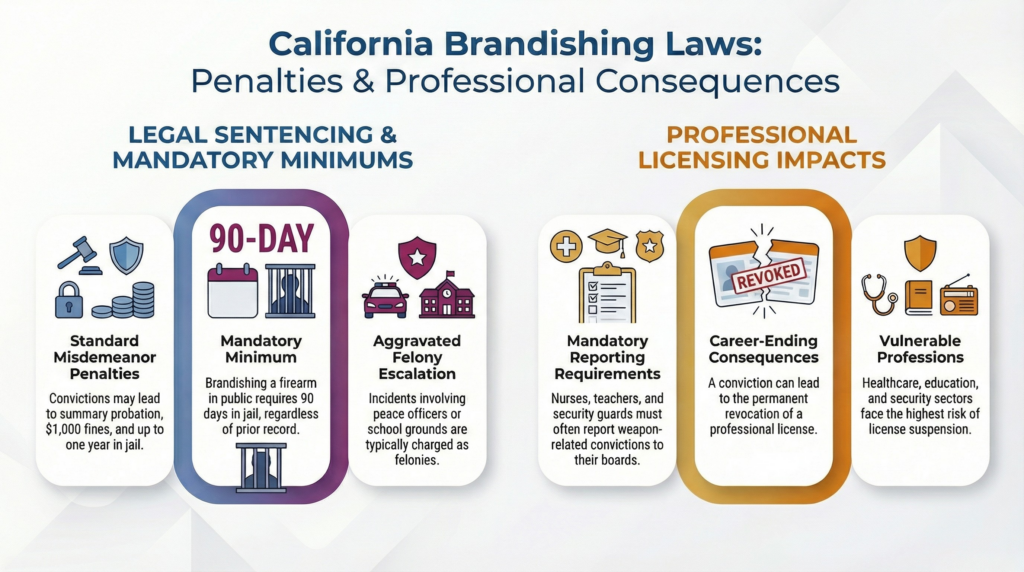
A basic PC 417 conviction can lead to:
- Summary (informal) probation.
- Up to six months or one year in county jail.
- Fines up to $1,000.
The 90-Day Mandatory Minimum
If you brandish a firearm in a public place, California law imposes a mandatory minimum sentence of 90 days in county jail. This applies even if you have a clean record.
Aggravating Factors
Charges become much more severe if the incident occurs:
- On school grounds or at a daycare.
- Against a peace officer (Police, EMT, or Firefighter) performing their duties. This is almost always a felony.
Professional Licensing
A conviction does more than just put you in jail; it can end your career. Nurses, teachers, and security guards often face mandatory reporting requirements to their licensing boards. A “crime of violence” or a weapon-related conviction can lead to the suspension or permanent revocation of your professional license.
Restorative Justice: Grace Legal Group’s Philosophy
At Grace Legal Group Inc., we don’t just see a case number; we see a human being who might have made a split-second decision under extreme stress. Our firm is built on the pillars of restorative justice and the belief that everyone deserves a second chance.
Moving Beyond Retribution
The traditional court system focuses on punishment. We focus on the “why.” Were you acting out of a history of trauma? Was there a misunderstanding that escalated? By humanizing our clients, we often convince prosecutors to look at alternatives to jail.
Diversion Programs for Gun Charges
California offers several “diversion” programs. These allow defendants to complete counseling, community service, or firearm safety courses in exchange for having their charges dismissed. Grace Legal Group Inc. aggressively pursues these options to keep your record clean.
Strategic Defenses Against Brandishing Charges
Our legal team investigates every angle to build a robust defense.
- Accidental Exposure: If your jacket blew open or you reached for an item on a high shelf and your holstered weapon became visible, that is not brandishing. There was no intent to threaten.
- False Accusations: Road rage incidents often lead to “he-said, she-said” reports where one party lies to get the other in trouble. We look for dashcam footage, GPS data, and witness statements to find the truth.
- Mistaken Identity: In high-stress situations, witnesses often get descriptions wrong. We challenge the reliability of the identification.
People Also Ask (FAQ)
1. Does a CCW permit allow me to draw my weapon in a heated argument? No. A Concealed Carry Weapon (CCW) permit only allows you to carry the weapon. It does not give you additional rights to brandish or use it. You are still bound by the same self-defense laws as everyone else.
2. Can I be charged if the other person never saw the gun, but knew I had it? Yes. If you made it clear you had a weapon and were using that knowledge to threaten or intimidate them during a quarrel, you can still be charged under the “presence of another” standard.
3. What is the difference between PC 417 and Assault with a Deadly Weapon (PC 245)? Brandishing (PC 417) is showing the weapon to threaten. Assault (PC 245) involves an attempt to use the weapon or an act that would likely result in physical force against the person. Assault carries much harsher penalties.
4. Can a brandishing conviction be expunged? Yes. In most cases, if you successfully complete your probation, Grace Legal Group Inc. can petition the court to have the conviction expunged under PC 1203.4, which can help significantly with employment.
5. Will I lose my gun rights forever? A misdemeanor brandishing conviction usually results in a 10-year ban on owning or possessing firearms in California. A felony conviction results in a lifetime ban.
6. What if I was on my own private property? While you have more rights at home, you still cannot brandish a weapon in a “rude, angry, or threatening” manner during a simple argument with a neighbor or delivery person unless you are in imminent fear of bodily harm.
Contact Grace Legal Group Inc. Today
A single moment of fear shouldn’t define the rest of your life. Whether you were defending your family or caught in a massive misunderstanding, you need a legal team that believes in restorative justice and has the experience to win.
At Grace Legal Group Inc., we take a “two lawyers on every case” approach to ensure no detail is missed. We offer flexible payment plans because we believe high-quality legal defense should be accessible to everyone.
Don’t wait for the prosecution to build their case. Call Grace Legal Group Inc. today for a free, confidential case evaluation and start your journey toward a second chance.