
A Serna motion asks a California court to dismiss criminal charges because the prosecution’s delay violated your right to a speedy trial under the California Constitution. It can succeed when the delay is long and unexplained, the government bears responsibility for it, and you can show concrete prejudice to your defense. If any of those conditions fit your situation, three things matter right now: stop signing general time waivers, preserve every record that documents the delay, and contact a criminal defense attorney before your next court date.
Table of Contents
- What is a Serna motion in California and who can file one?
- How do California courts apply the speedy-trial balancing test?
- When should you file, and what timing traps can kill the motion?
- What should a Serna motion filing actually include?
- What evidence persuades a judge that you were actually prejudiced?
- What happens if the court grants or denies the motion?
- Is filing a Serna motion always the right move?
- How Gracelegalgroup approaches Serna motions
- Key Takeaways
- When a Serna motion is likely to be worth pursuing
- Gracelegalgroup can help you evaluate your speedy-trial claim
- Authoritative sources and further reading
What is a Serna motion in California and who can file one?
The motion takes its name from Serna v. Superior Court, a 1985 California Supreme Court decision that applied the speedy-trial balancing test to state criminal cases. In plain terms, a Serna motion is a pretrial request to dismiss charges because the prosecution’s delay, whether before arrest or before trial, denied the defendant’s constitutional right to a speedy prosecution. The California Constitution’s speedy-trial guarantee is independent of the federal Sixth Amendment, and California courts apply their own balancing analysis rather than the federal Barker v. Wingo framework wholesale.
Who files it? The defendant, almost always through retained or appointed counsel, files the motion as a pretrial matter. In misdemeanor cases where the defendant has already served their sentence, the same claim can sometimes be raised through an extraordinary writ, including a habeas corpus petition under California Rules of Court, rule 4.551. The motion is not a trial defense; it is a procedural challenge that, if granted, ends the case before trial begins.
One important distinction from federal doctrine: under the federal Marion/Barker framework, extreme delays can sometimes create a presumption of prejudice. California practice is stricter. The defendant generally must make an affirmative showing of actual prejudice, which is why building a documented record from the start is so critical.
How do California courts apply the speedy-trial balancing test?
California courts weigh four factors drawn from the federal Barker analysis but applied through the lens of state constitutional doctrine as established in Serna.
The four factors courts weigh
| Factor | What courts look for |
|---|---|
| Length of delay | How long the prosecution waited; longer delays carry more weight and may trigger a hearing obligation |
| Reason for delay | Whether the government caused, contributed to, or failed to explain the delay |
| Defendant’s assertion of the right | Whether and how promptly the defendant raised the speedy-trial claim |
| Prejudice to the defense | Specific harm: lost witnesses, faded memories, destroyed records, impaired ability to mount a defense |
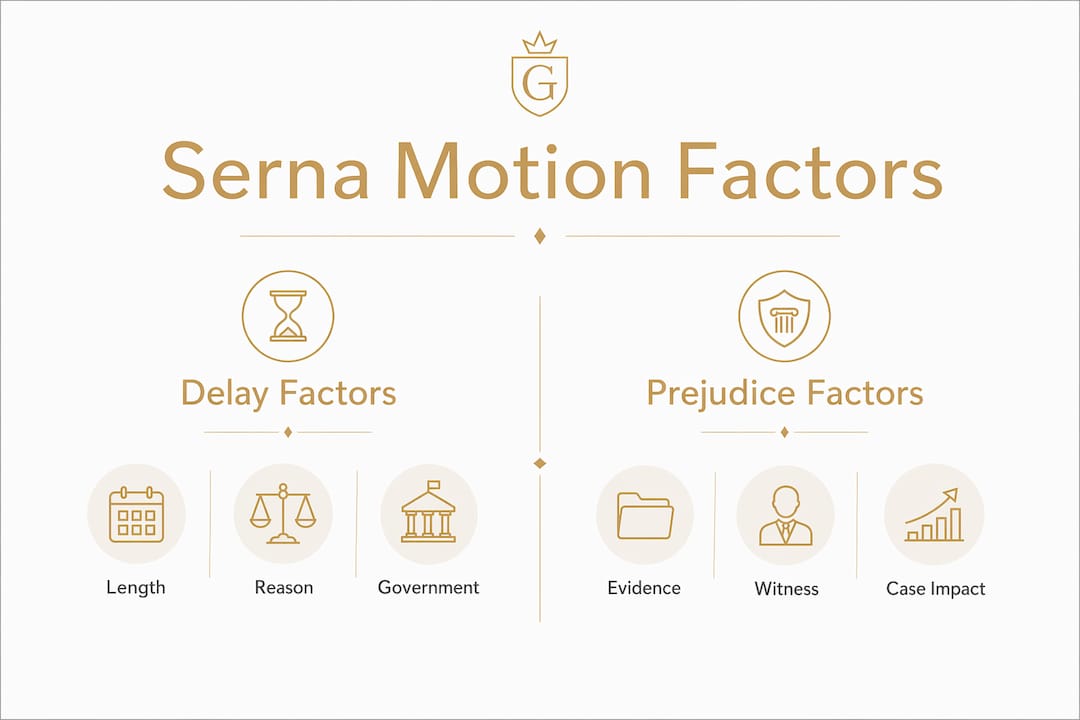
Length of delay is the threshold question. A short delay rarely triggers serious scrutiny; a multi-year unexplained gap is a different matter. In Serna, the California Supreme Court held that a trial court abused its discretion when it failed to require the People to justify a lengthy prearrest delay and skipped the balancing test entirely. That holding is the backbone of every Serna motion filed today.
Reason for delay matters almost as much. Deliberate prosecutorial foot-dragging weighs heavily against the government. Negligence weighs less, but still counts. Delays caused by court congestion or administrative backlog occupy a middle ground. If the prosecution can point to a legitimate reason, such as a complex investigation or a missing witness the government diligently pursued, the motion becomes harder to win.
Prejudice is where most California Serna motions succeed or fail. Unlike some federal analyses where extreme delay can create a presumption of prejudice, California practice emphasizes an active demonstration by the defendant. Vague claims that “memories fade” rarely move the needle. Specific declarations from witnesses who can no longer be located, records that were destroyed during the delay, or documented impairment of a key alibi are the kinds of showings that persuade judges.
Consider two contrasting scenarios. A defendant charged with a misdemeanor after a long prearrest delay, who can show that a key alibi witness moved abroad and is unavailable, stands on solid ground. A defendant facing a shorter delay in a felony case, with no identified witness loss and no documented record destruction, faces an uphill climb regardless of how long the wait felt.
When should you file, and what timing traps can kill the motion?
Timing is where many Serna motions die before they ever reach a hearing. The speedy-trial right does not attach the moment you feel the case is dragging. It attaches at specific trigger events, and the clock can be reset or forfeited by actions you or your attorney take.
Statutory deadlines under PC 1382
Penal Code §1382 sets the baseline statutory deadlines. In felony cases, the prosecution generally must bring the defendant to trial within 60 days of arraignment on the information or indictment. Misdemeanor timelines are shorter, typically 30 or 45 days depending on custody status. These statutory deadlines are separate from the constitutional Serna claim, but practitioners track both because a PC 1382 dismissal is often easier to obtain and does not require the same prejudice showing.
The constitutional Serna claim covers a broader period, including prearrest delay, which PC 1382 does not address. That is why defendants who were investigated for years before charges were filed often have stronger Serna arguments than those challenging post-filing delays.
Waivers and continuances: the two biggest traps
Signing a general time waiver is the single fastest way to forfeit a speedy-trial claim. A general waiver tells the court you are consenting to delay without a fixed end date, and courts treat it as a relinquishment of the statutory right. Defense-requested continuances have a similar effect: if your attorney asked for more time, the prosecution will argue that any resulting delay is on you.
The statute of limitations interacts with these timing rules in ways that can complicate the analysis, particularly in older cases where the prosecution may argue the charges were timely filed even if the investigation stretched over years.
At a Serna hearing, the court typically receives written briefs and supporting declarations. Depending on the complexity of the delay, the judge may also hear live testimony from witnesses who can speak to the timeline and the prejudice suffered.
What should a Serna motion filing actually include?
Filing a Serna motion is not a form exercise. A motion that wins is built on a documented factual record, not legal argument alone. Here is the practical sequence:
- Investigate and reconstruct the timeline. Pull every date-stamped document: the arrest report, the complaint filing date, arraignment notices, any prior court dates, and prosecutor correspondence. The goal is a chronology that shows exactly when the clock started and who caused each gap.
- Identify witnesses and document their current availability. Contact alibi witnesses, character witnesses, and anyone whose testimony would have helped the defense. If a witness has moved, died, or can no longer recall events clearly, document that in writing now.
- Prepare declarations. Each affected witness should sign a declaration describing what they would have testified to, when they were last contacted, and what is now unavailable. Your own declaration should address when you first learned of the charges and whether you ever consented to delay.
- Draft the motion and points and authorities. The motion should state the timeline, apply the four Serna factors to your facts, and cite the controlling cases. Attach all declarations and documentary exhibits.
- File and serve under local rules. Filing deadlines and service requirements vary by county. Some courts require a noticed hearing; others set the matter on the next available calendar. Check local rules before you file.
Key documents to gather:
- Date-stamped arrest reports and complaint filings
- Court notices and minute orders showing each continuance and who requested it
- Prosecutor correspondence (letters, emails, discovery transmittals)
- Phone records or contact logs showing attempts to reach witnesses
- Any records that have since been destroyed or are no longer accessible
A word on self-representation: filing a Serna motion without counsel is technically possible, but the procedural traps, local-court variations, and evidentiary requirements make it genuinely risky. Courts expect the motion to be legally precise, and a procedural misstep can forfeit the claim entirely. Understanding how a criminal defense attorney builds a case from day one gives you a clearer picture of what competent representation actually involves.
What evidence persuades a judge that you were actually prejudiced?
Prejudice is the heart of a California Serna motion, and it is the element most defendants underestimate. Saying “the delay hurt my case” is not enough. Courts want specifics.
The most persuasive evidence includes:
- Witness declarations that identify the witness by name, describe what they would have testified to, and explain why that testimony is now unavailable (the witness died, moved out of the country, or can no longer recall the relevant events).
- Records of lost or destroyed evidence, such as surveillance footage with a retention period that has expired, business records that were discarded, or phone records that carriers no longer hold.
- Medical or expert affidavits where the delay affected physical evidence, such as a toxicology result that could no longer be replicated or a forensic sample that degraded.
- Your own declaration describing the impact on your daily life during the delay, including job loss, housing instability, or the inability to mount a defense while charges were pending.
What a strong witness declaration looks like: it states the witness’s name and relationship to the case, the date they were last contacted and by whom, a summary of what they would have testified to, and a clear statement of what has changed since the delay (moved, memory faded, records gone). Vague declarations that say only “I don’t remember much anymore” carry little weight. Specific ones that say “I kept a log of the events in question but discarded it in 2023 after three years with no contact from anyone” are far more compelling.
Pro Tip: Start a preservation log today. Write down every witness name, their last known contact information, and what they know. Log every phone call, email, and court date. Courts reward defendants who can show they were actively trying to preserve their defense while the prosecution delayed.
Practical preservation steps to take immediately: save all text messages and emails related to the case, screenshot any social media posts that establish a timeline, and note when witnesses move or become unreachable. The DA’s filing timeline matters here too, because prearrest delay often begins accumulating long before a defendant even knows charges are coming.
What happens if the court grants or denies the motion?
The outcome of a Serna hearing has real consequences either way, and understanding them helps you and your attorney decide whether to file.
Dismissal with prejudice is the best possible result. It means the case is over. The prosecution cannot refile the same charges. Your record reflects a dismissal, and the criminal case ends. This is the outcome a strong Serna motion aims for.
Dismissal without prejudice is rarer in Serna contexts but possible. It means the prosecution could theoretically refile, though in practice the same delay and prejudice problems that led to dismissal often make refiling impractical or legally barred by the statute of limitations.
Denial does not end the case, but it is not necessarily the end of the road either. A well-documented Serna motion that falls short of dismissal can still shift plea negotiations. Prosecutors who see a serious prejudice record may offer better terms to avoid the risk of an appellate reversal. The motion also creates a record for appeal if the case proceeds to conviction.
There is one more practical consequence worth noting: a granted Serna motion can affect how the prosecution approaches related charges or co-defendants. If the delay was systemic, other defendants in the same investigation may benefit from the ruling.
Is filing a Serna motion always the right move?
Not always. A Serna motion is a powerful tool, but it is not cost-free, and the decision to file requires honest assessment of your specific facts.
- Assess your delay record honestly. A two-year unexplained prearrest delay with documented witness loss is a strong candidate. A four-month post-arraignment delay where your attorney requested two continuances is not.
- Weigh the risk of alerting the prosecution. Filing a Serna motion signals to the prosecutor that you are tracking the timeline closely. In some cases, that prompts them to accelerate preparation or shore up their evidence. In others, it opens a conversation about dismissal.
- Consider plea leverage. A documented prejudice record can be used as negotiating leverage without ever filing a formal motion. Sometimes the threat of a well-prepared Serna motion is more valuable than the motion itself.
- Check whether you have waived the right. If your attorney entered general time waivers or requested multiple continuances, the motion may be foreclosed regardless of how long the delay was. Review every minute order before deciding.
- Know your county. Local court culture matters enormously. Some prosecutors in Los Angeles County will dismiss a marginal case after seeing a strong prejudice showing; others will litigate every inch. An attorney who knows the local calendar and the assigned prosecutor’s tendencies can give you a realistic read on your odds.
The risk of not filing is also real. If the speedy-trial right exists and you do not assert it, you forfeit it. Courts do not raise the issue on your behalf. And once you sign a general time waiver or let the case drift without objection, the window can close permanently. Getting a criminal case dismissed requires knowing which procedural tools apply to your facts and using them before the deadlines pass.
How Gracelegalgroup approaches Serna motions
Gracelegalgroup brings a specific set of tools to speedy-trial claims that most defendants cannot replicate on their own. The firm’s two-attorney review model means a second set of eyes examines every minute order, continuance request, and prosecutor communication before the motion is drafted. Former law enforcement professionals on the team know how investigations are actually documented, which makes it easier to identify gaps in the prosecution’s timeline that a purely academic review might miss.
The firm’s mitigation packet process, which is normally associated with plea negotiations, translates directly to Serna preparation. Building a detailed factual record of a client’s circumstances, the impact of pending charges, and the specific prejudice suffered during delay is exactly what a Serna motion requires. That documentation, assembled early, often makes the difference between a motion that gets a hearing and one that gets denied on the papers.
Pro Tip: Request a confidential case review as early as possible. The earlier an attorney can document the delay and identify prejudice, the stronger the motion. Waiting until trial is imminent often means the best evidence of prejudice has already been lost.
This page provides general legal information about Serna motions in California. It is not individualized legal advice. For guidance specific to your case, consult a qualified California criminal defense attorney.
Key Takeaways
A Serna motion in California requires documented prejudice, a government-caused delay, and no defendant-created waivers to succeed.
| Point | Details |
|---|---|
| Prejudice must be specific | Vague claims of faded memory rarely win; name lost witnesses and destroyed records explicitly. |
| Waivers forfeit the right | Signing a general time waiver or requesting continuances can permanently defeat a speedy-trial claim. |
| PC 1382 and Serna are separate | Statutory dismissal under PC 1382 is easier to obtain; the constitutional Serna claim covers prearrest delay that the statute does not. |
| File before trial, not after | A Serna motion is a pretrial challenge; waiting until conviction means losing the remedy entirely. |
| Gracelegalgroup’s approach | Two-attorney review and mitigation packet preparation give defendants a documented prejudice record built for a Serna hearing. |
When a Serna motion is likely to be worth pursuing
The fact patterns where a speedy-trial motion tends to succeed share a few consistent features: a significant unexplained delay the prosecution cannot explain, witnesses who have since become unavailable through no fault of the defendant, and a record showing the defendant never consented to the delay.
Cases where the firm has seen the strongest results typically involve extended prearrest investigations before charges were filed, combined with at least one concrete, documentable loss. A key witness who relocated internationally. A business that closed and destroyed its records. Surveillance footage that was overwritten after the standard retention period expired. These are not hypothetical prejudice claims; they are specific, verifiable losses that a judge can weigh.
The cases that tend not to succeed involve defendants who signed general time waivers early in the proceedings, or where the delay was largely driven by defense-requested continuances. Even a long delay becomes legally irrelevant if the record shows the defendant consented to it.
If your case involves a significant unexplained gap between the alleged offense and the filing of charges, or between filing and trial, and you can identify at least one concrete piece of evidence or testimony that is now unavailable, it is worth having an attorney evaluate whether a Serna motion fits your facts. The defenses available in criminal cases extend well beyond speedy-trial claims, but for the right fact pattern, a Serna motion is one of the few that can end a case entirely before trial.
Gracelegalgroup can help you evaluate your speedy-trial claim

If you are facing criminal charges in California and the case has been dragging for months or years without a clear explanation, Gracelegalgroup offers a confidential case review focused on exactly this kind of situation. The firm’s two-attorney team will examine your court records, identify every continuance and waiver in the file, and give you a straight assessment of whether a Serna motion is viable in your case.
What to have ready for that call: the date of the alleged offense, the date charges were filed, every court date you can recall, any notices you received from the prosecution, and the names of any witnesses you know are no longer available. The more specific your timeline, the faster the review.
Gracelegalgroup’s free consultation is the starting point. The firm handles serious criminal charges across Los Angeles and surrounding counties, and the team’s background in law enforcement means they know how to read a prosecution’s delay for what it actually is. This page is general information, not legal advice for your specific situation. Confirm current rules and deadlines with qualified counsel before taking any procedural step.
Authoritative sources and further reading
- Serna v. Superior Court, 40 Cal.3d 239 (1985): The foundational California Supreme Court decision establishing the state-law speedy-trial balancing test and requiring courts to hold evidentiary hearings when long unexplained delays are shown.
- California Penal Code §1382: The statutory speedy-trial deadlines for felonies and misdemeanors, including the waiver provisions that can defeat a dismissal motion.
- California Rules of Court, Rule 4.551: Governs habeas corpus proceedings in California courts, relevant when a speedy-trial claim arises after judgment or in misdemeanor contexts where a writ is the appropriate vehicle.
- 18 U.S.C. §3161 (Speedy Trial Act): The federal statutory framework for comparison; understanding the federal standard clarifies why California’s constitutional analysis differs and why state-court defendants must make an affirmative prejudice showing.
Local court rules and the practices of individual judicial districts determine exact filing requirements, hearing procedures, and how judges weigh the Serna factors in practice. Always verify current rules with a California-licensed attorney before filing any motion. For deeper research, California’s CALCRIM jury instructions and the Witkin California Criminal Procedure treatise provide comprehensive practitioner-level analysis of speedy-trial doctrine.
Recommended
- Defending Domestic Violence Charges in California: What a Defense Lawyer Can and Cannot Do – Grace Legal Group
- Can a Strike Be Removed? Romero Motion Guide
- The Power Of Pitchess Motions: An Essential Tool in Criminal Defense – Grace Legal Group
- How a California Criminal Defense Attorney Builds a Strong Defense From Day One – Grace Legal Group