
Under California Penal Code §240, simple assault is a misdemeanor defined as a willful, unlawful attempt to apply force or violence to another person, when you have the present ability to do so. No physical contact needs to occur. A raised fist that stops short, a shove that misses, a threatening lunge toward someone — all of these can qualify. If convicted, you face up to six months in county jail and/or a $1,000 fine, plus possible probation and restitution to the victim.
What does California Penal Code §240 actually require the prosecution to prove?
Simple assault under §240 is a general intent crime, which means the prosecution does not need to show you planned to hurt anyone. What they do need to prove, under CALCRIM No. 915, is a specific set of elements — every one of them.
- You performed an act that by its nature would directly and probably result in the application of force to another person.
- You acted willfully, meaning you did the act on purpose, not by accident.
- You were aware of facts that would lead a reasonable person to realize the act would probably result in force being applied to someone.
- You had the present ability to apply force at the moment you acted.
The phrase “application of force” is broader than most people expect. Under California jury instructions, even the slightest touching in a rude or angry way counts. Contact through clothing counts. Force applied indirectly, by causing an object or another person to touch the victim, counts too.
| Element | What it means in plain terms | Common misconception |
|---|---|---|
| Willful act | Done on purpose, not accidentally | You must have intended to injure someone |
| Probable force | A reasonable person would see force as likely | You had to actually threaten verbally |
| Present ability | You could have applied force right then | You had to be physically touching the person |
| No contact needed | The attempt itself is enough | Assault requires a completed hit |
One point that trips people up: voluntary intoxication is not a defense to simple assault in California. Because §240 is a general intent crime, the prosecution does not have to prove you intended a specific outcome. Being drunk when you acted does not negate the willfulness element.
What penalties can you face for a simple assault conviction in California?
A §240 conviction carries a defined penalty range, though courts have discretion within it. The statutory maximum is six months in county jail and/or a $1,000 fine. In practice, first-time offenders often receive probation rather than jail time, but that is not guaranteed.
- County jail: Up to six months. Sentences served locally, not in state prison.
- Fine: Up to $1,000, plus court assessments that can push the total cost significantly higher.
- Probation: Courts frequently impose summary (informal) probation in lieu of or alongside jail time.
- Restitution: If the victim suffered any financial loss, even without physical injury, a judge can order you to pay it back.
- Prior record: A history of assault or related offenses can push a judge toward the higher end of the sentencing range.
Statistic callout: Courts may impose probation and require restitution to victims in simple assault cases, in addition to or instead of jail time, depending on the specifics of the case and the defendant’s criminal history.
County also matters. Los Angeles County prosecutors and judges may approach a §240 case differently than those in smaller counties, particularly when the incident involved a public setting, a vulnerable victim, or aggravating circumstances. The statutory ceiling is the same statewide, but how courts reach their sentence varies.
What are the most effective defenses against a simple assault charge?
Several defenses can defeat or significantly weaken a simple assault charge, as explained by Javitch Law Office | Civil Rights & Consumer Protection Attorneys. The right one depends on the facts of your specific case.
- Self-defense. California law permits the use of force when you reasonably believed you were in imminent danger of being harmed. The key word is “reasonably.” Your fear must be one a reasonable person would share given the same circumstances. Documented self-defense presentations, including witness statements, photos, and prior incident reports, give prosecutors a concrete reason to reduce or drop charges.
- Lack of willfulness. If the act was accidental, the prosecution cannot satisfy the willfulness element. Bumping into someone during a crowd surge, for example, is not assault.
- No present ability. If you were physically incapable of applying force at the time, the charge fails. Distance, a physical barrier, or a disability can all be relevant.
- Mistaken identity or false accusation. Eyewitness misidentification is a documented problem in criminal cases. Surveillance footage, alibi witnesses, and inconsistencies in the accuser’s account can all undermine the prosecution’s case.
- Consent or mutual combat. If both parties agreed to a physical confrontation, consent may serve as a partial defense, though its application is narrow and fact-specific.
- Insufficient evidence. The prosecution bears the burden of proving every element beyond a reasonable doubt. If the evidence is thin, a skilled attorney can challenge it at every stage.
Pro Tip: Document everything immediately after an incident. Text messages, photos of the scene, witness contact information, and any prior communications with the alleged victim can all become critical evidence in your defense.

How does simple assault differ from battery and assault with a deadly weapon?
California law treats assault, battery, and aggravated assault as distinct crimes with meaningfully different elements and penalties. Understanding where §240 ends and the more serious charges begin matters a great deal for anyone facing charges.
Battery under Penal Code §242 is defined as any willful and unlawful use of force or violence upon another person. The critical difference from assault: battery requires actual physical contact. Assault is the attempt; battery is the completion.
| Offense | Penal Code | Contact required | Classification | Max jail | Max fine |
|---|---|---|---|---|---|
| Simple assault | §240 | No | Misdemeanor | 6 months | $1,000 |
| Simple battery | §242 | Yes | Misdemeanor or felony | 6 months | $1,000 (misdemeanor) |
| Assault with deadly weapon | §245 | No | Felony or enhanced misdemeanor | Higher (varies) | Higher (varies) |
A few distinctions worth noting:
- Battery is a “wobbler” in many circumstances. Depending on the severity of injury and the victim’s identity, it can be charged as either a misdemeanor or a felony, with felony penalties reaching up to three years in county jail or state prison and fines up to $10,000.
- Battery on a peace officer is a separate and more serious charge. California law specifically addresses battery on a peace officer and other protected classes, including firefighters, emergency medical technicians, and school employees, with enhanced penalties.
- Assault with a deadly weapon under Penal Code §245 carries far heavier consequences than a §240 charge. A deadly weapon can be a firearm, a knife, or any object used in a way likely to cause great bodily injury. This charge can be filed as a felony even without physical contact.
The line between simple assault and aggravated assault often comes down to what was used and how it was used, not whether anyone was actually hurt.
How Gracelegalgroup builds a defense for simple assault charges
Facing a §240 charge is stressful, but the outcome is rarely predetermined. Gracelegalgroup, a Los Angeles-based criminal defense firm, approaches these cases with a strategy built around the specific facts of each client’s situation rather than a one-size-fits-all playbook.
- Mitigation packets. Gracelegalgroup prepares detailed mitigation packets that tell the client’s full story to prosecutors. These documents go beyond the arrest report and present context, character references, and evidence that can shift how a prosecutor views the case before it ever reaches trial.
- Ex-law enforcement analysis. The firm includes former law enforcement professionals who review cases from the perspective of how police build their evidence. That inside view often surfaces weaknesses in the prosecution’s case that a standard review would miss.
- Two attorneys per case. Every client at Gracelegalgroup gets two dedicated attorneys working their case. One attorney alone can miss an angle; two working together rarely do.
- Self-defense documentation. When self-defense is a viable argument, the firm works to gather and present every piece of supporting evidence, from medical records to witness accounts, in a format that gives prosecutors a clear reason to reconsider the charge.
- Plea negotiation and dismissal. Not every case goes to trial. Gracelegalgroup’s track record includes cases dismissed outright and charges reduced, outcomes that depend on early, aggressive advocacy.
You can explore the full range of criminal defense options Gracelegalgroup uses across assault and other charges. For anyone who wants to understand how a defense is built from the first day of a case, the firm’s approach to building a strong defense is worth reading before your first court date.

What are the long-term consequences of a simple assault conviction?
A misdemeanor conviction under §240 does not disappear when the sentence ends. The criminal record follows you, and its effects reach into areas most people do not anticipate when they are focused on avoiding jail time.
Employment is the most immediate concern. Many employers run background checks, and a conviction for assault, even a misdemeanor, raises red flags in fields that require trust, licensing, or contact with vulnerable populations. Healthcare, education, finance, and government positions often have explicit disqualification rules for assault convictions.
Professional licenses are another exposure point. California licensing boards for nurses, teachers, contractors, and real estate agents can deny, suspend, or revoke a license based on a criminal record. The board’s decision is separate from the criminal court’s, and it can be just as consequential.
Housing applications frequently include criminal history questions. Landlords in competitive rental markets use convictions as a screening tool, and a §240 on your record can cost you an apartment even years after the case closed.
A simple assault conviction stays on your criminal record indefinitely unless you successfully petition for expungement. California’s expungement process under Penal Code §1203.4 allows eligible defendants to withdraw their guilty plea or verdict and have the case dismissed, but expungement does not erase the record entirely. Certain agencies and licensing boards can still see it. If clearing your record is a priority, the California expungement process has specific eligibility requirements worth understanding early.
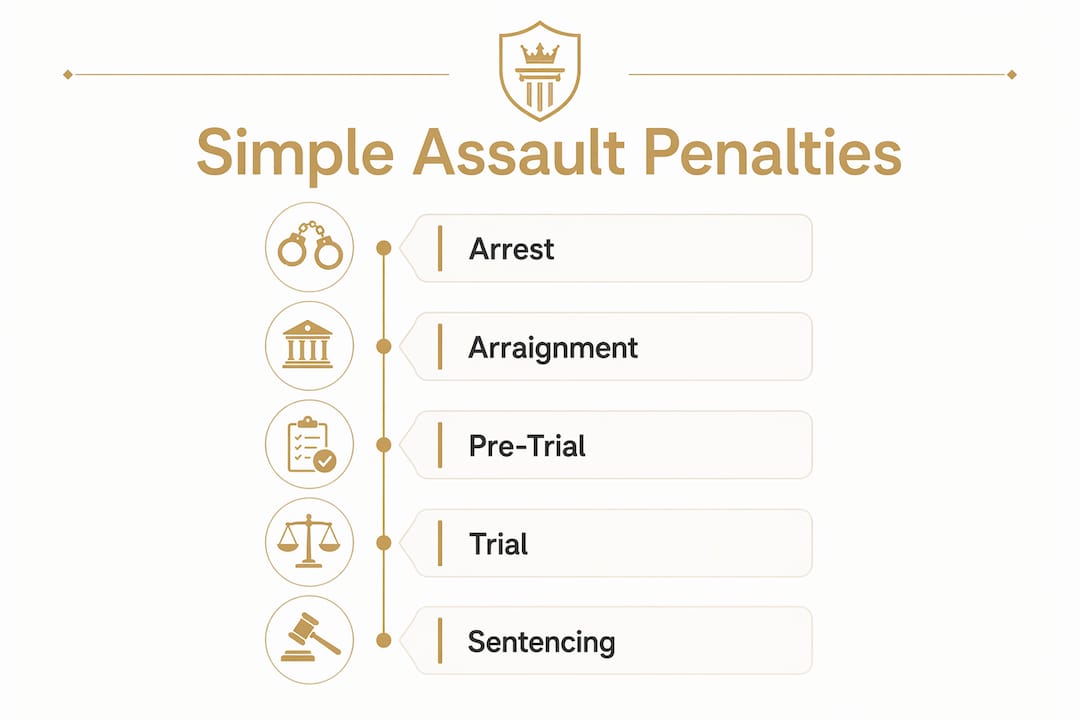
What happens after you are charged with simple assault in California?
The criminal process moves quickly once an arrest is made. Knowing what to expect at each stage helps you make better decisions and avoid costly mistakes.
Arrest and booking. After an arrest, you are booked at a local jail. Depending on the circumstances, you may be released on your own recognizance or required to post bail.
Arraignment. This is your first court appearance, typically within 48 hours of arrest for those in custody. The judge reads the charges, and you enter a plea of guilty, not guilty, or no contest. Entering a not guilty plea at arraignment preserves your options and gives your attorney time to review the evidence.
Pre-trial proceedings. Between arraignment and trial, your attorney can file motions to suppress evidence, challenge the sufficiency of the charges, or negotiate with the prosecutor. This is where plea bargaining most often happens. A prosecutor may offer to reduce a §240 charge to an infraction or dismiss it entirely in exchange for a plea to a lesser offense, particularly if the evidence is weak or the defendant has no prior record.
Trial. If no plea agreement is reached, the case goes to trial. For a misdemeanor like simple assault, you have the right to a jury trial. The prosecution must prove every element of the charge beyond a reasonable doubt. Your attorney can challenge witnesses, present evidence, and argue that the prosecution has not met its burden.
Sentencing. If convicted, sentencing follows. The judge considers the facts of the case, your criminal history, and any mitigating factors your attorney presents before imposing a sentence within the statutory range.
How does intent shape whether an act becomes simple assault?
Intent is the hinge on which many §240 cases turn. California assault is a general intent crime, which means the prosecution only needs to prove you acted willfully, not that you specifically intended to frighten or harm the other person. But the circumstances surrounding the act still matter enormously in how a case is charged and argued.
Context determines whether an act looks willful or accidental. A person who swings their arm during an animated conversation and accidentally grazes someone has not committed assault. A person who swings their arm toward someone’s face during an argument, even if they stop short, almost certainly has. The difference lies in what a reasonable person in the defendant’s position would have understood about the probable result of their action.
The relationship between the parties also shapes the analysis. An act between strangers in a bar is read differently than the same act between people with a documented history of conflict. Prior restraining orders, past police reports, and the sequence of events leading up to the incident all feed into how prosecutors and juries evaluate intent.
Circumstantial evidence carries significant weight in these cases. Text messages sent before the incident, witness accounts of what was said, and video footage of body language can all speak to whether the defendant’s act was purposeful. Defense attorneys look for gaps and inconsistencies in this evidence because the prosecution’s intent argument is only as strong as the facts supporting it.
Real examples of how California courts have applied simple assault law
California courts have worked through the boundaries of §240 in ways that clarify what the statute covers and what it does not.
The “conditional threat” problem. California courts have held that a conditional threat, one that says “if you do X, I will hurt you,” does not automatically constitute assault. The act must place the victim in reasonable apprehension of imminent harm. A threat tied to a future condition, with no immediate action to carry it out, typically falls short of the present ability requirement.
Indirect force. Courts have confirmed that assault does not require the defendant to personally touch the victim. Throwing an object at someone, even if it misses, can satisfy the elements of §240 if the defendant had the present ability to cause it to make contact. The California Supreme Court addressed the scope of “present ability” in People v. Williams (2001), clarifying that the defendant must have had the actual, not merely theoretical, capacity to apply force at the moment of the act.
The role of injury. No injury is required for a §240 conviction, but if an injury did occur, courts allow juries to consider it as evidence that force was applied. The absence of injury does not defeat the charge; it simply means the prosecution must rely more heavily on witness testimony and other circumstantial evidence to establish that the act would probably have resulted in force.
Transferred intent does not apply. Under California law, the doctrine of transferred intent, which holds that intent directed at one person transfers to an unintended victim, does not apply to general intent crimes like assault. If a defendant swings at Person A and nearly hits Person B, the charge must be evaluated based on the defendant’s conduct toward each person separately.
Key Takeaways
Simple assault under California Penal Code §240 is a misdemeanor requiring willful conduct and present ability to apply force, carrying up to six months in county jail and a $1,000 fine, with strong defenses available when the facts support them.
| Point | Details |
|---|---|
| No contact required | A §240 charge does not require physical contact; the attempt itself is enough. |
| Penalties are capped | Maximum penalties are six months in county jail and a $1,000 fine, plus possible probation and restitution. |
| Intent is general, not specific | The prosecution only needs to prove willfulness, not that you intended to injure anyone. |
| Convictions stay on record | A simple assault conviction remains indefinitely unless successfully expunged under Penal Code §1203.4. |
| Defense starts early | Mitigation packets and documented self-defense presented before trial can lead to reduced charges or dismissal. |