
California does not have a single “stand your ground” statute. Instead, the no-duty-to-retreat principle lives in appellate case law dating back to People v. Estrada (1923) and in two Judicial Council jury instructions: CALCRIM No. 3470 (non-homicide self-defense) and CALCRIM No. 505 (justifiable homicide). Those instructions, not a codified law, are what a jury reads when deciding whether your use of force was legally justified.
Three rules matter most right now:
- No statutory duty to retreat for a non-aggressor, whether in public or at home
- Self-defense requires a reasonable belief of imminent harm, immediate necessity, and proportional force
- Criminal acquittal does not eliminate civil liability — California offers no statutory civil immunity tied to self-defense
“A person who is not the initial aggressor and is not engaged in mutual combat has no duty to retreat before using force in self-defense.” — CALCRIM No. 3470, Judicial Council of California
If you used force and are now facing charges or a civil claim, the sections below explain exactly how California’s framework works and what to do next.
Table of Contents
- Does California have a stand your ground law?
- What are the legal elements required to claim self-defense?
- When is deadly force permitted, and how does the castle doctrine apply?
- Why a criminal acquittal doesn’t eliminate your civil risk
- What to do immediately after any incident involving force
- How defense attorneys actually build a stand-your-ground case
- Will California ever enact a stand-your-ground statute?
- When should you contact a criminal defense lawyer immediately?
- Key Takeaways
- The part most people underestimate about these cases
- Gracelegalgroup can help you protect your rights after a use-of-force incident
- Useful sources and further reading
Does California have a stand your ground law?
California’s self-defense framework produces the same practical result as a statutory stand-your-ground law, but it gets there differently. There is no single bill you can point to. The rule is embedded in common law and jury instructions, applied case by case through CALCRIM Nos. 3470 and 505.
That distinction matters more than it sounds. In states with codified stand-your-ground statutes, a defendant can often request a pretrial immunity hearing to get charges dismissed before trial. California has no such mechanism. Your self-defense claim is argued to a jury at trial, and the prosecution must disprove it beyond a reasonable doubt.
How the rule is sourced:
- People v. Estrada (1923) established the no-retreat principle in California appellate law
- CALCRIM No. 3470 applies it to non-lethal force situations
- CALCRIM No. 505 applies it to homicide cases, explicitly allowing a defendant to pursue an assailant until the danger has passed
- Penal Code § 198.5 adds a statutory presumption specifically for home defense
What the rule does not do:
- It does not create automatic immunity from prosecution
- It does not shield you from civil lawsuits
- It does not apply if you were the initial aggressor or provoked the confrontation
“The no-retreat rule has been recognized in California appellate law since at least 1923 and is applied through CALCRIM 3470 and 505.” — Kearnan Consulting Group
The National Conference of State Legislatures tracks which states have codified stand-your-ground statutes; California is not on that list, which is exactly why understanding the jury-instruction framework is so critical here.
What are the legal elements required to claim self-defense?
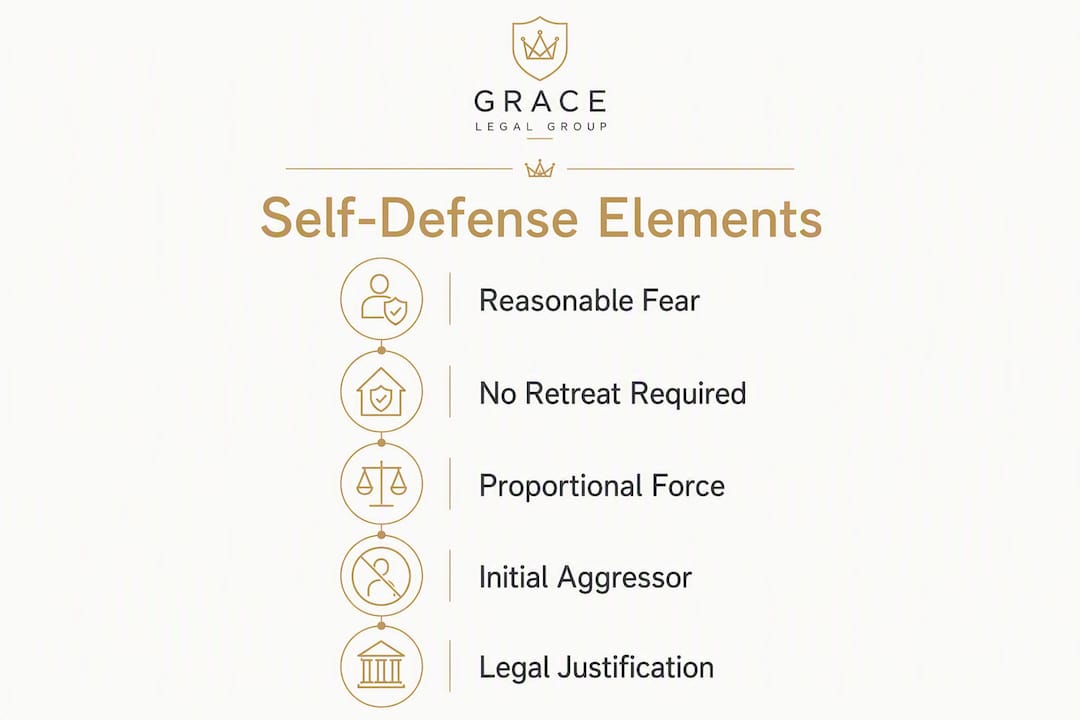
CALCRIM No. 3470 lays out three elements a jury must find before acquitting on self-defense grounds. All three must be present. Missing even one gives the prosecution an opening.
The three core elements:
- Reasonable belief of imminent harm. You genuinely believed you or someone else faced imminent bodily injury or an unlawful touching. “Imminent” means right now, not a future threat or a fear based on past events alone.
- Immediate necessity. You believed force was necessary at that moment to prevent the harm. A threat that could have been resolved without force, or one that had already passed, fails this element.
- Proportional force. You used no more force than a reasonable person would consider necessary under the circumstances. Responding to a shove with a firearm, for example, invites serious scrutiny on this element.
The initial aggressor rule
If you started the fight, threatened the other person first, or provoked the confrontation, you generally cannot claim self-defense unless you clearly withdrew from the conflict and communicated that withdrawal. Courts look at the full sequence of events, not just the moment force was used.
How juries evaluate “reasonable belief”
The standard is objective, not purely subjective. A jury asks: would a reasonable person in your exact situation, knowing what you knew, have believed force was necessary? Relevant factors include the size and apparent strength of the threat, any weapons present, prior threats (when admissible), and whether a safe exit was obviously available.
That last point deserves attention. California does not require you to retreat, but prosecutors can argue that an obvious, safe escape route undercuts the reasonableness of your belief that force was necessary. The retreat option does not create a legal duty; it becomes an evidentiary argument about whether your response was reasonable.
Quick scenarios:
- Public altercation: Someone charges at you in a parking lot. You have no duty to run. But if you had a clear path to your car and chose to engage instead, expect that fact to come up at trial.
- Threatened assault: A person raises a weapon and advances. Reasonable belief of imminent harm is strong here; proportional force is the question.
- Misperceived threat: You believed someone reaching into their jacket was drawing a weapon. Juries weigh whether that belief was objectively reasonable given all the circumstances, not just your fear in the moment.
When is deadly force permitted, and how does the castle doctrine apply?
Deadly force carries a higher threshold. You must reasonably believe it was necessary to prevent death or great bodily injury (GBI) to yourself or someone else. That standard comes directly from CALCRIM No. 505, which governs justifiable homicide cases.
Key rules for deadly force:
- The threat must be imminent, not speculative
- The force must be proportional to the perceived danger
- You may pursue an assailant if reasonably necessary to prevent the danger from continuing, per CALCRIM No. 505
- Using deadly force in response to a non-deadly threat is almost always prosecuted
How Penal Code § 198.5 changes the calculus at home
California’s castle doctrine, codified in Penal Code § 198.5, creates a presumption of reasonable fear when you use deadly force against someone who unlawfully and forcibly enters your home. You do not have to prove your fear was reasonable; the prosecution must rebut the presumption.

That presumption applies only to your residence. Step outside onto the street, and you are back to the standard CALCRIM 505/3470 framework with no presumption in your favor.
Home vs. public space, side by side:
- Inside your home: Penal Code § 198.5 presumption applies; forcible unlawful entry triggers it; burden shifts toward the prosecution to disprove reasonable fear
- Public space: No presumption; you must establish all three elements; prosecutor may argue available retreat undercuts reasonableness
- Curtilage (yard, driveway): Courts have addressed this inconsistently; the presumption does not extend as cleanly as it does inside the dwelling itself
A word on firearms. Defending your home with a gun is legal in California when the castle doctrine conditions are met, but firearm-specific rules layer on top. If you carried a firearm without a permit or transported it unlawfully before the incident, those facts can complicate your defense significantly. Understanding California’s gun carry laws before an incident is far better than explaining them after one.
Deadly force cases also draw greater scrutiny from prosecutors at the charging stage. Even a legally justified shooting can result in arrest, grand jury proceedings, and months of litigation before a jury ever hears the self-defense argument.
Why a criminal acquittal doesn’t eliminate your civil risk
This is the part most people miss. A not-guilty verdict in criminal court does not close the book on your legal exposure.
Criminal cases require the prosecution to prove guilt beyond a reasonable doubt. Civil cases use a much lower bar: preponderance of the evidence, meaning more likely than not. The same set of facts that produced an acquittal can still support a civil judgment against you.
California provides no statutory civil immunity tied to a self-defense finding. States with codified stand-your-ground laws sometimes include civil immunity provisions; California’s jury-instruction framework does not.
Potential civil claims after a use-of-force incident:
- Wrongful death (if the other party died)
- Personal injury (if they survived with injuries)
- Intentional infliction of emotional distress
- Battery (civil, separate from criminal battery)
Damages can include compensatory amounts for medical bills, lost income, and pain and suffering, and in some cases punitive damages if the conduct is found to be malicious or oppressive.
Pro Tip: Review your homeowners’ or renters’ insurance policy now. Many personal liability policies cover civil claims arising from incidents on your property, but coverage terms vary widely. An attorney can help you understand whether your insurer has a duty to defend you and whether early notification of a potential claim is required.
What to do immediately after any incident involving force
The decisions you make in the first hours after a use-of-force incident can shape your entire legal position. Here is the sequence that matters.
Do these things:
- Call 911 if anyone is injured or if there is an ongoing threat. Failure to report can be used against you later.
- Seek medical attention for yourself and anyone else who needs it. Document your injuries with photos before treatment if possible.
- Preserve evidence. Do not move anything at the scene. Photograph the scene, any weapons, property damage, and your own injuries from multiple angles.
- Write a contemporaneous account. While your memory is fresh, write down exactly what happened, in sequence, including what you saw, heard, and believed at each moment. Keep this private.
- Get witness contact information. Names and phone numbers of anyone who saw the incident, before they leave.
- Contact a criminal defense attorney before giving any detailed statement to police. This is not about hiding facts. It is about making sure your account is accurate, complete, and not inadvertently self-incriminating.
Do not do these things:
- Do not alter the scene or move evidence
- Do not delete texts, voicemails, social media messages, or video footage related to the incident
- Do not post about the incident on social media
- Do not admit fault or apologize to anyone at the scene, including police
- Do not give a recorded statement without your attorney present
On the question of cooperating with police: you can and should confirm basic safety information (who needs medical help, whether there is still a threat). For anything beyond that, politely state that you want to speak with an attorney before answering detailed questions. That is a constitutional right, not an admission of guilt.
How defense attorneys actually build a stand-your-ground case
Because California has no pretrial immunity hearing, self-defense is litigated at trial. That means the defense team’s job begins the moment a client calls, not the week before trial.
Evidence priorities, in order of impact:
- Contemporaneous medical records documenting your injuries
- Surveillance video, dashcam footage, or bodycam recordings from responding officers
- Physical evidence at the scene (weapon placement, shell casings, blood patterns)
- Witness statements taken as close to the incident as possible
- Prior threats or documented history of violence by the other party (admissibility varies)
- A precise timeline reconstruction showing the sequence of events
The prosecution’s central argument in most of these cases is that the defendant’s belief was not objectively reasonable. Every piece of evidence the defense team assembles either supports or undermines that reasonableness narrative. A surveillance video that shows the other party advancing aggressively is worth more than a hundred character witnesses.
What a defense firm actually prepares
Firms like Gracelegalgroup build detailed mitigation packets that tell the client’s full story to prosecutors before charges are formally filed or while plea negotiations are open. These packets include investigator reports, ex-law-enforcement case reviews that analyze the physical evidence the way a detective would, medical documentation, and character materials that humanize the client. The goal is to influence the charging decision before it becomes a trial.
A well-assembled mitigation packet and early ex-law-enforcement review often shift the dynamic in cases where the facts are genuinely disputed. Prosecutors respond to organized, credible defense presentations differently than they respond to a client who shows up without counsel.
Pro Tip: Ask any attorney you consult whether they use former law enforcement professionals to review the physical evidence. An ex-detective reading a police report sees things a pure litigator might miss, and that analysis can surface inconsistencies in the prosecution’s theory before trial.
Two-attorney teams also matter in complex use-of-force cases. One attorney manages the criminal defense track; the other monitors civil exposure and coordinates with insurers. That coordination prevents statements made in one proceeding from creating liability in the other.
Understanding criminal defense strategies at a structural level helps you ask better questions when you sit down with a defense attorney.
Will California ever enact a stand-your-ground statute?
California’s legislative history on this question is unsettled. AB 1333 proposed adding a retreat requirement outside the home, which would have moved California in the opposite direction from statutory stand-your-ground states. That bill was met with significant backlash and was ultimately repealed or withdrawn, leaving the existing common-law framework intact.
The episode signals two things: there is ongoing legislative interest in changing California’s retreat rules, and neither side has the votes to make a durable statutory change.
What would change if a stand-your-ground statute passed:
- Possible pretrial immunity hearings, shifting the burden to the prosecution to disprove self-defense before trial
- Codified civil immunity provisions (as some other states include)
- A clearer statutory record for appellate courts to interpret
What would change if a retreat-requirement bill passed:
- Duty to retreat in public spaces before using force
- Narrower self-defense claims outside the home
- Greater prosecutorial leverage in charging decisions
How to track future bills:
- California Legislative Information (official bill text and status)
- Giffords Law Center tracks state-level self-defense law changes
- NCSL’s self-defense law tracker compares state statutes
The current framework is judge-and-jury driven, which means outcomes vary more than they would under a clear statute. That unpredictability is itself a reason to have experienced counsel.
When should you contact a criminal defense lawyer immediately?
Some situations call for information-gathering. Others call for a phone call to an attorney before you do anything else.
Contact a criminal defense attorney immediately if:
- You have been arrested or booked in connection with a use-of-force incident
- Police have told you that you are under investigation, even informally
- You have been asked to give a recorded statement about the incident
- Someone was injured or killed, regardless of whether you have been charged yet
- You have received a civil demand letter or notice of a lawsuit related to the incident
- You are unsure whether your actions were legally justified and want to understand your exposure before speaking to anyone
Early attorney involvement does several things that cannot be replicated later. An attorney can communicate with investigators on your behalf, preventing inadvertent self-incrimination. They can coordinate evidence preservation before it disappears. They can assess whether the facts support a strong self-defense narrative or whether a negotiated resolution is more realistic. And they can notify your insurer in a way that preserves your coverage rights.
Representing yourself in a criminal matter involving force is a serious risk. The procedural rules, evidentiary standards, and charging dynamics in use-of-force cases are complex enough that even attorneys hire other attorneys when they face criminal charges themselves.
The earlier you secure counsel, the more options remain open.
Key Takeaways
California’s no-duty-to-retreat rule is real and enforceable, but it lives in jury instructions and case law rather than a single statute, which means every use-of-force case is litigated on its specific facts with no pretrial immunity shortcut.
| Point | Details |
|---|---|
| No single SYG statute | California’s no-retreat rule comes from CALCRIM Nos. 3470 and 505 and appellate case law, not a codified law. |
| Three required elements | Self-defense requires reasonable belief of imminent harm, immediate necessity, and proportional force. |
| Castle doctrine presumption | Penal Code § 198.5 creates a presumption of reasonable fear for home defense; no equivalent presumption applies in public. |
| Civil exposure remains | California offers no statutory civil immunity after a self-defense finding; a civil lawsuit can follow a criminal acquittal. |
| Gracelegalgroup’s approach | Gracelegalgroup builds mitigation packets with ex-law-enforcement review and two-attorney teams to influence charging decisions and prepare for trial. |
The part most people underestimate about these cases
The popular image of a stand-your-ground defense is someone invoking a law and walking free. California does not work that way, and honestly, neither does any other state when the facts are genuinely contested.
What actually determines outcomes in California use-of-force cases is the quality of the evidentiary record assembled in the first days after an incident, and whether the defense team can construct a coherent, credible narrative before the prosecution locks in its theory. Prosecutors make charging decisions early. Those decisions are influenced by what they see in front of them: a well-documented, represented defendant with a clear self-defense timeline, or an unrepresented person whose statements are inconsistent and whose evidence has degraded.
The civil exposure angle is equally underestimated. A criminal acquittal feels like vindication, and it is. But the family of the person you defended yourself against can still file a wrongful death suit the following week. California’s lack of statutory civil immunity means that exposure is real and separate. Defense strategy needs to account for both tracks from day one, not after the criminal case closes.
The other thing worth saying plainly: the “reasonable belief” standard sounds simple until a jury applies it to your specific facts. An obvious available exit that you did not take, a prior argument with the other party, a text message sent an hour before the incident — any of these can reframe what looked like a clear self-defense situation into something much harder to defend. That is not a reason to panic. It is a reason to take the legal process seriously and get experienced help early.
Gracelegalgroup can help you protect your rights after a use-of-force incident
When you have used force to defend yourself and are now facing criminal charges, an investigation, or a civil claim, the gap between a good outcome and a devastating one usually comes down to how quickly and how thoroughly your defense is built.

Gracelegalgroup is a Los Angeles criminal defense firm that handles exactly these situations. Every case gets two dedicated attorneys, a detailed mitigation packet that tells your full story to prosecutors, and a case review by former law enforcement professionals who analyze the physical evidence the way investigators do. That combination gives you the best chance of influencing charging decisions before they become trial verdicts.
The firm’s faith-based approach means your case is handled with genuine care for your outcome, not just the legal mechanics. If you used force and need to understand your options, the right time to call is now, before you give any statement and while the evidence is still fresh. Explore the defenses available in your case or contact Gracelegalgroup directly for a confidential consultation.
Useful sources and further reading
The primary sources below are the actual texts that govern California self-defense law. Reading the jury instructions yourself is worth the time.
- CALCRIM No. 3470 — Right to Self-Defense or Defense of Another (Non-Homicide): the controlling jury instruction for non-lethal force cases; includes the no-duty-to-retreat language
- CALCRIM No. 506 — Justifiable Homicide: Defending Against Harm to Person Within Home or on Property: the castle doctrine instruction with the home-defense presumption language
- California Penal Code § 198.5: the statutory castle doctrine presumption for home defense
- Giffords Law Center — Stand Your Ground in California: tracks California’s self-defense law status and legislative activity
- NCSL — Self-Defense and Stand Your Ground: national comparison of state statutes, useful for understanding how California differs
- California Legislative Information: official source for tracking current and pending bills on retreat rules and self-defense statutes
- People v. Humphrey (1996): California Supreme Court decision addressing the objective/subjective reasonableness standard in self-defense cases
This article is general legal information, not legal advice. Self-defense law turns on specific facts, and California statutes and case law change. Confirm current rules with a qualified California criminal defense attorney before making any decisions about your situation.