
The statute of limitations California law establishes is a hard legal deadline. Miss it by even one day, and courts lose jurisdiction over your claim forever, regardless of how strong your case is. California’s California Code of Civil Procedure (CCP) and Penal Code (PC) set these deadlines for every civil and criminal case type, from personal injury at 2 years under CCP § 335.1, to written contracts at 4 years under CCP § 337, to murder with no limit at all under PC § 799. Understanding these timelines is not optional. It is the foundation of any viable legal strategy.
What are the time limits for common civil claims in California?
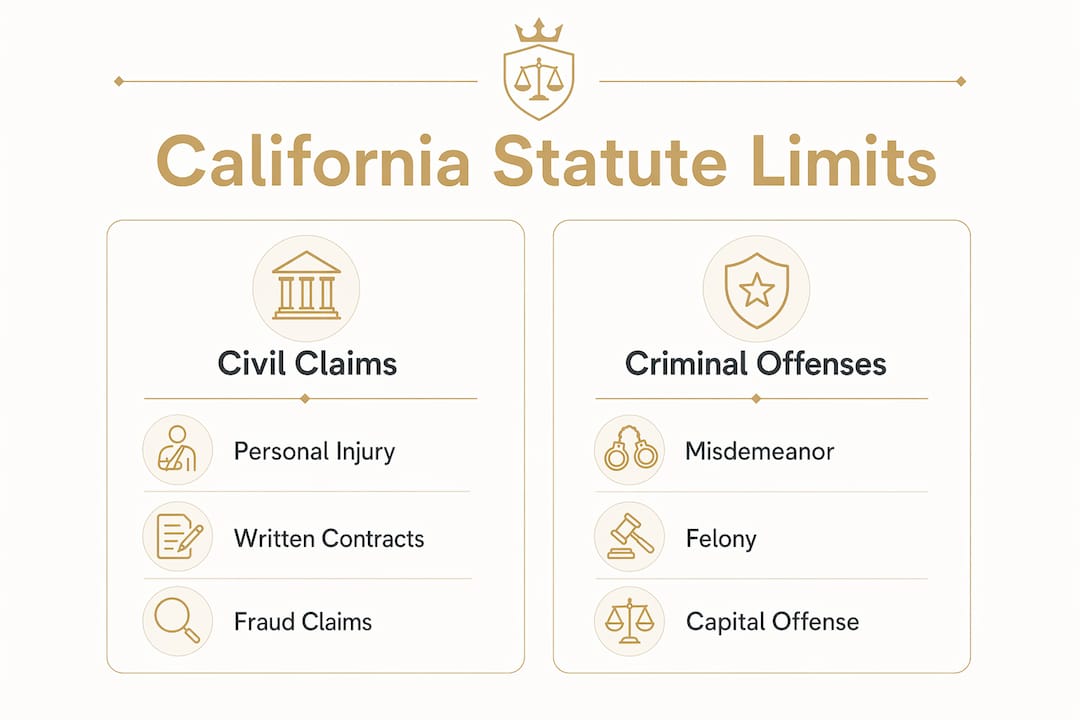
California’s civil filing deadlines vary significantly by claim type. Personal injury claims carry a 2-year limit under CCP § 335.1, while written contracts allow 4 years under CCP § 337. Oral contracts drop to 2 years under CCP § 339, and property damage claims allow 3 years under CCP § 338. Defamation is the tightest at just 1 year under CCP § 340©.
The clock typically starts on the date the injury or harm occurs. This is called accrual. For fraud claims, CCP § 338(d) applies a 3-year period measured from the date you discovered, or reasonably should have discovered, the fraud. That distinction matters enormously in practice.

| Claim type | Time limit | Code section |
|---|---|---|
| Personal injury | 2 years | CCP § 335.1 |
| Written contract | 4 years | CCP § 337 |
| Oral contract | 2 years | CCP § 339 |
| Property damage | 3 years | CCP § 338 |
| Defamation | 1 year | CCP § 340© |
| Fraud | 3 years from discovery | CCP § 338(d) |
The discovery rule is a narrow exception, not a general extension. It applies when a plaintiff could not reasonably have known about the injury at the time it occurred. Courts require plaintiffs to prove they had no earlier opportunity to discover the harm.
Pro Tip: If you are unsure whether the discovery rule applies to your civil claim, document every date you first noticed symptoms, received a diagnosis, or learned of potential wrongdoing. That paper trail is your evidence if you need to justify a delayed filing.
How does the statute of limitations apply to criminal offenses in California?
California’s criminal deadlines are set by the Penal Code and depend on the severity of the offense. Misdemeanors carry a 1-year limit under PC § 802(a). Most felonies fall under a 3-year window per PC § 801, though more serious felonies extend to 6 years under PC § 800. Murder, certain sex crimes, and other capital offenses carry no statute of limitations under PC § 799.
The clock starts when the offense is committed, or in some cases, when it is discovered. For fraud-based felonies and elder abuse, the discovery rule can shift the start date to when the crime was uncovered. Sexual offenses against minors follow special rules. Prosecution can begin when the victim turns 40 years old, or within 10 years of a report to law enforcement, whichever is later.
| Offense type | Time limit | Code section |
|---|---|---|
| Misdemeanor | 1 year | PC § 802(a) |
| Standard felony | 3 years | PC § 801 |
| Serious felony | 6 years | PC § 800 |
| Murder, capital crimes | No limit | PC § 799 |
| Fraud, elder abuse felonies | From discovery | PC § 803 |
Understanding how long the DA has to file charges is critical if you are facing a potential prosecution. Prosecutors must formally commence the case within the applicable window, but filing an arrest warrant or complaint before the deadline satisfies the requirement even if the trial occurs later.
Pro Tip: An arrest warrant filed before the deadline stops the clock. If you learn a warrant was issued against you years ago, the limitation period may already be satisfied. Consult an attorney immediately to assess your exposure.
What exceptions and pauses can affect the statute of limitations deadlines?
Tolling is the legal term for pausing the statute of limitations clock. California law recognizes several tolling provisions that can extend your filing window beyond the standard deadline.
Key tolling rules under California law include:
- Minors and incapacitated persons: Under CCP § 352, the clock does not start until the minor turns 18 or the incapacitated person regains legal capacity.
- Incarcerated persons: CCP § 352.1 allows up to 2 years of tolling for individuals serving a sentence of less than life.
- Fraudulent concealment: When a defendant actively hides the wrongdoing, the clock pauses until the plaintiff discovers or should have discovered the claim.
- Equitable tolling: Courts may pause deadlines when a plaintiff pursued a related legal remedy in good faith, was not negligent, and the defendant was not prejudiced.
Suing a government entity adds another layer of complexity. Under the Government Claims Act, you must file an administrative claim within 6 months of the incident. After the agency rejects your claim, you have 6 more months to file suit in court. Missing either deadline is a jurisdictional bar, not a procedural technicality.
Construction defect claims operate under a separate rule entirely. The statute of repose under CCP § 337.15 sets a hard 10-year cutoff from the date of substantial project completion. No tolling provision overrides this cap. That makes it one of the strictest deadlines in California civil law.
Pro Tip: Tolling gives you more time, but it does not give you unlimited time. Evidence degrades, witnesses forget details, and documents disappear. Acting as soon as possible always produces a stronger case than waiting until the last tolled day.
How do accrual rules and the discovery rule affect when the clock starts?
Accrual is the moment all elements of a legal claim exist and the law recognizes the injury. For most civil claims, accrual begins at the time of injury. For most criminal charges, it begins when the offense is committed. That starting point determines everything.
The discovery rule shifts the accrual date to when the plaintiff first knew, or reasonably should have known, about the injury. Courts apply it narrowly. It covers situations like latent medical injuries, childhood abuse claims, and fraud where the harm was hidden. The burden falls on the plaintiff to prove they could not have discovered the injury earlier through reasonable diligence.
Consider two scenarios. A car accident victim knows immediately that they were injured. Their 2-year clock starts that day. A patient who develops complications from a surgical implant years later may not discover the connection until a doctor identifies it. Their clock starts at discovery, not at the surgery date. That difference can mean the difference between a valid claim and a dismissed one.
Key rules governing deadline calculation under California law:
- The day the triggering event occurs is excluded from the count.
- Deadlines falling on weekends or court holidays automatically extend to the next court day under CCP §§ 12a and 12c.
- Forward-counting deadlines (from an event) and backward-counting deadlines (before a court date) follow different counting rules under CCP § 12.
- Misidentifying the accrual date is one of the most common reasons valid claims get dismissed.
Pro Tip: Never calculate your own deadline without verifying whether the discovery rule or a tolling provision applies. A single wrong assumption about the start date can permanently end your legal rights.
Key Takeaways
California’s statute of limitations sets firm, jurisdictional deadlines that courts enforce without exception, making early legal action the single most reliable way to protect your rights.
| Point | Details |
|---|---|
| Civil deadlines vary by claim | Personal injury allows 2 years; written contracts allow 4 years; defamation allows only 1 year. |
| Criminal limits depend on severity | Misdemeanors expire in 1 year; most felonies in 3–6 years; murder carries no limit. |
| Tolling can pause the clock | Minors, incapacitated persons, and fraud victims may qualify for extended filing windows. |
| Government claims need extra steps | You must file an administrative claim within 6 months before suing a public entity. |
| Accrual date is the critical variable | Misidentifying when your claim started is the most common cause of preventable dismissals. |
Why I think most people underestimate California’s filing deadlines
Most people assume the legal system will give them a fair warning before a deadline expires. It does not. Courts do not send reminders, and judges do not grant extensions out of sympathy. I have seen cases with clear liability and real harm get dismissed purely because the plaintiff waited too long, often by just a few weeks.
The part that surprises people most is how the discovery rule actually works in practice. Many assume it gives them years of flexibility whenever they did not know about the harm right away. Courts apply it far more narrowly than that. If a reasonable person in your situation would have investigated sooner, the clock started sooner. That is a hard standard to meet after the fact.
The tolling provisions for minors and incarcerated individuals are genuinely protective, but they create a false sense of security. Waiting until the last tolled day means working with old evidence, unavailable witnesses, and faded memories. Every month of delay costs you something, even when the law technically allows more time.
My honest advice: treat the standard deadline as your real deadline. Use tolling only as a safety net, not a plan. The clients who come in early give their attorneys the most to work with. The ones who come in at the final hour often face an uphill battle even when the law is on their side.
— Jake
How Gracelegalgroup can help you protect your rights
Missing a filing deadline is not just a procedural setback. It permanently ends your ability to pursue justice. Gracelegalgroup is a Los Angeles-based criminal defense firm with deep experience in cases where timing is everything.

Whether you are facing a criminal charge with a tight prosecution window or need to understand whether a tolling provision applies to your situation, Gracelegalgroup assigns two dedicated attorneys to every case. Their team includes former law enforcement professionals who know exactly how prosecutors calculate and exploit deadlines. If you are unsure whether your window is still open, the time to ask is now. Review your available criminal defenses with an attorney who understands how California’s timelines affect every strategy. Contact Gracelegalgroup for a free consultation before the clock runs out.
FAQ
What is the statute of limitations for personal injury in California?
California personal injury claims must be filed within 2 years of the injury under CCP § 335.1. The clock starts on the date of the incident, unless the discovery rule applies.
Can the statute of limitations be paused in California?
Yes. California law pauses the clock for minors, incapacitated persons, and incarcerated individuals, and also when a defendant commits fraudulent concealment. CCP § 352.1 allows up to 2 years of tolling for qualifying incarcerated persons.
Is there a statute of limitations for murder in California?
No. Murder and other capital offenses carry no filing deadline under PC § 799. Prosecutors can file charges at any time, regardless of how long ago the crime occurred.
What happens if I sue a California government agency?
You must file an administrative claim within 6 months of the incident under the Government Claims Act. After the agency rejects your claim, you have 6 months to file suit in court. Missing either step bars your case entirely.
What is a statute of repose in California?
A statute of repose is a hard deadline that cannot be extended by tolling or the discovery rule. Construction defect claims, for example, must be filed within 10 years of project completion under CCP § 337.15, no exceptions.