
California holds drivers under 21 to a far stricter standard than adults. While adults face DUI charges at a blood alcohol content of 0.08%, an underage driver can lose their license at just 0.01% BAC — a level so low that a single sip of alcohol could theoretically trigger it. Three separate Vehicle Codes govern these situations: VC 23136 (zero tolerance), VC 23140 (BAC 0.05% or higher), and VC 23152 (the standard adult DUI statute). Each carries its own penalties, and they can stack. If you or someone you know is facing an under 21 DUI in California, understanding exactly which law applies and what happens next is the difference between a manageable outcome and a conviction that follows you for years.
What does an under 21 DUI in California actually mean?
California’s underage DUI framework is built around three thresholds, and each one triggers a different legal response. Here is the core breakdown:
- 0.01% BAC or higher (VC 23136): The zero tolerance law. This is an administrative violation, not a criminal charge, but it still results in a mandatory one-year license suspension.
- 0.05% BAC or higher (VC 23140): A civil infraction with real consequences of fines, mandatory DUI education programs, and license suspension.
- 0.08% BAC or higher (VC 23152): The full adult DUI statute. Criminal prosecution, potential jail time, probation, and significantly higher fines all apply here.
Beyond alcohol, California treats drug-impaired driving the same as alcohol DUI. Driving under the influence of marijuana, prescription medications, or any other substance falls under the same legal framework, with costs reaching $13,500 when you factor in attorney fees, insurance hikes, and court costs.
After an arrest, your first 10 days matter most. The California Department of Motor Vehicles (DMV) gives you only 10 days from the date of arrest to request a hearing to contest your license suspension. Miss that window, and the suspension becomes automatic. Contact an attorney immediately, request the DMV hearing, and do not discuss the details of your case with anyone except your lawyer.
1. California Vehicle Code 23136: The zero tolerance law explained
California Vehicle Code 23136 is the foundation of California’s underage drinking and driving enforcement. It sets a BAC threshold of 0.01% for drivers under 21, which is essentially any detectable amount of alcohol. The law does not require proof of impairment. If a preliminary alcohol screening (PAS) test or chemical test shows 0.01% or more, the violation is established.
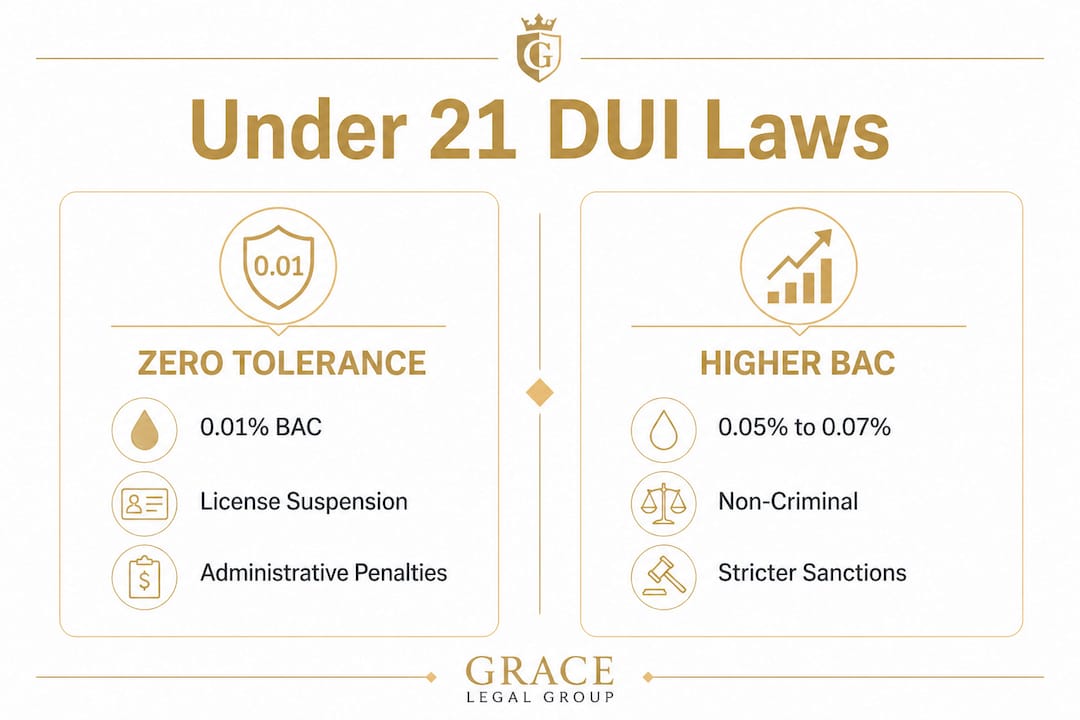
Because VC 23136 is an administrative law rather than a criminal statute, the consequences flow entirely through the DMV, not the courts. You will not face a criminal record for a BAC between 0.01% and 0.04% under this code alone. But the DMV penalties are real and immediate.
Penalties under VC 23136:
- One-year license suspension for a first offense
- Two-year revocation for a second offense within 10 years
- Three-year revocation for a third or subsequent offense within 10 years
- A $100 reissue fee (lower than the standard $125 fee for adult DUI suspensions) to reinstate your license after the suspension ends
- Mandatory completion of a licensed DUI program before reinstatement
The administrative process moves fast. When an officer detains a driver under 21 and a PAS test shows 0.01% or higher, the officer typically issues an Order of Suspension on the spot and confiscates the license. That order serves as a temporary license for 30 days. After that, the suspension kicks in unless you have requested a DMV hearing.
Scenarios covered by VC 23136 include any situation where an underage driver is stopped at a checkpoint, pulled over for a traffic violation, or involved in an accident and a PAS test reveals any alcohol. The law applies even if the driver shows zero signs of impairment.
Pro Tip: Request your DMV hearing within 10 days of arrest, not 10 business days. Calendar days. Missing this deadline waives your right to contest the suspension administratively, and you will have no opportunity to argue the officer lacked reasonable cause to detain you.
2. California Vehicle Code 23140: When BAC reaches 0.05%
California Vehicle Code 23140 targets underage drivers with a BAC of 0.05% or higher. Unlike VC 23136, this statute is a civil infraction with court involvement, though it still falls short of a full criminal DUI charge. The law makes it unlawful for any person under 21 to drive with 0.05% or more alcohol by weight in their blood.
One important detail: a prosecutor can pursue a VC 23140 charge even without a chemical test result, provided there is evidence the driver consumed alcohol and was driving with a BAC at or above 0.05%. Witness testimony, officer observations, and field sobriety test results can all factor in.
Penalties under VC 23140:
- One-year license suspension (administrative, through the DMV)
- Fines associated with the infraction
- Mandatory enrollment in a licensed DUI education or treatment program
- No jail time under this statute alone, but the civil record can affect future cases
- Possible overlap with VC 23136 penalties if BAC also exceeds 0.01%
The key distinction between VC 23140 and the adult DUI statute (VC 23152) is that VC 23140 does not carry criminal penalties on its own. There is no misdemeanor or felony charge, no probation, and no criminal record from a standalone VC 23140 violation. That said, prosecutors sometimes file VC 23140 alongside other charges, and the DUI education program requirement is not optional.
For drivers whose BAC falls in the 0.05% to 0.07% range, VC 23140 is typically the primary charge. Once BAC hits 0.08%, the calculus shifts entirely.
3. How the adult DUI statute applies to drivers under 21
California Vehicle Code 23152 is the standard DUI law that applies to everyone, regardless of age. When an underage driver’s BAC reaches 0.08% or higher, they face the same criminal prosecution as an adult. The fact that they are under 21 does not reduce the charges under this statute. It can actually make things worse, because they are simultaneously subject to the zero tolerance administrative penalties through the DMV.
This dual-track system is one of the most misunderstood aspects of underage DUI law in California. The criminal case proceeds through the courts. The administrative suspension proceeds through the DMV. These are entirely separate proceedings with separate timelines, separate penalties, and separate opportunities to fight back.
Criminal penalties under VC 23152 for a first offense:
- Up to six months in county jail
- Fines ranging from $390 to $1,000, plus penalty assessments that can multiply the base fine several times over
- Three to five years of informal probation
- Mandatory DUI school (three months for a first offense at standard BAC; longer programs for higher BAC levels)
- A six-month license suspension through the criminal court, separate from the DMV administrative suspension
- Possible installation of an ignition interlock device (IID)
Repeat offenses escalate sharply. A second DUI conviction within 10 years brings longer jail time, a two-year license revocation, and an 18-month or 30-month DUI program. A third offense can result in felony charges. For underage drivers, understanding when a DUI becomes a felony is critical, because the line can be crossed faster than most people expect.
4. How BAC is measured and what happens if you refuse a test
California’s implied consent law means that any driver who operates a vehicle on a public road has already agreed, by law, to submit to chemical testing if lawfully arrested for DUI. For drivers under 21, this obligation extends even further: the implied consent law requires submission to a PAS test upon request by an officer who suspects underage drinking, even before a formal arrest.
Types of tests used in underage DUI cases:
- Preliminary Alcohol Screening (PAS): A handheld breath test administered roadside. For drivers under 21, this is mandatory upon request. Adults have the right to refuse a PAS before arrest; underage drivers do not.
- Evidentiary breath test: Administered at the station using a more accurate device (typically the Draeger Alcotest or similar equipment).
- Blood test: The most accurate method and the one most commonly used when drug impairment is suspected alongside alcohol.
- Urine test: Rarely used, typically only when breath and blood tests are unavailable.
When marijuana or other drugs are involved, blood testing becomes the primary tool. THC blood test accuracy is a genuinely contested area of science. Unlike alcohol, THC metabolites can remain in the bloodstream for days or weeks after use, meaning a positive result does not necessarily prove impairment at the time of driving. This is a significant defense angle in marijuana DUI California cases, and one that a skilled attorney can exploit.
Consequences of refusing a chemical test are severe. Under California DMV guidelines, an underage driver who refuses or fails to complete a PAS test or other chemical test faces:
- One-year suspension for a first refusal
- Two-year revocation for a second refusal within 10 years
- Three-year revocation for a third or subsequent refusal within 10 years
Refusal does not prevent prosecution. Prosecutors can use the refusal itself as evidence of consciousness of guilt at trial.
Pro Tip: Refusing a test does not help you. The suspension for refusal is the same length as the suspension for a positive test, but refusal eliminates your ability to challenge the BAC reading in court. You lose the test result as a defense tool and gain nothing.
5. License suspension, hardship licenses, and how to fight back
A license suspension after an underage DUI in California operates on two tracks simultaneously: the DMV administrative action and the court-ordered suspension. Both can run concurrently or consecutively depending on the outcome of each proceeding. Understanding how they interact is where many young drivers make costly mistakes.
Suspension durations and reinstatement requirements:
- Under VC 23136 (zero tolerance): one-year suspension for a first offense
- Under VC 23140 or VC 23152: one-year suspension for a first offense
- Reinstatement requires payment of a reissue fee ($100 for zero tolerance, $125 for other DUI suspensions) and proof of financial responsibility
- SR-22 insurance filing is mandatory for three years after reinstatement, and it typically causes premiums to spike by 50% or more during that period
Hardship licenses (formally called restricted licenses) allow some suspended drivers to continue driving to school, work, or DUI programs. However, underage drivers suspended under the zero tolerance law are generally not eligible for a restricted license during the suspension period. Eligibility depends on the specific charge and the driver’s history.
The DMV hearing process is your first line of defense against the administrative suspension. You must request this hearing within 10 days of arrest. At the hearing, a DMV officer (not a judge) reviews whether the officer had reasonable cause to believe you were driving with alcohol in your system, whether you were lawfully detained, and whether the test results were valid. Winning this hearing stops the administrative suspension entirely.
Strategies for challenging the suspension or charges include:
- Arguing the officer lacked reasonable cause to stop or detain you
- Challenging the calibration or maintenance records of the PAS device
- Contesting the chain of custody for blood samples
- Demonstrating procedural errors in how the test was administered
- Presenting evidence that the BAC reading was affected by mouth alcohol, medical conditions, or dietary factors
A DUI defense lawyer in California will typically subpoena the PAS device maintenance logs and the arresting officer’s training records as a first step. These documents reveal errors that never appear in the police report.
6. Legal defenses that actually work in underage DUI cases
The most effective defenses in underage DUI cases target the evidence before it ever reaches a jury. California law gives defendants meaningful tools to challenge both the stop itself and the reliability of the testing that followed.
Challenging the traffic stop: An officer must have reasonable suspicion of a traffic violation or criminal activity to pull you over. If the stop was pretextual or based on a hunch rather than an observable violation, any evidence gathered afterward may be suppressible under the Fourth Amendment. Sobriety checkpoints operate under specific constitutional requirements in California, and a checkpoint that fails to meet those standards can invalidate the stop entirely.
Attacking chemical test accuracy:
- PAS devices require regular calibration and maintenance. Records showing a device was out of calibration at the time of the test can undermine the BAC reading entirely.
- Blood samples must be properly stored, labeled, and analyzed. DUI blood lab errors, including contamination, fermentation of the sample, or improper handling, are more common than most people realize and can produce falsely elevated BAC readings.
- For marijuana DUI California cases, the absence of a per se THC limit in California law means the prosecution must prove actual impairment, not just the presence of THC metabolites in the blood. THC blood test accuracy issues give defense attorneys significant room to challenge these results.
Field sobriety test reliability: The three standardized field sobriety tests (the Horizontal Gaze Nystagmus test, the Walk-and-Turn, and the One-Leg Stand) have known accuracy limitations. Medical conditions, fatigue, anxiety, and uneven road surfaces all affect performance. A field sobriety test defense built around these variables can significantly weaken the prosecution’s case.
Procedural errors that can lead to dismissal include failure to advise of implied consent rights, improper observation periods before breath testing, and violations of Title 17 of the California Code of Regulations, which governs how chemical tests must be administered.
Mitigation and plea bargaining: When outright dismissal is not achievable, a well-prepared mitigation packet can shift the outcome substantially. Prosecutors respond to evidence of community ties, academic standing, employment, and voluntary enrollment in alcohol education programs. These factors do not erase the charge, but they change the conversation.
Pro Tip: Never plead guilty at your first court appearance. The initial offer from a prosecutor is rarely the best one available. An attorney who has reviewed the evidence, the officer’s training records, and the testing device logs will almost always find leverage that was not visible at arraignment.
7. Drug DUI and marijuana DUI: what underage drivers need to know
California’s drug DUI laws apply to every substance, not just alcohol. Driving under the influence of marijuana, prescription medications, over-the-counter drugs, or any combination of substances is treated identically to alcohol DUI under VC 23152. The California Office of Traffic Safety confirms there is no per se legal limit for drugs in California, meaning impairment is proven through behavioral evidence rather than a single number.
This creates a genuinely different legal situation than alcohol DUI. With alcohol, the BAC number does most of the work for prosecutors. With drug impairment, they rely on Drug Recognition Expert (DRE) evaluations, officer observations, and blood test results. Each of these is challengeable.
For underage drivers, marijuana DUI California cases are particularly complicated. A driver who used marijuana two days before getting behind the wheel may still test positive for THC metabolites in a blood draw. THC blood test accuracy is contested precisely because THC does not metabolize the way alcohol does. The presence of THC in blood does not prove the driver was impaired at the moment of driving, and defense attorneys routinely argue this distinction successfully.
DUID (driving under the influence of drugs) charges carry the same penalties as alcohol DUI under VC 23152, including potential jail time, fines, probation, and license suspension. The California Office of Traffic Safety estimates the total cost of a first-time DUI offense at approximately $13,500 when all associated expenses are included.
8. How legal representation affects underage DUI outcomes
The gap between a represented and unrepresented defendant in an underage DUI case is not subtle. It shows up in whether the DMV hearing is won or lost, whether charges are reduced or dismissed, and whether the driver keeps their license during the process.
Gracelegalgroup brings a specific advantage to these cases: the firm’s attorneys include former law enforcement professionals who know exactly how DUI investigations are supposed to be conducted and where they typically fall short. When a case involves a PAS test, they know which maintenance records to request. When a blood draw is involved, they know how to identify chain-of-custody gaps that prosecutors would prefer to ignore.
What experienced representation delivers in underage DUI cases:
- Early identification of Fourth Amendment violations that can suppress evidence before trial
- Subpoenas for device calibration logs, officer training records, and lab documentation
- Preparation of detailed mitigation packets that reframe the client’s story for prosecutors
- Simultaneous management of the DMV hearing and the criminal case, so neither track is neglected
- Negotiation for reduced charges (such as a “wet reckless” under VC 23103.5) when dismissal is not available
The mitigation packet approach is one of Gracelegalgroup’s most effective tools. Prosecutors see hundreds of DUI cases. A well-constructed packet that presents the driver as a full person, with academic records, character references, employment history, and voluntary program enrollment, changes the dynamic of plea negotiations in ways that a bare legal argument cannot.

If you are facing an underage DUI charge in California, the time to act is now, not after the 10-day DMV deadline passes. Gracelegalgroup offers dedicated two-attorney representation on every case, with a track record of dismissed charges and reduced sentences for young drivers across Los Angeles. Explore available criminal defenses or visit Gracelegalgroup to schedule a consultation.
Key Takeaways
California’s zero tolerance law means an underage driver can lose their license at just 0.01% BAC, with criminal charges possible at 0.05% and full adult DUI prosecution at 0.08%.
| Point | Details |
|---|---|
| Three-code framework | VC 23136, VC 23140, and VC 23152 each apply at different BAC thresholds with escalating penalties. |
| 10-day DMV deadline | You must request a DMV hearing within 10 calendar days of arrest or the suspension becomes automatic. |
| SR-22 requirement | An underage DUI conviction triggers a mandatory three-year SR-22 filing, often raising premiums by 50% or more. |
| Drug DUI applies equally | Marijuana and prescription drug impairment carry the same penalties as alcohol DUI under California law. |
| Test refusal backfires | Refusing a PAS or chemical test results in the same suspension length as a positive test, with no BAC reading to challenge. |