
If you are facing a vandalism charge under California Penal Code 594, you likely have many questions about your future. At Grace Legal Group, we believe in second chances and help individuals navigate the complex legal system with empathy and expert advocacy.
Defining Vandalism Under California Penal Code 594
In California, vandalism is defined as maliciously defacing, damaging, or destroying someone else’s property. This includes everything from spray-painting a wall to breaking a window or even keying a car.
The Three Legal Elements of Vandalism
To get a conviction, a prosecutor must prove three things:
- You maliciously defaced, damaged, or destroyed property.
- You did not own the property (or you owned it jointly with someone else).
- The amount of damage caused.
What Counts as “Malicious” Intent?
“Malicious” doesn’t necessarily mean you hated the person whose property you damaged. In legal terms, it simply means you intentionally did a wrongful act or acted with the intent to annoy or injure someone else.
Vandalism vs. Graffiti: Is There a Difference?
While people often use these terms interchangeably, California law distinguishes them based on the act. Graffiti specifically refers to “inscribed material” like paint, ink, or chalk. Vandalism is a broader “umbrella” term that includes graffiti but also covers physical destruction like smashing a mailbox or slashing tires.
The “Wobbler” Rule: How California Classifies Vandalism Charges
California classifies vandalism as a “wobbler,” meaning the prosecutor can choose to charge it as either a misdemeanor or a felony. This decision usually depends on the dollar amount of the damage and your prior criminal history.
Misdemeanor Vandalism (Damage Under $400)
If the damage is valued at less than $400, it is typically charged as a misdemeanor. While less severe than a felony, it still results in a permanent criminal record if you are convicted.
Felony Vandalism (Damage of $400 or More)
Once the damage reaches or exceeds $400, the state can upgrade the charge to a felony. This is a much more serious situation that can lead to state prison time and the loss of certain civil rights.
Infraction Options: When Can Charges Be Reduced?
In some cases involving very minor damage (often under $250) and a clean record, a skilled attorney from Grace Legal Group may be able to negotiate the charge down to an “infraction.” An infraction is similar to a speeding ticket; it does not result in jail time and typically won’t show up on a standard criminal background check.
Criminal Penalties and Sentencing Guidelines
The consequences for vandalism depend heavily on the classification of the crime.
Jail and Prison Time: What to Expect
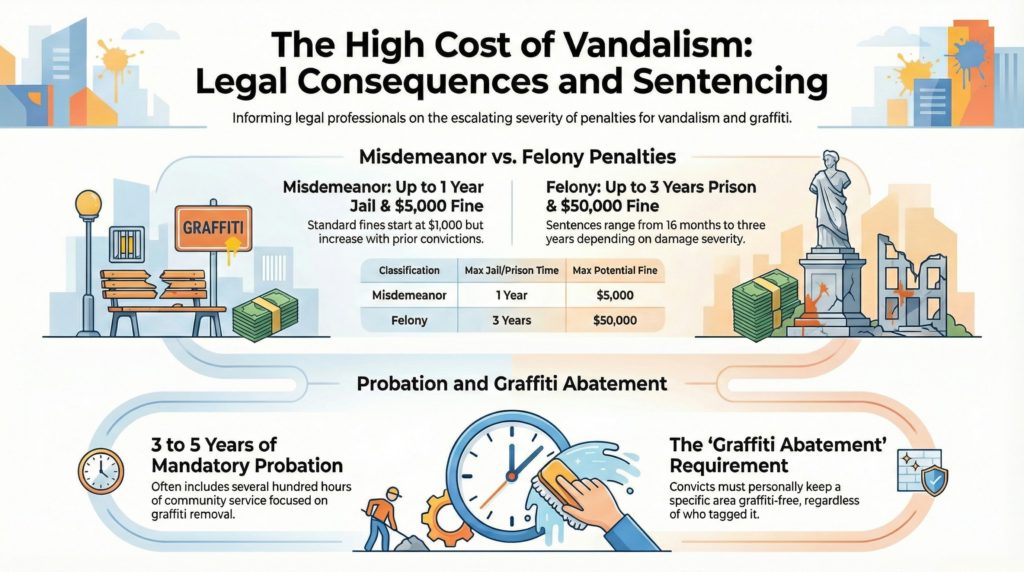
- Misdemeanor: Up to one year in county jail.
- Felony: A sentence of 16 months, two years, or three years in county jail or state prison.
Fines and State Penalty Assessments
Fines can be staggering. A misdemeanor carries a fine of up to $1,000 (unless you have prior convictions, which can raise it to $5,000). A felony conviction can result in a fine of up to $10,000, or even $50,000 if the damage was exceptionally high.
Probation and Mandatory Community Service
Most judges will order three to five years of probation. During this time, you may be required to complete several hundred hours of community service, often specifically related to cleaning up graffiti.
The “Graffiti Abatement” Requirement
California law often requires those convicted of graffiti-related vandalism to keep a specific area “graffiti-free” for a set period. If new graffiti appears in your assigned area, the court may require you to remove it personally, even if you weren’t the one who did it.
Beyond the Fine: Collateral Consequences of a Conviction
A conviction is more than just a court date; it creates ripples that affect your daily life.
Mandatory Driver’s License Suspension
One of the most surprising penalties is that the court must suspend your driver’s license for up to two years under Vehicle Code 13202.6. If you don’t have a license yet, the court can delay your ability to get one for up to three years.
Impact on Professional Licenses and Employment
Many jobs—especially in healthcare, teaching, or law enforcement—require “good moral character.” A vandalism conviction, especially one involving “moral turpitude,” can lead to the denial or revocation of professional licenses.
Immigration Consequences for Non-Citizens
For non-citizens, certain vandalism convictions can be classified as “crimes involving moral turpitude.” This can lead to deportation or being denied a green card or citizenship.
Restitution: Paying Back the Victim
Restitution is the money you pay to the victim to make them “whole” again.
How Courts Calculate Repair vs. Replacement Costs
The court doesn’t just look at the price of a can of paint. They look at the “fair market value” of the repair, which includes labor costs and any loss of use the owner suffered while the property was being fixed.
The Difference Between Restitution Fines and Victim Restitution
You will likely pay two types of money: a Restitution Fine (which goes to a state fund for crime victims) and Direct Victim Restitution (which goes directly to the person whose property was damaged).
Juvenile Vandalism: Special Rules for Minors
Vandalism is one of the most common charges faced by minors. The juvenile system focuses more on rehabilitation than punishment, but the stakes are still high.
Parental Financial Liability for a Child’s Vandalism
In California, parents can be held “jointly and severally” liable for the damages their child causes. This means a victim can sue the parents for the full cost of the repairs.
Mandatory Parental Participation in Community Service
If a minor is ordered to perform community service to remove graffiti, the court may also require the parent to attend and participate in that service alongside their child.
Enhanced Penalties for Specific Types of Vandalism
Some vandalism carries extra weight because of where it happens or who it targets.
- Religious Property (PC 594.3): Vandalizing a church or mosque is a felony if it is motivated by religious bias.
- Highways/Freeways (PC 640.7): Damaging property on or near a highway can lead to doubled fines and mandatory jail time.
- Hate Crimes: If the vandalism was intended to intimidate a person based on their race, gender, or orientation, it can lead to significant sentencing “enhancements.”
Common Legal Defenses Against Vandalism Charges
An arrest is not a conviction. Grace Legal Group uses several proven strategies to defend these cases:
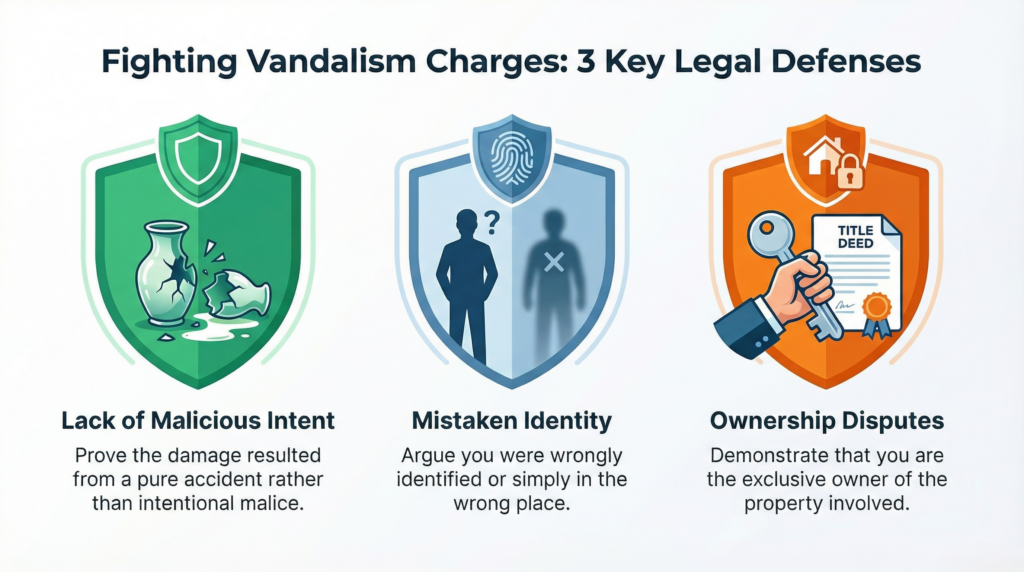
- Lack of Malicious Intent: Proving the damage was a pure accident.
- Mistaken Identity: You were in the wrong place at the wrong time, or the witness was mistaken.
- Ownership Disputes: You cannot be convicted of vandalizing property that you own exclusively.
Diversion Programs: A Path to Dismissal
There is often a way to keep your record clean through “Diversion.”
Penal Code 1001.95: Judicial Diversion Explained
This law allows a judge to pause your case for up to a year. If you complete community service, pay restitution, and stay out of trouble, the judge will dismiss your case entirely. It will be as if the arrest never happened.
Civil Compromise: Settling with the Victim
Under PC 1377 and 1378, if the victim agrees that they have been fully compensated (usually through a payment), the judge has the power to dismiss the misdemeanor charges over the prosecutor’s objection.
People Also Ask (FAQ)
Can I go to jail for a first-time vandalism offense?
Yes, even first-time offenders can face jail time, though it is less common for minor damage. A lawyer can often help you secure probation or a diversion program instead.
Will a vandalism charge show up on a background check? A
Yes. Unless the case is dismissed through diversion or later expunged, it will appear on criminal background checks for housing and employment.
Can I be charged with vandalism if I damaged my spouse’s property?
Yes. California law considers “community property” or jointly owned property as property belonging to “another” for the purposes of vandalism laws.
What happens if I can’t afford to pay the restitution?
The court will assess your “ability to pay.” While you still owe the debt, a lawyer can help negotiate a payment plan that fits your financial situation.
How long does a vandalism conviction stay on my record?
It stays on your record permanently unless you successfully petition the court for an expungement (PC 1203.4) after completing your probation.
Facing Vandalism Charges? Contact Grace Legal Group Today
A single moment of poor judgment shouldn’t define the rest of your life. At Grace Legal Group, we provide faith-based, empathetic representation to help you secure a second chance. We specialize in navigating the “wobbler” laws and diversion programs to protect your freedom and your future.
Don’t wait until it’s too late. Call us today for a free consultation at (818) 650-1744