
Veterans Court in Los Angeles is a judge-supervised diversion program that routes eligible veterans into VA-selected treatment instead of ordinary jail time. Placement isn’t automatic. It requires a court order, a VA suitability evaluation, and usually an attorney filing the right motion at the right moment. If you’re facing charges in LA County, consider contacting an attorney or the Legal Aid Foundation of Los Angeles to ask about a suitability review.
TL;DR:
- Eligibility requires military service, a qualifying service-related condition, and a link between that condition and the offense, with court approval through a formal motion.
- The program involves a minimum of 18 months of active participation, with regular court reviews, VA progress reports, drug testing, and potential sanctions for non-compliance.
- Success often hinges on early evidence gathering, including medical records and service connection proof, ideally before plea negotiations start.
- Completion can lead to early probation termination and dismissal of the conviction, but the process demands years of structured accountability and proper legal footing.
- Private or public attorneys must file motions for eligibility, and starting early improves the chances of a favorable diversion decision.
Table of Contents
- How the Los Angeles Veterans Court Program Actually Works
- Who Qualifies for Veterans Court in Los Angeles?
- What Does Participation in Veterans Court Actually Require?
- What Happens Legally After Veterans Court Ends?
- Where to Get Help With Veterans Court in Los Angeles
- How Early Case Preparation Changes Veterans Court Outcomes
- How Grace Legal Group Helps Veterans Pursue Court Diversion
- Sources
- FAQ
How the Los Angeles Veterans Court Program Actually Works
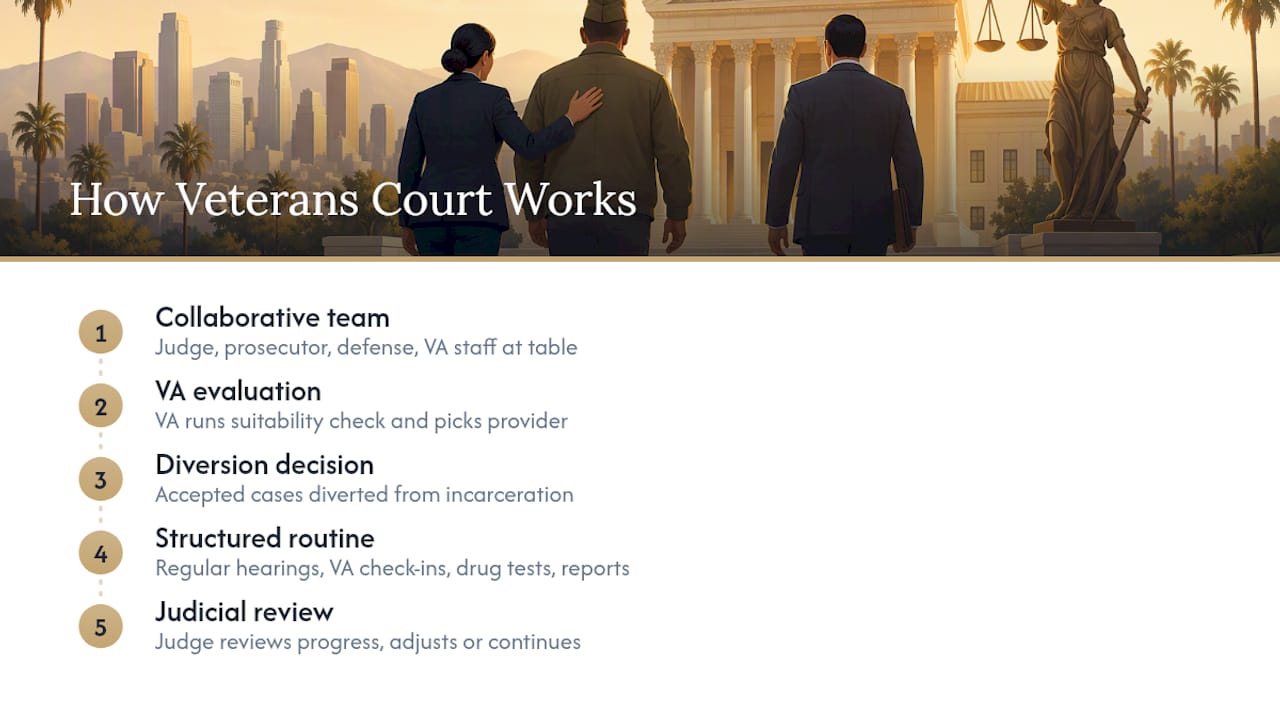
Veterans Court is built on the same collaborative model as drug court, but the treatment plan comes from the VA instead of a generic county provider. A judge, prosecutor, defense counsel, and VA staff all sit at the same table, tracking one goal: getting a veteran into treatment that actually fits their diagnosis instead of cycling them through jail.
The Los Angeles County Public Defender’s office describes it as an alternative sentencing program for veterans facing felony charges or felony probation violations, diverting them into VA-supervised treatment rather than incarceration. The VA runs the suitability evaluation, picks the treatment provider, and in many cases pays for the treatment itself. That’s a meaningful detail: the court isn’t just supervising sobriety or attendance, it’s coordinating with a federal agency that has its own clinical judgment about what a veteran needs.
Once a case is accepted, expect a structured routine. Regular court hearings, VA case management check ins, drug testing, and progress reports that the judge reviews before deciding whether to keep things moving or tighten the leash. This isn’t a paperwork diversion you complete quietly on the side. It’s active, monitored, and it expects follow through. For readers weighing this against other California diversion tracks, the structure resembles what you’d find in a mental health court model, just built specifically around military service and VA resources.
Who Qualifies for Veterans Court in Los Angeles?
Eligibility runs through Penal Code §1170.9, California’s military diversion statute. The court looks at six things: whether you served in the military, whether you have a qualifying service-related condition (PTSD, traumatic brain injury, military sexual trauma, or substance use disorder), whether that condition caused or substantially contributed to the offense, whether a suitable treatment program exists, whether you consent to the process, and whether you’re eligible for probation in the first place.
Here’s the part most veterans don’t realize until it’s almost too late: you cannot self-enroll. A formal court order is required, and that means an attorney has to file a motion or negotiate the referral. Public defenders can do this, private counsel can do this, and sometimes prosecutors will flag a case for review, but nobody walks into Veterans Court on their own.
Before you or your attorney file, gather:
- Your DD214 or other proof of service.
- VA or medical records connecting your diagnosis to the charged conduct.
- Statements from clinicians, family, or fellow service members who can speak to the condition and its effects.
Timing matters more than most defendants expect. Raise Veterans Court eligibility as early as the pretrial phase, not after a plea is already on the table. California court guidance treats early engagement as the standard path; a late-stage push is possible but much harder to win without a documented history.
Pro Tip: Request the VA suitability evaluation the same week you retain counsel. That evaluation often takes weeks to schedule, and every day it sits unrequested is a day added to your case timeline.
What Does Participation in Veterans Court Actually Require?
This is not a light diversion. The minimum commitment is 18 months, and total probation supervision commonly runs 3 to 5 years depending on how a veteran progresses and what the judge orders along the way, according to the Los Angeles County Public Defender. Treatment can be outpatient or residential depending on the VA’s recommendation, and the VA’s ongoing progress reports are what the judge relies on to decide whether a participant is on track.
Expect the following as standard parts of the process:
- Scheduled court review hearings where a judge checks progress directly.
- VA case management meetings tied to your specific treatment plan.
- Drug and alcohol testing on a set schedule.
- Documented milestones that can support a petition for early termination once you’ve shown consistent compliance.
- Sanctions for missed appointments or failed tests, which can range from warnings to program removal depending on severity.
The tradeoff is real. Veterans Court asks for years of structured accountability in exchange for a shot at avoiding a felony record and the incarceration that would otherwise follow. For someone whose offense grew directly out of PTSD or a brain injury from deployment, that trade is usually worth making. It is, however, a genuine commitment, not a shortcut.
What Happens Legally After Veterans Court Ends?
Graduation opens real doors. Veterans who complete the program can typically petition for early termination of probation and dismissal of the conviction. That dismissal under §1170.9(h) works differently than a standard expungement under Penal Code §1203.4. An expungement withdraws a guilty plea after conviction and generally still shows up in certain background checks; a §1170.9(h) dismissal is tied specifically to successful program completion and can offer a cleaner outcome for veterans who finish treatment. Either route beats carrying an unresolved felony conviction into future job or housing applications, and Grace Legal Group’s overview of California expungements breaks down how that second-chance process works for defendants generally.
There’s a separate pathway for veterans already serving time. Penal Code §1170.91 allows a petition for recall of sentence and resentencing when a service-related trauma, like combat PTSD or a brain injury, wasn’t considered at the original sentencing hearing. It’s not automatic relief. The court has to find that the condition was genuinely overlooked and that resentencing serves the interest of justice, so the strength of your documentation still decides the outcome.
Practically, this means working with counsel to file the right motion at the right stage: a dismissal petition after graduation, or a recall petition if you’re already incarcerated. Bring progress reports, VA records, and any documentation from your original case. The paperwork does the persuading; a well-organized file moves faster than a thin one.
Where to Get Help With Veterans Court in Los Angeles
Start with the Legal Aid Foundation of Los Angeles Veterans Justice Center, the county’s longest-running free legal service for veterans. LAFLA helps regardless of discharge status, covering everything from benefits and housing to court representation, with offices spread across LA County.
For the clinical side, VA Veterans Justice Outreach staff handle the suitability evaluations that determine treatment placement and coordinate directly with the court once a case is accepted. If you’re active duty, a retiree, or a dependent, Military OneSource and your installation’s legal assistance office can help with paperwork and referrals, though neither substitutes for a criminal defense attorney handling your actual court motions.
- LAFLA Veterans Justice Center: free representation and benefits help, any discharge status.
- VA Veterans Justice Outreach: suitability evaluations and treatment coordination.
- Military OneSource / installation legal offices: guidance for active duty, retirees, and dependents.
- Private defense counsel: motion filing, evidence gathering, mitigation packets, and court advocacy.
If your case involves felony charges, contested facts, or a prosecutor who isn’t inclined to agree to diversion, that’s usually the point where private counsel earns its cost. Free resources are excellent for guidance and case management support, but someone still has to argue your motion in front of a judge.
How Early Case Preparation Changes Veterans Court Outcomes
The single biggest factor in whether a veteran gets into this program isn’t the severity of the charge. It’s how early the right evidence gets in front of the court. A judge deciding on a §1170.9 motion wants to see a documented connection between military service and the offense, not just an assertion of one.
That’s why building the nexus early, through medical records, clinician evaluations, and service history, matters more than almost anything else in the case. Assigning multiple attorneys to review a single case can catch gaps that a solo review misses: a missing record, an overlooked witness, a detail in the police report that supports the service connection. Experience on the law enforcement side of these cases helps too, because it means someone on the defense team already knows how prosecutors read an incident report and where the room for argument actually is. A faith-based approach to mitigation, when it fits the client, adds a human dimension to a case file that can otherwise read as just charges and dates. None of it replaces the paperwork. It just makes the paperwork land harder.
— Jake
How Grace Legal Group Helps Veterans Pursue Court Diversion
Some legal groups offer veterans assistance with filing the §1170.9 motion, not just explaining what it is. Assigning multiple attorneys to a case and leveraging team experience, including former law enforcement professionals, can help build the service-connection evidence a judge needs to approve diversion instead of jail.

Bring your DD214, any VA or medical records tied to your diagnosis, and a timeline of the offense to your first conversation. Legal teams often build detailed mitigation packets designed to shift how prosecutors and judges see a case, and timing matters: motions filed early, before a plea is locked in, generally have more room to work with than ones filed at the last minute. If you’re already serving a sentence and believe your service-related trauma wasn’t considered at sentencing, the same early-preparation approach applies to a §1170.91 resentencing petition. Start with a consultation through Grace Legal Group’s criminal defense page and get your case reviewed before your next court date arrives.
This article is general information, not a substitute for advice from a qualified lawyer. Consult a qualified legal professional about your own circumstances before acting on anything here.
Sources
- The Veterans Court Pilot Program – Los Angeles County Public Defender
- Penal Code §1170.9 — Military Diversion Program (California)
- Veterans Justice Center – LAFLA: Legal Aid Foundation of Los Angeles
FAQ
Does My Discharge Status Affect Veterans Court Eligibility?
Discharge status isn’t the deciding factor for §1170.9 eligibility itself, which focuses on service, a qualifying condition, and its connection to the offense. Free resources like LAFLA’s Veterans Justice Center explicitly help veterans regardless of discharge status, so a less-than-honorable discharge shouldn’t stop you from asking about a referral.
How Long Does the Veterans Court Program Last?
The program requires a substantial minimum commitment of several months, and total probation supervision often runs 3 to 5 years depending on your progress and the judge’s orders. Completion milestones can support a petition for early termination before that full window closes.
Can I Get Into Veterans Court Without a Lawyer?
No. Placement requires a formal court order after a motion is filed, and that motion has to come from an attorney, whether private counsel or a public defender. There’s no self-enrollment path.
What Happens to My Record After I Complete the Program?
Graduates can typically petition for early termination of probation and dismissal of the conviction under §1170.9(h). This works differently from a standard §1203.4 expungement, and an attorney can walk you through which relief applies to your specific case.
What Does It Cost to Hire an Attorney for a Veterans Court Motion?
Pricing depends on the complexity of your case and the evidence involved, and current rates are available directly through Grace Legal Group. Most veterans find it worth a consultation before deciding, since early motion filing tends to matter more than cost when it comes to actually getting into the program.