
Reckless driving under California law is a criminal misdemeanor under CVC §23103, not a simple traffic infraction, and a conviction can mean jail time, fines, and a mark on your criminal record. If you have been charged, your first move should be to preserve any available evidence, such as dashcam footage or witness contact information, and contact an experienced California criminal defense attorney before you say anything else to police or prosecutors.
TL;DR:
- A standard conviction carries 5 to 90 days in county jail, $145 to $1,000 in fines, two DMV points, and potential insurance and record consequences.
- When driving causes bodily injury, prosecutors can pursue charges under CVC §23104 or §23105, which carry harsher penalties than the baseline offense.
- Preserve dashcam and bodycam footage, witness details, and device calibration logs immediately; agencies may overwrite recordings or discard records before a formal request arrives.
- Strong defenses challenge whether conduct showed willful disregard, the driver’s identity, speed device calibration, or evidence of an emergency or mechanical failure.
- For most noncustodial cases, trial must begin within 45 days of arraignment unless time is waived; an initial not guilty plea preserves review time.
Table of Contents
- What Reckless Driving (CVC §23103) Means and the Penalties You Face
- Common Defenses That Can Defeat or Reduce Reckless Driving Charges
- Evidence and Discovery: What to Preserve and How to Request the Prosecutor’s Files
- Court Process and Timeline: Arraignment, Speedy Trial, and Plea Choices
- Practical Outcomes: Dismissal, Wet Reckless, Conviction, and What Follows
- How We Build a Defense: Evidence, Mitigation Packets, and Two-Attorney Teams
- Our Faith-Based Approach to Legal Defense and What It Means for Your Case
- Why Speed Matters More Than People Think
- How Grace Legal Group Can Help With Your Reckless Driving Case
- FAQ
- Sources
What Reckless Driving (CVC §23103) Means and the Penalties You Face
California defines reckless driving as operating a vehicle with willful or wanton disregard for the safety of people or property. That phrase matters because it sets a higher bar than ordinary carelessness: the prosecution has to show you knew your driving created a risk and chose to drive that way anyway. Under California Vehicle Code §23103, a standard conviction carries 5 to 90 days in county jail and fines between $145 and $1,000.
A §23103 conviction alone can cost you up to 90 days in jail and $1,000 in fines, before accounting for related charges or civil exposure. When the same conduct causes bodily injury, the case moves to related statutes that raise the stakes considerably.
A reckless driving case can touch far more than the courtroom:
- Jail exposure of 5 to 90 days and fines of $145 to $1,000 under the baseline statute.
- Harsher penalties under CVC §23104 and §23105 when the driving causes bodily injury to another person.
- Two points added to your DMV driving record, which can trigger license suspension if combined with other violations.
- A permanent criminal record that can surface in background checks for jobs, licensing, and housing.
- Sharp increases in auto insurance premiums, since insurers treat reckless driving as a major violation.
- Immigration consequences for noncitizens, since a criminal conviction (as opposed to a traffic infraction) can affect visa or residency applications.
Common Defenses That Can Defeat or Reduce Reckless Driving Charges
The prosecution has to prove you drove with willful or wanton disregard, and that mental-state requirement is often the weakest part of their case. A defense attorney’s job is to attack that element directly, along with the physical evidence used to support it.
Several defense strategies come up repeatedly in these cases, and the right one depends on how the stop happened and what evidence exists:
- Insufficient evidence of recklessness. Ordinary speeding or a single lane change rarely meets the legal threshold; the defense can argue the conduct, even if careless, never rose to willful disregard.
- Identity challenges. When an officer did not clearly observe the driver, or multiple vehicles were involved, misidentification becomes a live issue.
- Equipment and calibration attacks. Radar guns, lidar devices, and speed-estimation tools require regular calibration, and a missing or expired calibration log can undercut the state’s speed evidence.
- Video and witness contradictions. Dashcam, bodycam, or surveillance footage that contradicts the officer’s written report can be some of the strongest material in the case.
- Necessity or medical emergency. Driving erratically to escape danger or respond to a sudden medical event can justify conduct that would otherwise look reckless.
- Mechanical failure. A sudden brake failure, blowout, or steering malfunction outside the driver’s control can defeat the willfulness element entirely.
These theories work best when backed by specific evidence: the officer’s calibration and training records, dashcam or bodycam video, medical records for a necessity defense, or repair and maintenance records for a mechanical failure claim. According to LegalClarity’s overview of reckless driving defenses, the hardest element for prosecutors to prove is the driver’s actual state of mind, which is why contextual details about the road, traffic, and surrounding conditions often decide these cases.
Pro Tip: Ask your attorney to request calibration and maintenance logs for the speed-measuring device used in your stop within the first week, since many agencies only retain these records for a limited period.
Evidence and Discovery: What to Preserve and How to Request the Prosecutor’s Files
Evidence in a reckless driving case disappears fast. Police agencies often overwrite dashcam and bodycam footage after a set retention window, and calibration logs can be archived or discarded if no one asks for them in time.
Preserve or request the following as soon as possible after your citation or arrest:
- Dashcam and bodycam footage from the responding officer’s vehicle and body camera.
- The officer’s written report and any handwritten notes taken at the scene.
- Calibration and maintenance logs for radar, lidar, or other speed-measurement devices.
- Names and contact information for any witnesses at the scene.
- Photographs of the road, weather conditions, signage, and vehicle damage.
Once an attorney is retained, discovery requests go out to the prosecutor and the police agency involved, seeking the complete police file, video evidence, witness statements, and any device calibration records tied to the stop. According to LegalClarity, prosecutors are required to disclose this material, but agencies sometimes overwrite recordings before a formal request lands, which is why early action matters more than almost anything else in these cases.
For your first attorney meeting, bring the citation itself, any photos or video you captured, insurance information, and a written timeline of events while your memory is still fresh.
Pro Tip: Write down everything you remember about the stop, including the time, weather, traffic, and what the officer said, within 24 hours while the details are still accurate.
Court Process and Timeline: Arraignment, Speedy Trial, and Plea Choices
Your first court appearance, the arraignment, sets the tone for the entire case. According to California Courts’ overview of arraignment procedure, the judge advises you of the charges against you, confirms your right to an attorney (including appointed counsel if you cannot afford one), and asks how you plead.
A few practical points shape what happens next:
- For a noncustodial misdemeanor like most §23103 charges, trial must generally begin within 45 days of arraignment unless you waive that right.
- Waiving time gives your attorney more room to investigate, request discovery, and negotiate, but it also extends how long the case hangs over you.
- Entering a plea at arraignment can waive procedural rights, so pleading not guilty initially is almost always the strategic choice, giving counsel time to review the evidence before committing to a position.
- Plea negotiations often happen in the weeks following arraignment, once the defense has reviewed police reports, video, and calibration records.
Court procedural materials, including Sacramento County’s traffic rights advisement, reinforce that defendants should consult counsel before entering any plea, since a guilty or no-contest plea at the outset forecloses options that a negotiated resolution or trial might otherwise preserve.
Practical Outcomes: Dismissal, Wet Reckless, Conviction, and What Follows
Reckless driving cases resolve in one of a few predictable ways, and each carries a different long-term footprint. Dismissal ends the matter with no conviction on your record. A reduction to “wet reckless,” a plea available when alcohol was involved, carries lighter penalties than a DUI while still resolving the case; we cover that option in more detail in our wet reckless California guide. A conviction on the full charge carries the statutory range.
A §23103 conviction can mean up to 90 days in jail and fines up to $1,000, under California Vehicle Code §23103, though many cases resolve with probation, community service, or a reduced charge instead of jail time.
Outcomes carry consequences well beyond the courtroom:
- DMV points that can affect license status and future insurance eligibility.
- Insurance premium increases, since carriers classify reckless driving as a major violation.
- Employment screening issues, particularly for driving-related jobs or roles requiring background checks.
- Immigration risk for noncitizens, since a criminal conviction can carry different consequences than a traffic infraction.
When the underlying conduct caused injury, the case can shift toward charges covered under CVC §23104 or §23105, or even toward vehicular manslaughter theories; our guide to vehicular manslaughter defenses in California covers those more serious scenarios.
How We Build a Defense: Evidence, Mitigation Packets, and Two-Attorney Teams
When we take on a reckless driving case, the first 48 hours matter most. We send out discovery requests and preservation letters immediately, including subpoenas for dashcam or bodycam footage and calibration logs, before an agency’s retention window closes.
From there, our approach centers on building a complete picture of you, not just the citation:
- We prepare mitigation packets that give prosecutors context about your history, circumstances, and character, often reshaping how a case gets evaluated.
- Our team includes attorneys with law enforcement backgrounds, which helps us read police reports and procedure with an informed perspective.
- We assign multiple attorneys to each case, so strategy gets a second set of eyes and client communication does not stall between court dates.
- We use negotiation tactics aimed at reductions or dismissal, drawing on the evidence we have gathered rather than generic plea offers.
You can read more about how we approach case-building from the first phone call in our breakdown of how a California criminal defense attorney builds a strong defense from day one.
Our Faith-Based Approach to Legal Defense and What It Means for Your Case
We take a faith-based approach to criminal defense, which shapes how we treat every client who walks through our door. Practically, that means we start from the premise that a single charge, even a serious one, does not define a person’s whole story. Prosecutors and judges respond to context, and our mitigation work is built to supply it: who you are outside the incident, what led to that moment, and what you have done since.
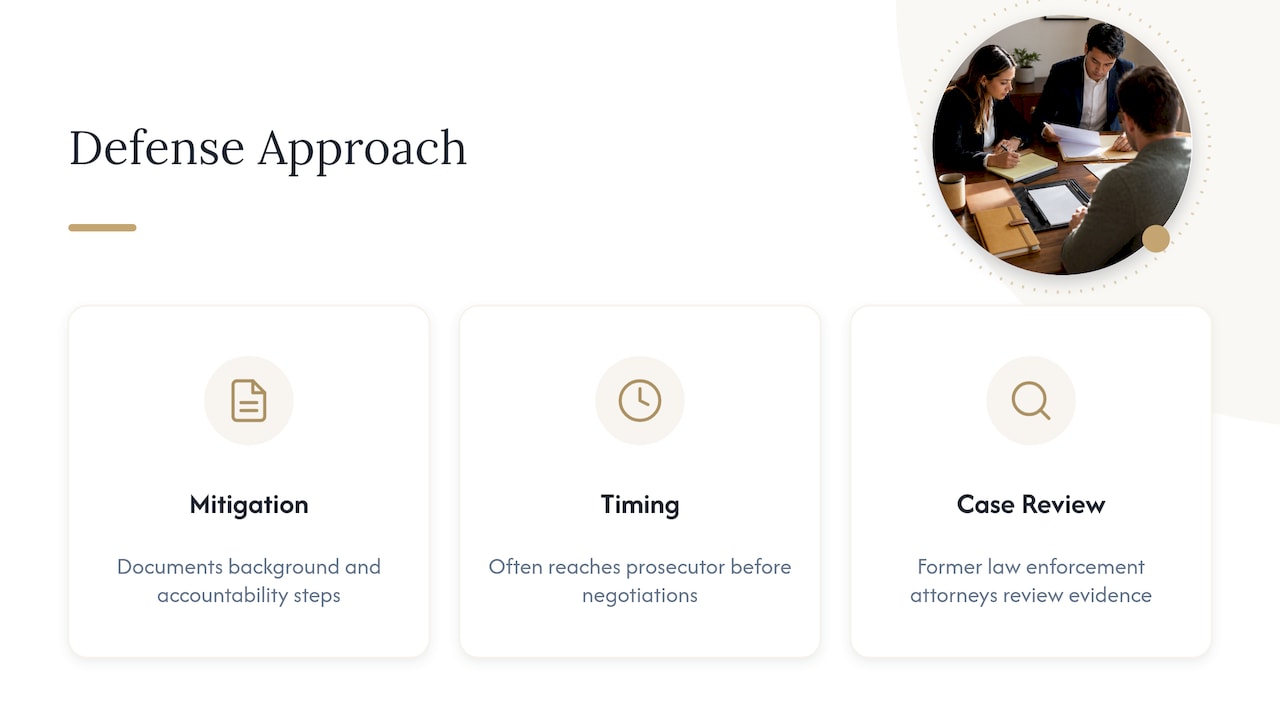
This approach shows up most clearly in the mitigation packets we prepare for reckless driving and other criminal cases. Rather than letting a police report stand as the only narrative, we document your background, circumstances, and any steps you have taken toward accountability, such as traffic safety courses or community involvement. That material gets placed directly in front of the prosecutor handling your case, often before negotiations even formally begin.
We pair that narrative work with technical case review from attorneys who have former law enforcement experience, so the human context and the hard evidence move together rather than separately. The goal is straightforward: give the people deciding your case a reason to see a path toward reduction or dismissal, not just the citation in front of them. That combination of compassion and rigor reflects how we believe every client deserves to be represented, regardless of the charge.
Why Speed Matters More Than People Think
The biggest mistake I see is waiting. Dashcam footage gets overwritten, witnesses move on, and calibration records get archived within weeks. If you are facing a reckless driving charge, do not talk to police beyond basic identification, write down what you remember now, and call an attorney before your arraignment.
A free consultation should give you a clear read on your exposure, the evidence worth chasing immediately, and a realistic sense of timeline and cost before you commit to anything.
— Jake
How Grace Legal Group Can Help With Your Reckless Driving Case

We handle reckless driving and related traffic-crime cases alongside our broader criminal defense practice, including DUI defense and cases involving bodily injury. Every case gets two attorneys, input from team members with former law enforcement backgrounds, and a mitigation packet built around your specific circumstances rather than a template.
If you were cited or arrested for reckless driving, bring your citation, any photos or video, and your insurance information to a consultation with our Los Angeles traffic crimes team. It is also worth a quick call to your insurer, and resources like Hettler Insurance Agency’s guidance on auto coverage explain how coverage decisions can intersect with an incident like this. The sooner we start preserving evidence, the more options we have.
- Criminal defense representation covering reckless driving, DUI, and related vehicle code charges.
- Multiple attorney case teams with mitigation packet preparation on matters we take.
- Case review informed by legal and investigatory experience on our team.
Contact our criminal defense team today to schedule a consultation and find out what your options look like.
This article is general information, not a substitute for advice from a qualified lawyer. Consult a qualified legal professional about your own circumstances before acting on anything here.
FAQ
What is the best defense for reckless driving?
The strongest defenses typically target the prosecution’s burden to prove willful or wanton disregard, since that mental-state element is hard to establish beyond a reasonable doubt. Common approaches include challenging whether the conduct met that threshold, questioning speed-measurement calibration, or presenting evidence of a mechanical failure or medical emergency, according to LegalClarity’s defense overview.
What is the minimum jail sentence for reckless driving in California?
There is no mandatory minimum under CVC §23103; the statute allows a range of 5 to 90 days in county jail along with fines of $145 to $1,000. Many cases resolve with probation, community service, or a reduced charge instead of jail time.
Is it hard to get a reckless driving charge dropped?
It depends heavily on the evidence, including calibration records, video footage, and witness statements, since the prosecution has to prove willful or wanton disregard rather than simple carelessness. Cases built on weak officer observations or missing calibration logs are often strong candidates for dismissal or reduction to a lesser charge like wet reckless.
How much is a ticket in California for reckless driving?
Reckless driving under CVC §23103 is charged as a misdemeanor crime, not a simple traffic ticket, and carries fines of $145 to $1,000 in addition to possible jail time and DMV points. The final amount depends on the specific facts of the case and any plea negotiated with the prosecutor.
Sources
- California Vehicle Code §23103
- California Courts: The arraignment
- How to beat a reckless driving charge: defense strategies – LegalClarity
- Sacramento County traffic advisement of rights