
What is a wet reckless charge in California?
A wet reckless is a misdemeanor plea reduction from a DUI charge, governed by California Vehicle Code Sections 23103 and 23103.5. The “wet” label signals that alcohol or drugs were involved in the reckless driving incident. No officer writes a wet reckless ticket at a traffic stop. It exists only as a negotiated outcome in court, after a DUI arrest under Vehicle Code Section 23152.
Key facts about the charge:
- It is a misdemeanor, not an infraction or a dismissal.
- The prosecutor must state on the record that alcohol or drugs were involved.
- The court notifies the California DMV of every such conviction.
- A wet reckless counts as a prior DUI for a full 10 years from the offense date.
- Unlike a dry reckless, it carries priorability, meaning a future DUI arrest within that window triggers enhanced sentencing.
Treating a wet reckless as a minor traffic matter is a mistake. It lives on your criminal record, carries probation, and can make a future DUI charge dramatically more expensive to defend.
Legal penalties you face with a wet reckless plea
The penalties are real, even if they are lighter than a standard DUI. Under Vehicle Code Section 23103, a wet reckless conviction carries:
- Jail time of 5–90 days in county jail (rarely imposed for first offenses, but possible).
- Fines ranging from $145 to $1,000, before penalty assessments.
- Informal probation for 1–2 years, shorter than the 3–5 years typical for a DUI.
- Mandatory alcohol or drug education program as a probation condition.
- Possible ignition interlock device (IID) installation, with a minimum term of three months.
The 10-year rule is the sharpest edge of a wet reckless. Accept this plea today, and any DUI arrest within the next decade treats you as a repeat offender, with longer suspensions, mandatory jail time, and extended DUI school.
On the insurance side, premiums typically rise after a wet reckless conviction, and the conviction stays on your driving record for 10 years. Good driver discounts disappear for the same period. Some carriers score a reckless-driving-with-alcohol conviction differently from a full DUI, so the premium increase may be smaller, but savings are not guaranteed and depend entirely on your insurer’s underwriting rules.
The DMV piece catches many drivers off guard. Administrative License Suspension by the DMV runs on a completely separate track from the criminal case. Even if your DUI is reduced to a wet reckless in court, the DMV can still suspend your license through the Administrative Per Se (APS) process unless you requested a hearing within 10 days of your arrest and won it.

How does a wet reckless compare to a DUI conviction?
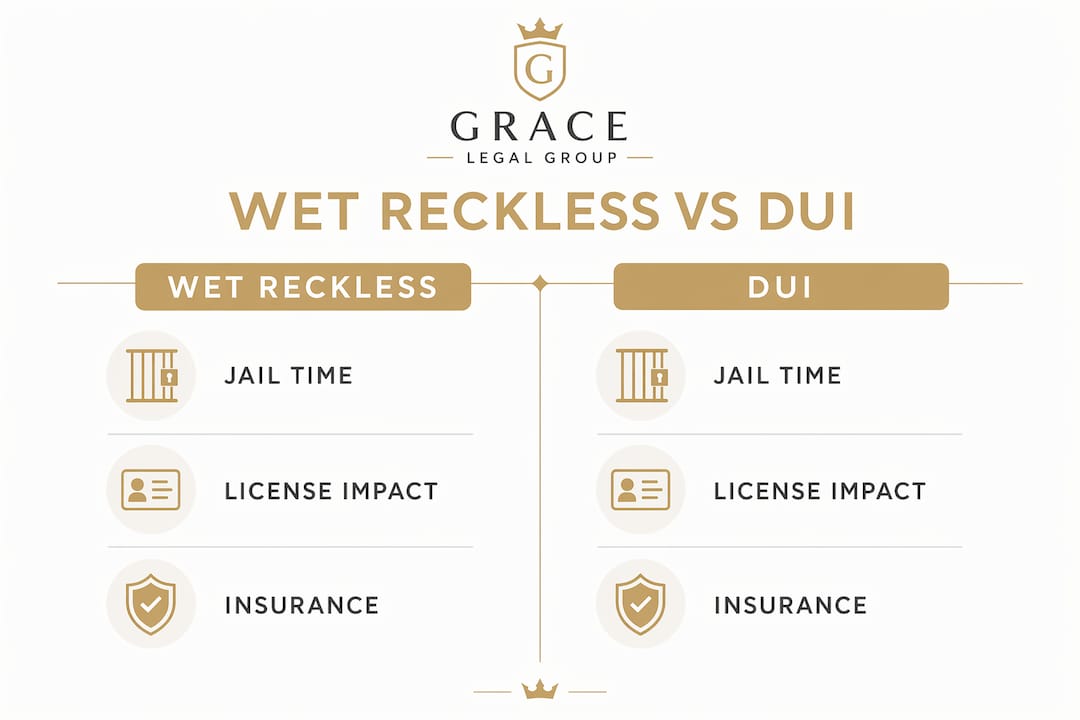
The gap between these two outcomes is real, but it has limits. Here is how the key factors stack up:
| Factor | Wet Reckless (VC 23103.5) | DUI (VC 23152) |
|---|---|---|
| Jail exposure | 5–90 days (rarely imposed on first offense) | 5–90 days jail on first offense; more for priors |
| Fines | $145–$1,000 | $145–$1,000 plus penalty assessments |
| Probation | 1–2 years informal | 3–5 years informal |
| License suspension | No court-imposed suspension; DMV APS still applies | No court suspension plus DMV APS |
| DUI school | Possible, shorter program | 3, 6, or 9-month program required |
| Counts as prior DUI | Yes, for 10 years | Yes, for 10 years |
| Employment stigma | Lower than DUI | Higher, especially for licensed professions |
| Insurance impact | Moderate increase, varies by carrier | Larger increase; SR-22 often required |
The license column deserves a closer look. A wet reckless avoids the court-imposed six-month suspension that follows a first DUI conviction, but it does not wipe out the DMV’s administrative action. Drivers who miss the 10-day APS hearing deadline lose their license regardless of what happens in criminal court.
Employment consequences also differ. A DUI conviction is more likely to trigger background check flags for jobs requiring professional licenses, commercial driving credentials, or security clearances. A wet reckless still shows as a criminal conviction, but the charge name carries less automatic stigma in many hiring contexts.
When do prosecutors offer a wet reckless plea?
Prosecutors offer a wet reckless when they are not confident they can prove the DUI at trial. The goal is to lock in a conviction rather than risk an acquittal. That dynamic is what creates the opening for negotiation.
Common factors that favor a plea offer:
- Low BAC: A blood alcohol concentration below 0.08% makes a DUI conviction harder to prove.
- No prior record: First-time offenders with clean histories receive more favorable treatment.
- Treatment participation: Voluntarily entering alcohol education or substance abuse treatment signals responsibility.
- Faulty testing equipment: Breathalyzer machines that are poorly calibrated or inadequately maintained can undermine the prosecution’s evidence.
- Procedural errors: If the arresting officer did not follow mandated BAC testing protocol, the results may be challengeable.
Aggravating factors cut the other way. Accidents, injuries to other parties, high BAC readings, or prior DUI history all make prosecutors far less willing to reduce the charge. A case involving a collision with injuries is unlikely to result in a wet reckless offer regardless of evidentiary issues.
Pro Tip: Request a DMV APS hearing within 10 days of your arrest, even before your first court date. Missing that deadline costs you your license automatically, no matter how well your criminal case goes.
How the plea negotiation process actually works
Negotiating a wet reckless plea deal is not a single conversation. It is a process that starts the moment an attorney reviews the arrest report and evidence.
The defense attorney first obtains and analyzes all discovery: the police report, dashcam footage, breathalyzer calibration records, and field sobriety test documentation. Weaknesses in any of these areas become leverage. A borderline BAC, a questionable traffic stop, or a gap in the chain of custody for a blood sample all give the defense something concrete to bring to the prosecutor.
From there, the attorney presents a formal argument for reduction, often supported by a mitigation packet that documents the client’s background, employment, lack of prior record, and any treatment steps already taken. Prosecutors respond to documented facts, not just requests. The stronger and earlier that documentation arrives, the better the negotiating position.
Once both sides agree, the defendant enters a guilty or no contest plea to the reckless driving charge under Vehicle Code Section 23103, with the alcohol notation entered on the record as required by Section 23103.5. The judge then sentences according to the agreed terms. The entire process can resolve in weeks or stretch across several court dates depending on the county and the complexity of the evidence.
How to defend against a wet reckless charge
Once you have accepted a wet reckless plea, the conviction stands. The time to mount a defense is before any plea is entered, and the strongest defenses target the original DUI evidence.

A skilled DUI defense attorney looks at several pressure points. Breathalyzer calibration logs are public records, and departments that skip routine maintenance produce unreliable readings. Blood test results can be challenged if the sample was mishandled, stored improperly, or retested with a different result. Field sobriety tests are inherently subjective and can be undermined by medical conditions, uneven road surfaces, or poor lighting at the stop.
The traffic stop itself is another avenue. If the officer lacked reasonable suspicion to pull you over, any evidence gathered afterward may be suppressible under the Fourth Amendment. Suppressing the BAC result often collapses the prosecution’s case entirely, opening the door to a dismissal rather than just a reduction.
Understanding what defenses apply to your specific facts is the first step. A defense that works in one case may be irrelevant in another. The goal is always to identify the weakest link in the prosecution’s chain and pull it.
How California counties handle wet reckless cases differently
California law sets the framework, but county-level practices vary enough to affect your outcome. Los Angeles County handles an enormous volume of DUI cases, and prosecutors there tend to follow more standardized charging policies. A wet reckless offer in an LA case often depends heavily on documented evidentiary problems rather than general leniency.
San Francisco has historically used diversion programs for some first-time DUI offenders, which can create alternative paths that do not exist in other counties. Smaller counties, particularly in rural Northern California, may have prosecutors who are less familiar with aggressive wet reckless negotiations, or conversely, more willing to resolve cases efficiently given limited court resources.
Orange County and San Diego County are generally known for stricter DUI prosecution. Wet reckless offers there tend to require stronger evidentiary justification. Riverside and San Bernardino counties fall somewhere in between, with outcomes that vary significantly by courthouse and individual prosecutor.
The practical takeaway: an attorney with experience in the specific county where your case is filed has a real advantage. Local knowledge of which prosecutors respond to which arguments, and which judges impose which conditions, shapes the outcome in ways that general legal knowledge cannot replicate.
Key Takeaways
A wet reckless in California is a meaningful improvement over a DUI conviction, but it is still a criminal conviction that counts as a prior DUI for 10 years and carries real penalties.
| Point | Details |
|---|---|
| Legal basis | Wet reckless charges arise under Vehicle Code Sections 23103 and 23103.5 as a plea reduction from a DUI. |
| Penalties | Jail up to 90 days, fines from $145 to $1,000, and informal probation of 1–2 years. |
| Prior DUI status | A wet reckless counts as a prior DUI for 10 years, triggering enhanced penalties on any future DUI arrest. |
| DMV action is separate | A court plea does not stop the DMV’s APS suspension; you must request a hearing within 10 days of arrest. |
| County practices vary | Prosecution standards and plea offer likelihood differ significantly across California counties. |
Facing a DUI charge in California and wondering whether a wet reckless plea is the right move? Gracelegalgroup’s Los Angeles criminal defense team includes former law enforcement professionals who know exactly where DUI evidence breaks down. With two dedicated attorneys on every case and a track record of reduced charges and dismissed cases, Gracelegalgroup builds the kind of case file that gives prosecutors a reason to negotiate. Get a free consultation and find out where your case stands before you accept anything.