
A defense investigator is the defense team’s fact-finder: they locate witnesses, gather and preserve evidence, and turn findings into court-ready reports that let a lawyer pressure-test the prosecution’s version of events. Their work often decides whether a case gets dismissed, reduced, or fought at trial. The role matters most when hired early, before memories fade and video gets overwritten.
TL;DR:
- Early investigation is crucial, as evidence like videos can be overwritten within hours and witnesses may become unreachable over time.
- Most defense investigators are licensed private detectives with backgrounds in law enforcement, journalism, or military service, and skills like report writing and digital data analysis are essential.
- Investigation work involves thorough record collection, witness interviews, scene documentation, and preserving digital evidence, all of which directly influence trial and plea negotiations.
- Funding and jurisdictional limits often restrict investigative scope, and time constraints combined with reluctant witnesses pose significant challenges.
- Properly conducted investigations, documented and verified, can significantly alter case outcomes by exposing inconsistencies, contradictions, or procedural errors before trial.
Table of Contents
- The Core Duties of a Criminal Defense Investigator
- What Qualifications and Skills Does a Defense Investigator Need?
- Where Do Defense Investigators Work Day to Day?
- How to Become a Defense Investigator
- What Tools and Methods Do Defense Investigators Use?
- How Much Do Defense Investigators Get Paid?
- Objectivity, Confidentiality, and the Investigator’s Ethical Line
- How Grace Legal Group Uses Investigators in Practice
- How Defense Investigators Interact With Law Enforcement and Prosecutors
- Why Investigator Findings Can Change the Outcome of a Case
- Common Challenges Defense Investigators Face on the Job
- Why Confidentiality and Privilege Protect the Whole Defense Strategy
- What Kinds of Cases Rely on Defense Investigators?
- The Real Value of a Good Investigator Isn’t What Most People Assume
- When to Bring in Counsel and How Grace Legal Group Fits In
- Sources
- FAQ
The Core Duties of a Criminal Defense Investigator
A defense investigator’s job description reads less like a detective show and more like a research and documentation role with legal stakes attached. The bulk of the work happens away from cameras, in DMV records, jail visitation logs, and long conversations on someone’s front porch.
Locating and vetting witnesses tops the list. That means finding people the police report mentions only in passing, confirming what they actually saw, and preparing them to testify without ever coaching them toward a specific answer. Coaching a witness is a bright ethical line; preparation just means walking them through what to expect on the stand.
Beyond witnesses, a criminal defense investigator typically handles:
- Canvassing the scene to document conditions, lighting, sightlines, and anything that might contradict the official account
- Preserving perishable evidence like surveillance footage before it’s automatically deleted or recorded over
- Pulling records: police reports, medical charts, cell phone data, social media activity, and court dockets
- Writing detailed, verification-labeled reports that hold up under cross-examination
- Coordinating subpoenas and managing the logistics of getting witnesses and evidence into court
- Testifying about their own findings when the defense needs to introduce evidence directly
Federal public defender job listings echo this same list almost line for line, including investigation management, witness relations, and mitigation research as standard duties.
What Qualifications and Skills Does a Defense Investigator Need?
Most offices expect a valid driver’s license, a clean background check, and, in many states, a private investigator license before you touch a real case. The Bureau of Labor Statistics notes that most states require licensing for private detectives and investigators, so the exact rules depend heavily on where you plan to work.
Backgrounds vary more than people expect. Former police officers bring records fluency and interview experience, but journalists, social workers, and military veterans often make equally strong investigators because they already know how to build rapport with reluctant sources.
The skills that separate a good defense investigator from an average one:
- Interviewing people who don’t want to talk, without pressuring them into a version of events they don’t actually believe
- Clear, precise report writing that survives a defense attorney’s scrutiny and a prosecutor’s cross-examination
- Cultural competency, especially in communities skeptical of anyone connected to the legal system
- Chain-of-custody awareness so evidence stays admissible
- Comfort with digital tools, from public records databases to basic phone data review
Pro Tip: If you’re evaluating an investigator’s resume, ask for a writing sample. A weak report can undo months of good fieldwork.
Where Do Defense Investigators Work Day to Day?
Some investigators work as staff inside a public defender’s office; others are private investigators retained directly by defense counsel on a case-by-case basis. The staff role often comes with steadier access to case files, while private investigators sometimes face more friction getting cooperation from institutions that don’t know them.
A typical case moves through a fairly consistent workflow:
- Intake, where the investigator reviews the charging documents and the attorney’s initial theory of the case
- Discovery review, digging through everything the prosecution has turned over
- Field investigation: interviews, scene visits, and records requests
- Reporting, where findings get organized into something the attorney can actually use
- Trial support, including last-minute witness logistics and testimony if needed
Video and witness memory both degrade fast, which is why early deployment matters more in this field than almost any other investigative work.
How to Become a Defense Investigator
There’s no single required degree. Some investigators come in with a criminal justice background; others substitute years of law enforcement, military, or paralegal experience for formal schooling entirely.
Licensing requirements vary by state, so check your local rules before assuming a national standard applies. Many states require a set number of supervised hours or an apprenticeship under a licensed PI before you can operate independently.
Getting started usually looks like this:
- Apply for internships or entry-level investigator assistant roles at a public defender’s office
- Watch for openings on federal defender job boards, which often hire investigators directly into staff positions
- Study a structured investigative framework like the Component Method, which teaches an iterative approach: interview, verify, re-interview as new facts surface
- Take digital-evidence workshops to get comfortable with phone data, metadata, and video authentication
- Practice courtroom testimony, since even the best fieldwork falls apart if you can’t explain it clearly under oath
What Tools and Methods Do Defense Investigators Use?
Records work forms the backbone of most investigations. That includes court dockets, property records, and law enforcement databases where public defender offices have access. Beyond paperwork, video has become one of the most contested and time-sensitive pieces of evidence in any case.
Investigators lean on a handful of core methods:
- Requesting and preserving body-worn camera and surveillance footage before retention windows close
- Structured interviews with detailed notes on what’s confirmed versus what’s simply claimed
- Cross-referencing phone records, social media, and financial documents against witness statements
- Bringing in forensic or digital-evidence specialists when data requires technical extraction or authentication
Pro Tip: Label every unverified statement in your report as unverified. A practitioner standard in the field is that unlabeled claims create surprises at trial that can blow up an otherwise solid case.
How Much Do Defense Investigators Get Paid?
The median annual wage for private detectives and investigators was $52,370 as of May 2024, or about $25.18 an hour. Detectives and criminal investigators working in law enforcement earned a higher median wage in the same period.
Federal public defender investigator postings often pay more than the general BLS median, with salary bands reported to range from roughly $82,000 to $179,000 depending on grade, location, and years of experience. Demand keeps climbing, too. Defense advocacy groups have pushed for years for resource parity with prosecution teams, and that pressure is slowly translating into more funded investigator positions at public defender offices nationwide.
Objectivity, Confidentiality, and the Investigator’s Ethical Line
A defense investigator’s job isn’t to find only helpful evidence. Practitioners describe the role as impartial fact-finding, not acting as a partisan “hired gun” who buries anything unfavorable. Reporting an inconvenient truth to the attorney is part of the job, even when it complicates the defense strategy.
That’s also why investigators are almost always retained through the attorney rather than hired directly by the client:
- Attorney-directed retention keeps the investigator’s work covered under attorney-client privilege
- It limits how much a witness is exposed to repeated contact from multiple people on the case
- Confidentiality has real limits, including mandatory reporting obligations in certain situations
- NACDL and ABA standards both stress that defense teams need investigative resources on par with what prosecutors already have
How Grace Legal Group Uses Investigators in Practice
Some criminal defense firms build case strategy around former law enforcement professionals who know how prosecutors build a case, because they used to build them. That inside knowledge shapes how the firm assembles mitigation packets meant to shift a prosecutor’s view of the client before charges even harden.
Some firms assign two attorneys to each case, allowing investigative findings to be reviewed from multiple perspectives. Readers weighing whether discovery materials support a stronger defense can also look at how discovery works in criminal cases to understand what investigators are actually reviewing.
How Defense Investigators Interact With Law Enforcement and Prosecutors
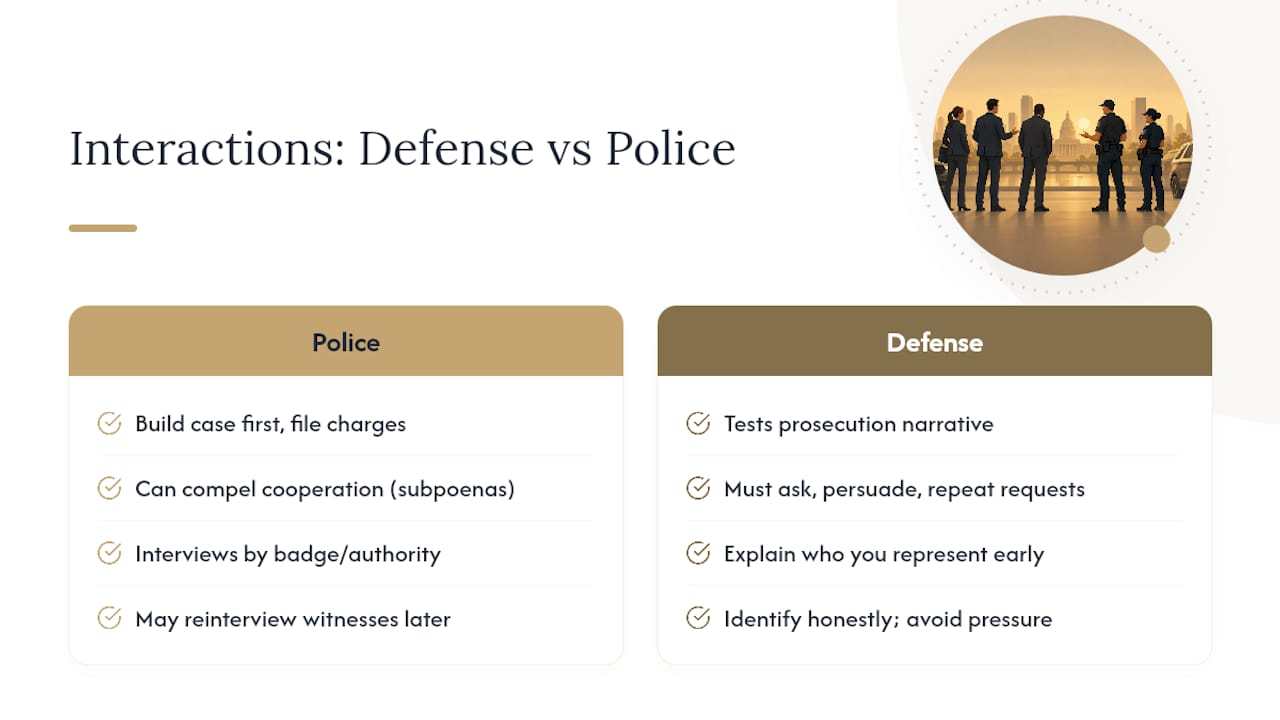
Defense investigators and police investigators work the same case from opposite chairs, and that creates friction by design. Police typically build their case first, then hand discovery over to the defense once charges are filed. A defense investigator’s job often starts by testing that narrative rather than accepting it.
Access is rarely equal. Law enforcement investigators can compel cooperation through badges and subpoenas issued as part of an active police investigation. A defense investigator usually has to ask, persuade, and sometimes simply show up more than once before a reluctant witness will talk. Some witnesses assume anyone asking questions works for the police, so part of the job is explaining, clearly and early, who you actually represent.
Direct contact with the alleged victim or key prosecution witnesses requires care. Investigators have to identify themselves honestly, avoid any suggestion of pressure, and document every interaction in case the defense needs to explain later exactly how that conversation happened. A sloppy approach here can backfire badly, sometimes triggering allegations of witness tampering that damage the defense’s credibility with the court.
Prosecutors and their own investigators, often detectives assigned specifically to a district attorney’s office, sometimes revisit witnesses after the defense has already spoken with them. That back and forth isn’t hostile by default. Reinterviewing happens on both sides as the case develops and new facts surface. What separates good defense work is documentation: a clear record of who said what, when, and to whom, so no one can later dispute the accuracy of a defense interview.
Why Investigator Findings Can Change the Outcome of a Case
A single overlooked witness can unravel a prosecution’s timeline. A single piece of preserved surveillance footage can contradict a police report’s account of what happened before an arrest. This is where defense investigation stops being background work and starts directly shaping trial strategy.
Findings feed into decisions long before a jury ever hears opening statements. An investigator who documents that a key witness has changed their story twice gives the attorney real leverage in plea negotiations. Evidence that undercuts an officer’s account of probable cause can lead to a suppression motion that guts the prosecution’s case entirely. None of that happens without someone doing the legwork to find it.
Mitigation research carries similar weight, especially in sentencing. Investigators who dig into a client’s background, medical history, or circumstances surrounding the alleged offense often surface context that reframes how a prosecutor or judge sees the case. That’s part of why firms that build detailed mitigation packets treat investigation as a strategic tool, not a formality.
Trial outcomes hinge on which side controls the narrative first. A defense team with strong investigative findings walks into negotiations, hearings, and trial with facts instead of assumptions. Prosecutors adjust offers when they know the defense has evidence that could unravel their case in front of a jury. That shift, from reactive to proactive, is usually the clearest sign an investigator did their job well.
Common Challenges Defense Investigators Face on the Job
The biggest obstacle isn’t usually the crime scene. It’s time. Video footage gets overwritten in days, sometimes hours, at many businesses and police departments. Witnesses move, change phone numbers, or simply become harder to find the longer a case drags on. Every week that passes without an investigator on the case is a week of potential evidence quietly disappearing.
Funding gaps compound the problem. Research on public defense investigation use, including a Texas-based study reviewed by NACDL, found that investigators frequently operate with constrained budgets and inconsistent access across jurisdictions. That means some defendants get thorough investigative support while others get very little, based entirely on where they were charged.
Reluctant witnesses present their own challenge. People connected to a criminal case often don’t want to talk to anyone, and some specifically distrust an investigator working for the defense. Building enough trust to get an honest, usable statement takes patience that doesn’t always fit neatly into a case timeline driven by court dates.
There’s also the emotional weight of the work itself. Investigators regularly interview victims, grieving family members, and people in crisis. Doing that respectfully while still gathering the facts the defense needs requires a level of judgment that no training program fully prepares you for. And through all of it, the investigator has to stay neutral, reporting what they find even when it doesn’t help the client’s case.
Why Confidentiality and Privilege Protect the Whole Defense Strategy
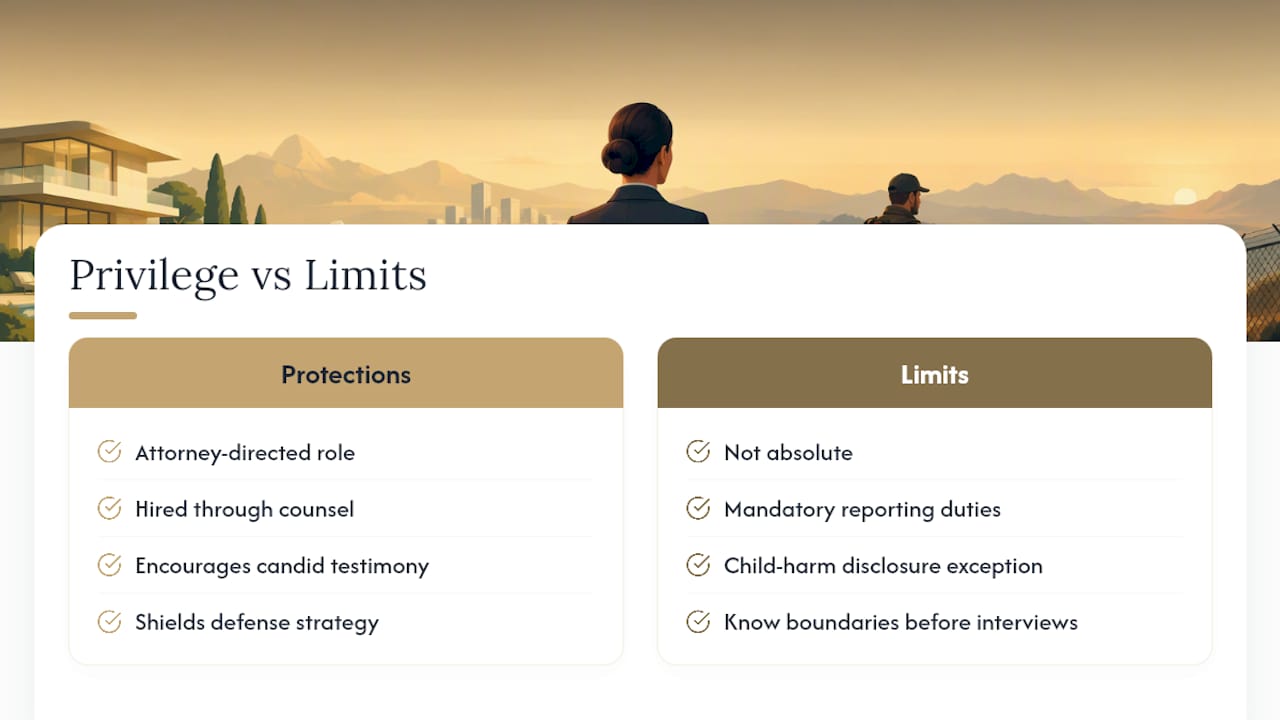
Attorney-client privilege doesn’t automatically cover everything an investigator does. It applies because the investigator is working under the attorney’s direction, as an extension of the legal team rather than an independent operator. That distinction is why defense investigators are almost always hired through counsel instead of directly by the defendant or their family.
This structure protects more than paperwork. A witness who speaks candidly to an investigator working under privilege can share details that might otherwise stay hidden if they feared that conversation would end up handed straight to prosecutors. Confidentiality creates the space for people to be honest, which is often the only way an investigator uncovers something that actually changes the case.
There are limits, though. Confidentiality isn’t absolute, and investigators can face mandatory reporting obligations in specific situations, such as certain disclosures involving harm to a child. Anyone hiring or working as a defense investigator should understand exactly where those lines sit before an interview ever starts, not after.
Privilege also shields investigative strategy from the prosecution. If defense theories, witness lists, and preliminary findings stayed unprotected, prosecutors could anticipate and counter every move before trial even begins. That protection is part of why courts and bar associations treat attorney-directed investigation as a right worth defending, not just a procedural formality. Losing that protection would flatten the natural advantage a defense team builds through independent fact-finding.
What Kinds of Cases Rely on Defense Investigators?
Not every criminal charge needs a full-scale investigation, but several case types depend on one almost by default.
DUI cases often hinge on details an investigator can dig up that a police report glosses over: the accuracy of field sobriety tests, whether the arresting officer followed proper procedure, or whether video from the stop supports or contradicts the written narrative.
Assault and domestic violence cases frequently come down to conflicting accounts, which makes witness interviews and scene documentation central to the defense. Investigators often uncover inconsistencies between what a witness told police initially and what they say weeks later, which can become critical during cross-examination.
Drug offense cases lean heavily on the legality of how evidence was obtained. An investigator retracing the timeline of a search or stop can surface procedural errors that lead to a suppression motion.
Sex crime and violent crime cases, given the stakes involved, typically require the most extensive investigation: forensic evidence review, alibi verification, and careful, respectful interviews with everyone connected to the incident. Federal crimes often add another layer, since they can involve financial records, wiretap evidence, or multi-jurisdictional witnesses that take specialized skill to track down and verify.
The Real Value of a Good Investigator Isn’t What Most People Assume
Most explanations of this role focus on the dramatic parts: canvassing scenes, chasing down witnesses, catching contradictions on camera. That’s real, but it’s not where the actual value sits. The value is in what gets written down and how carefully it gets verified.
A defense case rarely collapses because an investigator missed a clue. It collapses because a report treated a rumor as a fact, or because a witness statement got treated as gospel when it should have carried a caveat. The BLS pay data and federal job postings referenced throughout this piece describe a role built on documentation discipline as much as fieldwork, and that discipline is exactly what separates investigators who help a case from those who quietly damage it.
The conventional advice, hire an investigator when things get complicated, gets the timing backwards. By the time a case looks complicated, the video is often already gone and the witness has already moved. Anyone reading this to decide whether they need one should treat early retention as the priority, not the fallback. Everything else, the licensing, the skills, the tools, only pays off if it happens while the evidence is still there to find.
— Jake
When to Bring in Counsel and How Grace Legal Group Fits In
If you’re facing charges, the first move isn’t hiring an investigator on your own. It’s hiring counsel, because investigator work only carries privilege protection and real strategic value when it happens under an attorney’s direction.

Some criminal defense firms use a collaborative structure involving former law enforcement professionals and multiple attorneys reviewing investigative findings before shaping a defense strategy. That combination is what feeds into the detailed mitigation packets the firm uses to change how prosecutors view a case from the outset.
Before reaching out, gather what you can: discovery documents if you have them, a rough timeline of events, and names of anyone who witnessed what happened. That head start lets the legal team move fast while evidence is still fresh. Whether you’re facing DUI, drug offense, assault, or violent crime charges, the next step is the same: schedule a consultation with Grace Legal Group’s criminal defense team before more time passes.
This article is general information, not a substitute for advice from a qualified lawyer. Consult a qualified legal professional about your own circumstances before acting on anything here.
Sources
- Federal Public Defender investigator job overview (Boston FPDO listing)
- NACDL reports on defense resources and investigation use
- BLS: Private detectives and investigators — job duties and requirements
FAQ
What Does a Defense Investigator Do?
A defense investigator gathers and verifies facts for the defense team, including locating witnesses, collecting records, preserving evidence, and writing reports attorneys use to build a defense strategy. Federal public defender listings describe duties spanning witness relations, background research, and mitigation support.
How Much Do Defense Investigators Make?
The median annual wage for private detectives and investigators was $52,370 as of May 2024. Federal public defender investigator roles often pay more, with postings showing salary bands roughly between $82,000 and $179,000 depending on grade and location.
How Do You Become a Defense Investigator?
Most people enter through a background in law enforcement, military service, journalism, or paralegal work, then meet their state’s licensing requirements for private investigators. Structured training like the Component Method helps build the interview and documentation skills the job demands.
Do Defense Investigators Make a Lot of Money?
Pay varies widely by setting. Private investigators earn a median of $52,370 annually, while law enforcement detectives and criminal investigators earn closer to a median of $91,100, and federal public defender investigator positions can pay considerably more depending on experience and location.
Does Grace Legal Group Use Investigators on Criminal Cases?
Grace Legal Group’s approach relies on former law enforcement professionals who help analyze cases and build the mitigation packets central to the firm’s defense strategy. Each case is handled by two attorneys, and current details on the firm’s criminal defense services are available on its criminal defense page.