
California Penal Code §148 makes it illegal to willfully resist, delay, or obstruct a peace officer, public officer, or EMT performing their duties, and a conviction can mean up to a year in county jail. Several defenses can change that outcome, including unlawful arrest, self-defense, lack of intent, and video evidence that contradicts an officer’s account. If you or a family member were arrested, contact a California criminal defense attorney right away to protect the evidence that may decide your case.
TL;DR:
- The prosecution must prove willfulness, knowledge, resistance, and lawful duty performance beyond a reasonable doubt for a resisting arrest charge.
- Video evidence contradicting officer testimony can be crucial defense, especially when it shows calm or non-violent interactions.
- Unlawful arrest defenses are viable if the officer lacked legal authority, but reliance on resistance to unlawful arrest carries risks.
- Penalties include up to one year in jail for misdemeanor resistance, with higher risks if threats or violence lead to a felony charge under PC 69.
- Preserving all evidence immediately after arrest, including videos and witness contacts, is essential for building a strong defense.
Table of Contents
- What California law says: PC 148 and related statutes
- Elements the prosecution must prove under PC 148
- Common defenses: unlawful arrest, self-defense, and lack of intent
- Penalties and collateral consequences of a resisting arrest conviction
- How evidence shapes defense strategy
- What to do immediately after an arrest or police contact
- How Grace Legal Group defends resisting arrest cases
- Statistical likelihood of conviction and acquittal based on case factors
- Specific case law examples and precedents shaping resisting arrest defenses
- Role of Miranda rights and their violation in resisting arrest defense
- A practitioner’s note on resisting arrest cases
- Get help from a California resisting arrest defense attorney
- FAQ
- Sources
What California law says: PC 148 and related statutes
Most resisting arrest charges in California fall under Penal Code §148(a)(1), which bars willfully resisting, delaying, or obstructing a public officer, peace officer, or emergency medical technician while they carry out their duties. The statute protects a wide range of officials, not just police: firefighters, code enforcement officers, and EMTs responding to a call can all qualify. A PC 148 charge is usually filed as a misdemeanor, though repeat conduct or aggravating facts can push prosecutors toward harsher treatment.
A related but more serious law, Penal Code §69, covers resisting an executive officer through threats or violence. Unlike PC 148, this statute is a wobbler, meaning prosecutors can file it as either a misdemeanor or a felony depending on the facts.
California also gives residents real protection when they record police activity in public. Filming an arrest or police stop from a lawful vantage point is generally protected, and that footage often becomes central evidence in resisting arrest cases.
- PC 148(a)(1) covers obstructing officers, firefighters, and EMTs and is typically a misdemeanor.
- PC 69 covers resisting an executive officer with threats or violence and can be charged as a felony.
- Recording police in public is broadly protected and frequently used as defense evidence.
Elements the prosecution must prove under PC 148
A resisting arrest charge is not automatic just because an arrest happened. Prosecutors carry the burden of proving each element of the offense beyond a reasonable doubt, and a gap in any one of them can unravel the case.
- Willfulness: The prosecution must show you acted on purpose, not by accident. Pulling away during a stumble looks very different from physically twisting out of an officer’s grip.
- Knowledge: You must have known, or reasonably should have known, that the person was an officer performing official duties. Plainclothes officers or ambiguous situations can weaken this element.
- An act of resistance, delay, or obstruction: This can be physical resistance, refusing to comply with a lawful order, or interfering with an arrest in progress.
- Lawful performance of duty: The officer must have been acting within the lawful scope of their job at the time, which opens the door to an unlawful arrest defense.
Prosecutors typically build their case on officer testimony, bodycam footage, radio dispatch recordings, and statements from witnesses at the scene. When that evidence is incomplete, inconsistent, or contradicted by independent video, the elements become much harder to prove.
Common defenses: unlawful arrest, self-defense, and lack of intent
Several defense theories recur in California resisting arrest cases, and each depends heavily on the specific facts and evidence available.
An unlawful arrest defense argues the officer lacked legal authority to detain or arrest you in the first place, which undercuts the “lawful performance of duty” element. Nolo’s legal explainer notes that while some jurisdictions allow limited resistance to an unlawful arrest, relying on that defense carries real risk, since courts often expect people to comply first and challenge the arrest’s legality later in court.
Self-defense against excessive force is a narrow allowance: it requires that the force used in response was proportional to the threat and that the officer’s force exceeded what the situation called for. Our overview of self-defense principles explains how California courts weigh proportionality in these situations.
Lack of intent or mistaken identity applies when a defendant genuinely did not realize they were interacting with an officer, or when they are confused with someone else entirely at a chaotic scene.
Passive noncompliance, such as going limp or refusing verbal commands, is treated very differently from active resistance like pulling away or swinging an arm. Courts and prosecutors tend to escalate charges once physical struggle enters the picture.
- Unlawful arrest challenges whether the officer had legal grounds to detain you.
- Self-defense applies only when an officer’s force was disproportionate to the situation.
- Lack of intent or mistaken identity applies when the defendant did not knowingly resist an officer.
- Passive resistance and active resistance are treated differently and can lead to different charges.
Pro Tip: Write down everything you remember about the arrest within 24 hours, including exact words, who was present, and any visible injuries, while the details are still fresh.
Penalties and collateral consequences of a resisting arrest conviction
A standard PC 148 conviction is a misdemeanor, and FindLaw’s California resisting arrest overview confirms it carries up to one year in county jail along with fines. Charges filed under PC 69 carry heavier exposure, since that statute can be filed as a felony when threats or violence toward an officer are alleged.
- PC 148 misdemeanor: up to one year in county jail plus fines.
- PC 69: a wobbler that can be filed as a felony with significantly higher stakes.
- A conviction becomes part of your criminal record and may later be eligible for sealing or expungement depending on the outcome.
A resisting charge rarely travels alone. FindLaw’s analysis of Penal Code §69 points out that cases involving threats or violence against an officer carry substantially higher exposure than a standard misdemeanor obstruction charge.
Beyond the courtroom, a conviction can affect job applications, professional licensing boards, firearm ownership rights, and in some cases immigration status for noncitizens. These downstream effects are often what push defendants to fight the charge rather than accept a quick plea.
How evidence shapes defense strategy
Video evidence, whether from a bystander’s phone, a business’s surveillance camera, or an officer’s own bodycam, is often the single most persuasive piece of evidence in a resisting arrest case. According to LawInfo’s overview of resisting arrest defenses, footage and witness statements are commonly the deciding factors when an officer’s account is challenged.
Preserving that evidence quickly matters, because surveillance footage is often overwritten within days and witnesses move on or forget details.
- Request bodycam footage and the police report as early as possible through your attorney.
- Identify and contact bystanders before their memory of events fades.
- Photograph any visible injuries and keep medical records tied to the date of the incident.
- Save phone video with its original timestamp rather than a re-recorded copy.
Medical records can corroborate a self-defense claim by documenting injuries consistent with excessive force, while inconsistent witness statements can undercut an officer’s written report.
What to do immediately after an arrest or police contact
What you do in the hours after an arrest can shape the entire case. The goal is to avoid making the situation worse while preserving every piece of evidence that might help later.
- During the encounter, comply with physical instructions to avoid escalating the situation, clearly state that you want an attorney, and avoid volunteering explanations or arguing your case to the officer.
- After release, write down everything you remember, including times, locations, and officer badge numbers if visible.
- Collect witness information from anyone who saw the encounter before they leave the scene or become hard to reach.
- Preserve your phone video without editing it, and note the original timestamp.
- Request the police report and bodycam footage through counsel as soon as possible, since early legal intervention gives an attorney time to build a mitigation packet and secure evidence before it disappears.
Pro Tip: Never delete or edit video from the encounter, even partial or shaky footage; our guidance on acting quickly when probable cause is questionable explains why the first 48 hours matter so much.
How Grace Legal Group defends resisting arrest cases
We build mitigation packets that gather employment history, character letters, treatment records, and community ties to provide a fuller picture of our client before charges are finalized. Our approach includes analysis of whether a detention was lawful and whether the evidence holds up, and we assign attorneys to each case for a thorough review. For a first consultation, bring the police report if you have it, any video or photos from the incident, and contact information for witnesses.
Statistical likelihood of conviction and acquittal based on case factors
There is no single, published conviction rate specific to California resisting arrest cases, and any number claiming otherwise should be treated with caution. What does shift outcomes consistently, based on the defense theories and evidence patterns described above, is the strength of the underlying facts: whether the arrest itself was lawful, whether video contradicts the officer’s written account, and whether the defendant’s conduct was passive or active.
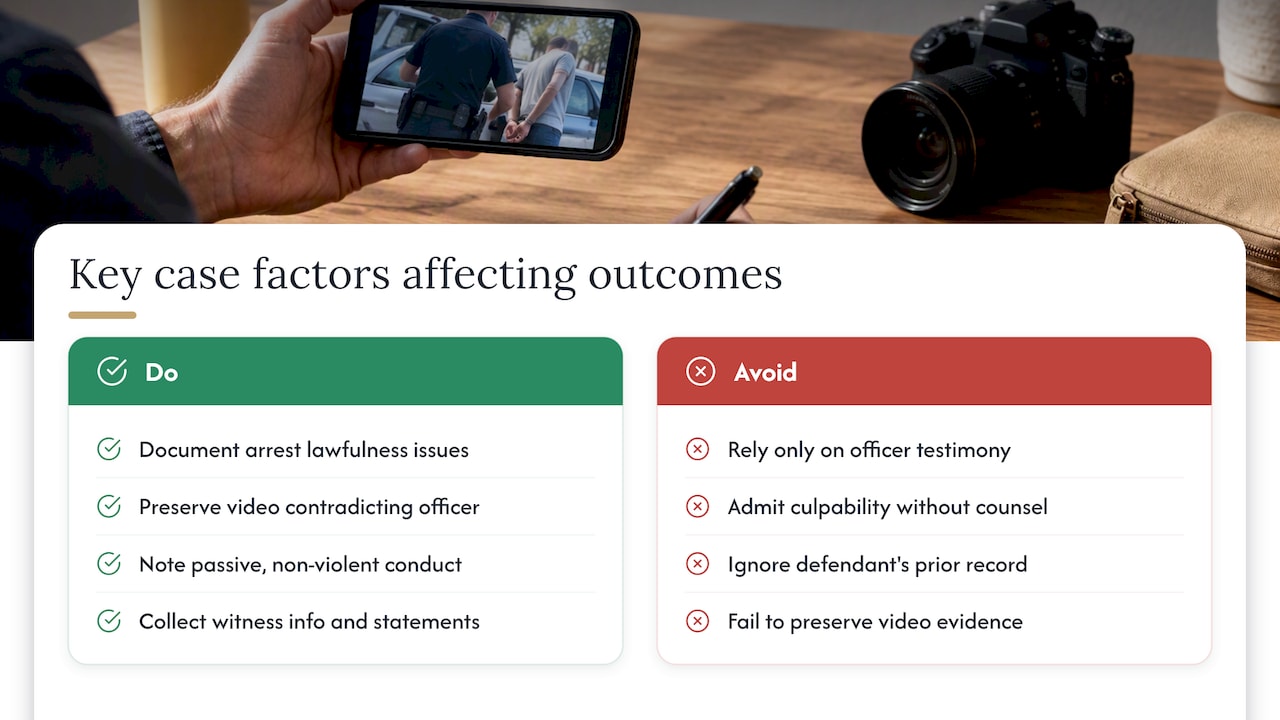
Cases built heavily on an officer’s uncorroborated testimony tend to be more vulnerable to challenge than cases backed by multiple forms of evidence. When bodycam or bystander video shows a calm, non-violent interaction that an officer described as aggressive, that contradiction often becomes the strongest point of leverage for the defense. Conversely, cases where a defendant made admissions to officers after the fact, without an attorney present, tend to be harder to unwind later.
The presence of a prior criminal record also tends to affect how prosecutors approach a case, often influencing charging decisions and plea offers more than it affects the underlying legal elements. None of these patterns guarantee a particular result, since every case turns on its own specific facts, witnesses, and evidence.
Specific case law examples and precedents shaping resisting arrest defenses
California courts have long treated the lawfulness of the underlying detention as the hinge point in resisting arrest cases: if the officer was not lawfully performing their duties at the time, the obstruction charge often cannot stand on its own. This principle traces back to the structure of PC 148 itself, which explicitly requires that the officer be acting within the lawful scope of duty.
Cornell Law’s overview of false arrest doctrine explains the broader legal framework courts use to determine when a detention lacks probable cause, which is the same question that often decides whether a PC 148 charge can succeed. When probable cause was missing or the stop exceeded its lawful scope, that defect can undercut the prosecution’s entire theory of the case.
California courts have also distinguished between merely failing to cooperate and actively obstructing an officer’s duties, a distinction that matters when prosecutors try to escalate passive noncompliance into a resisting charge. The specific facts of each stop, including bodycam and bystander footage now routinely available, continue to shape how trial courts apply these standards case by case.
Role of Miranda rights and their violation in resisting arrest defense
Miranda warnings apply to statements made during custodial interrogation, not to the physical act of resisting, delaying, or obstructing an officer. That distinction matters because a resisting arrest charge is based on conduct at the scene, which happens before any interrogation and therefore before Miranda rights are triggered.
Where Miranda violations do matter is in what happens afterward. If officers continue questioning a suspect in custody without a warning, and the suspect makes statements that prosecutors later try to use to prove intent or willfulness, those statements may be challenged and potentially excluded. That exclusion does not erase the underlying resisting charge, but it can remove a piece of evidence prosecutors were relying on to prove the willfulness element.
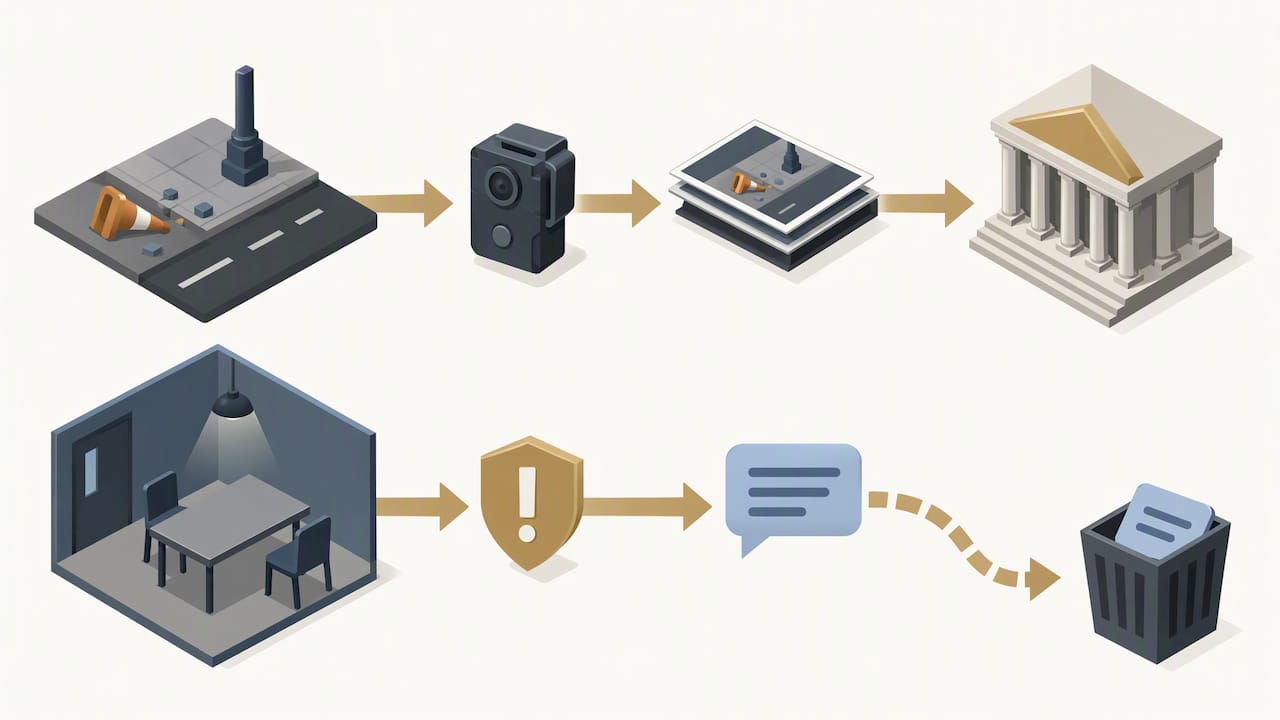
This is why staying silent and asking for an attorney immediately, rather than trying to explain yourself to officers, protects you on two fronts: it avoids volunteering statements that could be used against you, and it preserves any later argument that improperly obtained statements should be excluded from the case.
A practitioner’s note on resisting arrest cases
Resisting arrest cases almost always turn on the same question: what actually happened in those first chaotic seconds, and what evidence exists to prove it. Outcomes depend entirely on the facts in front of us, not on generic assumptions about how these cases usually go. If you were arrested, preserve every photo and video you have and talk to an attorney before you talk to anyone else about the case.
— Jake
Get help from a California resisting arrest defense attorney
Facing a resisting arrest charge alongside other allegations, such as assault on an officer, a DUI stop, or a drug offense, calls for a defense built around the specific facts of your arrest, not a generic script. We build mitigation packets, bring former law enforcement officers onto case review, and assign two attorneys to every file so nothing gets missed.

- Bring any police reports, photos, or video you already have to your first meeting.
- List names and contact information for anyone who witnessed the arrest.
- Ask about our criminal defense services covering resisting arrest and related charges.
Reach out to our criminal defense team today to start building your case while the evidence is still fresh.
This article is general information, not a substitute for advice from a qualified lawyer. Consult a qualified legal professional about your own circumstances before acting on anything here.
FAQ
Can a police officer shoot someone for resisting arrest?
California law limits an officer’s use of deadly force to situations involving an immediate threat of death or serious injury, not mere noncompliance or passive resistance. Excessive force used during a resisting arrest encounter can itself become part of a self-defense argument in the defendant’s favor.
Can you be handcuffed before being read your Miranda rights?
Yes, officers can handcuff and detain someone without first reading Miranda rights, since those warnings apply only to custodial interrogation, not to the physical act of arrest. A Miranda violation typically affects whether later statements can be used in court, not whether the handcuffing itself was lawful.
How long does a resisting arrest conviction stay on a record?
A resisting arrest conviction generally remains on a criminal record indefinitely unless it is sealed or expunged through a separate court process. Eligibility and timelines for that process depend on the specific conviction and the rest of a person’s record, which is best reviewed with a defense attorney.
Can I legally swear at a police officer?
Using offensive language toward an officer is generally protected speech and is not, by itself, a basis for a resisting arrest charge in California. Problems arise when words are combined with physical acts of obstruction or threats, which is a distinct legal question from speech alone.
Sources
- California resisting arrest laws – FindLaw
- Resisting arrest – LawInfo
- Resisting unlawful arrest – Nolo