
In California, you can file a motion to vacate a conviction under Penal Code §1473.7 when a prejudicial immigration-advice error, newly discovered evidence, or a racial-justice violation made your plea or conviction legally invalid. Start by locating Judicial Council Form CR-187, confirming you are no longer in criminal custody, and gathering your plea paperwork or contacting an attorney before you file anything.
TL;DR:
- Filing a motion under Penal Code §1473.7 requires proof of immigration-advice errors, newly discovered evidence, or racial bias, with evidence needing to show it is more likely than not true.
- The motion is only available to individuals no longer in custody and must be filed promptly after discovering the grounds, with no strict deadlines but delays weakening credibility.
- Successful vacatur relies heavily on detailed evidence like plea transcripts, prior counsel communications, immigration notices, and expert declarations that clearly establish the defect or bias.
- A vacated conviction under §1473.7 can significantly improve employment, housing, and immigration outcomes, but the process timing varies by county and case complexity.
- Prosecutors typically oppose such motions, often claiming proper advisement or undue delay, so thorough documentation and timely filing are essential for success.
Table of Contents
- What Penal Code §1473.7 Allows and the Statutory Grounds
- Who Qualifies and When You Need to File
- Step by Step: Filing Form CR-187 and Building Your Motion
- Proving Prejudice: What Evidence Actually Persuades Judges
- Vacatur vs. Expungement: Why the Difference Matters for Immigration
- What Happens After the Court Rules
- How Prosecutors Push Back and How to Respond
- Beyond Immigration: Employment, Housing, and Other Collateral Effects
- How Long the Process Typically Takes
- Writing Declarations That Support Your Motion
- Checking Local Rules Before You File
- Why Early Case Review and a Real Mitigation Packet Change Outcomes
- How Grace Legal Group Can Help With Your Motion to Vacate
- Sources
- FAQ
What Penal Code §1473.7 Allows and the Statutory Grounds
Penal Code §1473.7 lets a person who is no longer in criminal custody ask a California court to vacate a conviction or sentence when it is legally invalid. The statute recognizes three distinct paths to relief, and a motion needs to fit squarely into one of them to have a chance.
- Prejudicial immigration-advice error: your attorney failed to properly advise you, or you failed to meaningfully understand, the actual or potential immigration consequences of a plea.
- Newly discovered evidence of innocence: evidence that was not known and could not have been discovered earlier now supports your innocence or undermines the original conviction.
- Racial-justice violations: the conviction resulted from conduct connected to race, ethnicity, or national origin bias in charging, convicting, or sentencing.
The person bringing the motion has to prove the ground for relief by a preponderance of the evidence, meaning it is more likely than not that the claim is true. Under §1473.7, certain circumstances create a presumption that the conviction is legally invalid, which shifts some of the practical burden back onto the prosecution to rebut. A common example is a plea entered decades ago with no record of immigration advisement anywhere in the file, paired with a credible declaration that the person would have rejected the plea had they understood what it meant for their immigration status.
Who Qualifies and When You Need to File
Not everyone can bring a §1473.7 motion, and timing matters as much as the underlying facts. The statute is built around people who have already served their sentence or resolved their custody status, since it exists specifically to help people deal with consequences that surface after the criminal case is otherwise closed.
- Out-of-custody requirement: you generally must no longer be serving a sentence of custody, whether that means probation has ended, parole has expired, or you were never sentenced to custody at all.
- Reasonable diligence trigger: courts look at whether you filed within a reasonable time after learning of the problem, often measured from events like receiving a Notice to Appear in immigration court or a final removal order.
- No fixed deadline, but delay matters: there is no strict statute of limitations, but waiting years after you knew or should have known about the immigration consequences can weaken your claim.
- Newly discovered evidence and racial-justice claims: these grounds also require prompt action once the evidence or the pattern of bias becomes apparent, since unexplained delay invites a court to question your credibility.
If you are still in custody or currently on probation, other post-conviction remedies, such as a direct appeal or a different habeas petition, may fit your situation better than a §1473.7 motion.
Step by Step: Filing Form CR-187 and Building Your Motion
Filing a motion to vacate is a paperwork-heavy process, and missing a step can cost you months. Here is the practical sequence most petitioners follow.
- Download Form CR-187 from the California Courts self-help site and review the boxes that let you check which statutory ground you are relying on and whether you are requesting appointment of counsel.
- Pull your case file, including the plea transcript or plea form, any minute orders, and whatever record exists (or does not exist) of immigration advisement at the time of the plea.
- Draft your declaration, written in your own words, describing what you were told, what you understood, and why you would not have pleaded guilty had you known the immigration consequences.
- Gather supporting evidence, such as immigration notices (a Notice to Appear or removal order), letters from prior counsel, expert declarations on immigration consequences, and any mitigation materials that support your credibility and circumstances.
- File the motion and all attachments with the superior court in the county where you were convicted, keeping conformed copies for your own file.
- Serve the prosecutor’s office, and serve any implicated law enforcement agency when the motion raises allegations against it, then file your proof of service with the court.
- Request a hearing date, and if you cannot appear in person, ask the court about proceeding without your presence when good cause exists.
Pro Tip: Request appointment of counsel on Form CR-187 itself if you cannot afford an attorney; leaving that box blank can cost you the chance to have one assigned.
Pro se filers can complete this process, but the preponderance standard and the technical rules around service and timing make representation valuable. An attorney who has handled these motions before knows what language persuades a judge and what gaps invite denial, which is often the difference between a granted motion and a wasted filing fee.
Proving Prejudice: What Evidence Actually Persuades Judges
Winning a §1473.7 motion comes down to convincing a judge, by a preponderance of the evidence, that you would not have accepted the plea if you had understood its immigration consequences. Some kinds of proof carry far more weight than a bare assertion.
- Plea colloquy transcript: shows exactly what the judge and your attorney said, or failed to say, about immigration consequences at the time.
- Prior counsel communications: letters, case notes, or the absence of any documented advisement.
- Immigration notices: a Notice to Appear or removal order that ties directly to the conviction being challenged.
- Expert declarations: an immigration attorney’s assessment of how the conviction actually affects status.
- Witness affidavits or new forensic evidence: relevant primarily to the newly-discovered-evidence ground.
- A detailed mitigation packet: personal history, family ties, and community context that make the “would not have pleaded” claim credible to a judge weighing intent years after the fact.
Pro Tip: A declaration that only says “I didn’t know about immigration consequences” rarely succeeds on its own; pair it with documentary proof and a clear personal narrative.
Vacatur vs. Expungement: Why the Difference Matters for Immigration
A PC 1203.4 dismissal and a §1473.7 vacatur are not interchangeable, and confusing them can be costly for anyone facing immigration consequences.
- PC 1203.4 dismissal: allows someone who successfully completed probation to withdraw a plea and have the case dismissed, which helps with many state background checks but does not erase the conviction for every purpose.
- Federal treatment of rehabilitative dismissals: federal guidance reflecting the reasoning in Matter of Roldan and Matter of Pickering indicates that immigration authorities generally do not treat a routine rehabilitative dismissal as removing a conviction for immigration purposes.
- Vacatur for legal invalidity: a §1473.7 order that vacates a conviction based on a procedural or constitutional defect, rather than rehabilitation, is far more likely to be recognized by USCIS and immigration courts.
- Practical coordination: collect the exact court order stating the legal basis for the vacatur and bring it to immigration counsel, since the stated reasoning matters as much as the outcome itself.
For background on how specific convictions interact with immigration status, a partner resource on drug convictions and immigration walks through common scenarios outside the vacatur context.
What Happens After the Court Rules
A granted motion typically lets you withdraw your plea, and the court then vacates the conviction, which can lead to dismissal of the charges or, in some cases, re-prosecution by the district attorney. The clerk’s entry will reflect that the plea was withdrawn and the conviction vacated under §1473.7, language that matters when you later present the order to immigration authorities.
- If denied: you may have appeal rights, though options narrow once you are out of custody and cannot pursue certain habeas remedies.
- If granted: expect the possibility of renewed prosecution on the original charges, so any renegotiated plea needs to actually avoid the immigration consequence that triggered the motion.
- Coordination with immigration counsel: bring the signed order to your immigration attorney promptly, since federal agencies look closely at whether the order specifies a procedural or substantive defect rather than generic rehabilitation language.
If your motion involves withdrawing a plea before sentencing, a related plea withdrawal checklist covers the procedural steps that often run parallel to a §1473.7 filing.
How Prosecutors Push Back and How to Respond
Prosecutors rarely concede a §1473.7 motion without a fight, and several objections come up repeatedly. Knowing them in advance lets you build your motion to answer them before they are even raised.
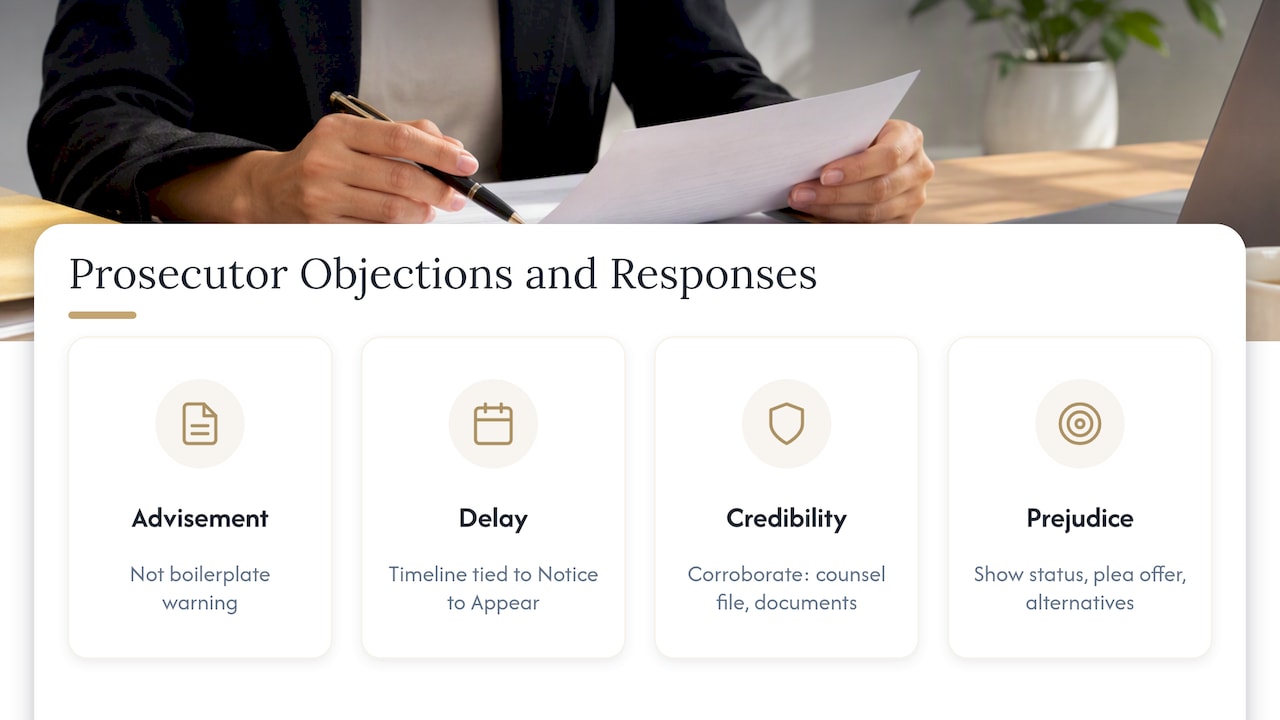
One common defense is arguing that the record already shows adequate immigration advisement, often by pointing to a boilerplate warning on the plea form. The counter is showing that a generic warning is not the same as a meaningful, case-specific discussion of consequences, which is what the statute actually requires.
Prosecutors also frequently argue undue delay, claiming you waited too long after learning of the immigration consequence to file. A clear timeline connecting your filing date to a specific triggering event, such as a Notice to Appear, directly rebuts that argument.
A third objection challenges credibility, suggesting your declaration is self-serving and unsupported. This is where corroborating evidence, such as prior counsel’s file, contemporaneous documents, or a detailed mitigation packet, carries real weight, because it backs your account with something beyond your own word.
Finally, prosecutors sometimes argue the conviction would have happened regardless of the alleged error, meaning no real prejudice resulted. Responding well requires specific facts about your immigration status at the time, the actual plea offer, and any alternative disposition that would have avoided the immigration consequence.
Beyond Immigration: Employment, Housing, and Other Collateral Effects
Immigration status is often the driving reason behind a §1473.7 motion, but a vacated conviction can affect other parts of life as well. Once a conviction is vacated and the case is dismissed or resolved favorably, the record generally reflects that outcome on many background checks used by employers and landlords.
Many employers run criminal background checks as part of hiring, and a vacated conviction, unlike a routine expungement, removes the underlying conviction itself rather than simply marking it as dismissed after probation. That distinction can matter to licensing boards and employers who ask specifically about convictions rather than arrests or dismissals.
Housing applications often include similar background screening, and a cleared record can open doors that a standing conviction, even a dismissed one, sometimes keeps closed. Some occupational licenses, security clearances, and professional certifications also weigh the underlying legal status of a conviction, not just whether it was later dismissed, so a full vacatur under §1473.7 can carry benefits that reach beyond the immigration system that originally motivated the filing.
How Long the Process Typically Takes
There is no fixed statewide timeline for a §1473.7 motion, and processing times vary by county caseload, whether the prosecution contests the motion, and how complex the underlying facts are. A motion that is unopposed and well-documented can move through the court relatively quickly, sometimes resolved within a few months of filing.
A contested motion involving live testimony, expert declarations, or disputed facts about what happened at the original plea hearing takes longer, often stretching to many months or beyond a year in busier counties. Scheduling a hearing date itself can add weeks depending on the court’s calendar, and continuances are common when either side needs more time to gather evidence.
Petitioners facing an active immigration case, particularly one with a scheduled removal hearing, should flag the urgency to the court and to immigration counsel early, since coordinating the criminal case timeline with immigration court proceedings can affect strategy on both sides.
Writing Declarations That Support Your Motion
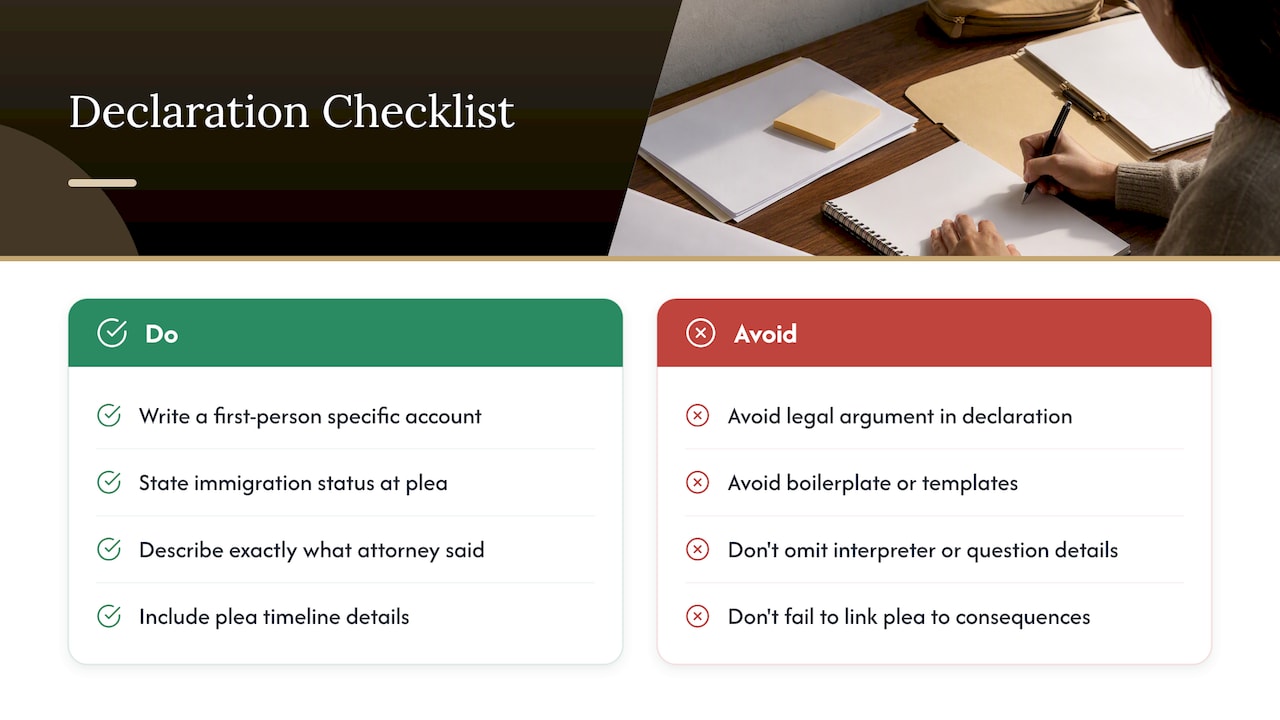
A strong declaration reads like a specific, first-person account, not a legal argument. It should state your immigration status at the time of the plea, exactly what your attorney told you or failed to tell you, and what you would have done differently if you had understood the consequences.
Effective declarations typically walk through the timeline in plain language: when the plea happened, whether an interpreter was present, what questions you asked, and what answers, if any, you received about how the plea would affect your immigration status. They also connect the dots explicitly, stating that had you known the plea would trigger removal proceedings or bar future relief, you would have insisted on negotiating a different disposition or taking the case to trial.
Supporting declarations from family members, employers, or community members can reinforce credibility and provide context for a mitigation packet, describing your ties to the community and the practical stakes of the immigration consequence you now face. These are not boilerplate forms, and a declaration that reads as generic or copied from a template tends to carry less weight than one grounded in specific, checkable details.
Checking Local Rules Before You File
California’s superior courts share the same governing statute, but local rules and practices can differ from county to county. Some courts have specific local forms, particular filing windows, or preferences about how motions are calendared that are not spelled out in the Judicial Council paperwork itself.
Before filing, check the self-help or criminal division page of the superior court in the county where you were convicted, since many counties publish local rules, required cover sheets, or specific instructions for post-conviction motions. The California Courts self-help guide also outlines general filing expectations that apply statewide, which is a useful starting point before you dig into a specific county’s local rules.
Court clerks can confirm procedural requirements, such as how many copies to bring or whether a filing fee waiver applies, but they cannot give legal advice about your case, so pairing that local research with an attorney consultation is usually the safer path.
Why Early Case Review and a Real Mitigation Packet Change Outcomes
Grace Legal Group is a Los Angeles-based criminal defense firm built around serious charges and a faith-based, client-focused approach. The firm’s attorneys, supported by former law enforcement professionals, build detailed mitigation packets that give judges a fuller picture of who is asking for relief, not just the bare facts of the conviction. Every case gets two dedicated attorneys, a structure meant to catch details a single-attorney review might miss, and the firm’s own track record includes dismissals and reduced sentences that it credits to that early, thorough approach.
— Jake
How Grace Legal Group Can Help With Your Motion to Vacate
Filing a §1473.7 motion without guidance means navigating statutory presumptions, service rules, and a preponderance standard largely on your own. Grace Legal Group handles post-conviction relief matters connected to serious charges, including case review, mitigation packet preparation, courtroom representation at the hearing, and coordination with immigration counsel so the vacatur order says what it needs to say for federal purposes.

If you or someone in your family is weighing whether a past plea can be undone, a case review with two attorneys assigned to your file is a concrete way to find out where you stand before a filing deadline or immigration hearing forces the issue. Reach out through Grace Legal Group’s criminal defense page to schedule that review.
This article is general information, not a substitute for advice from a qualified lawyer. Consult a qualified legal professional about your own circumstances before acting on anything here.
Sources
- Motion to Vacate Conviction or Sentence (CR-187)
- Federal guidance on immigration treatment of state-level dismissal/expungement (EOIR/USCIS decisions)
- Criminal Procedure: Motion and Order to Vacate Conviction or Sentence | Judicial Branch of California
FAQ
What happens if a conviction is vacated?
A vacated conviction is legally undone, meaning the plea is withdrawn and the case returns to its pre-conviction status, which can lead to dismissal or, in some instances, renewed prosecution. Unlike a routine dismissal, a properly documented vacatur under §1473.7 is more likely to be recognized by immigration authorities as removing the conviction for federal purposes.
What are the requirements for a motion to vacate judgment in California?
The person filing must generally be out of criminal custody and must prove, by a preponderance of the evidence, one of three grounds under §1473.7: prejudicial immigration-advice error, newly discovered evidence, or a racial-justice violation. The motion is filed on Form CR-187 in the superior court where the conviction occurred, with service on the prosecutor and, when relevant, the implicated law enforcement agency.
How can I remove a felony conviction from my record in California?
Removing a felony conviction usually means either a §1473.7 vacatur, which undoes a legally invalid conviction, or a PC 1203.4 dismissal after successful probation, which is a different, more limited remedy. The two are not interchangeable, and a state dismissal often does not remove immigration consequences the way a vacatur based on a legal defect can.
What does a motion to vacate a sentence mean?
A motion to vacate a sentence asks the court to set aside the conviction or sentence because it was legally invalid, not simply because the person now regrets the outcome. Under §1473.7, that invalidity typically rests on an immigration-advice error, new evidence, or a racial-justice violation proven by a preponderance of the evidence.